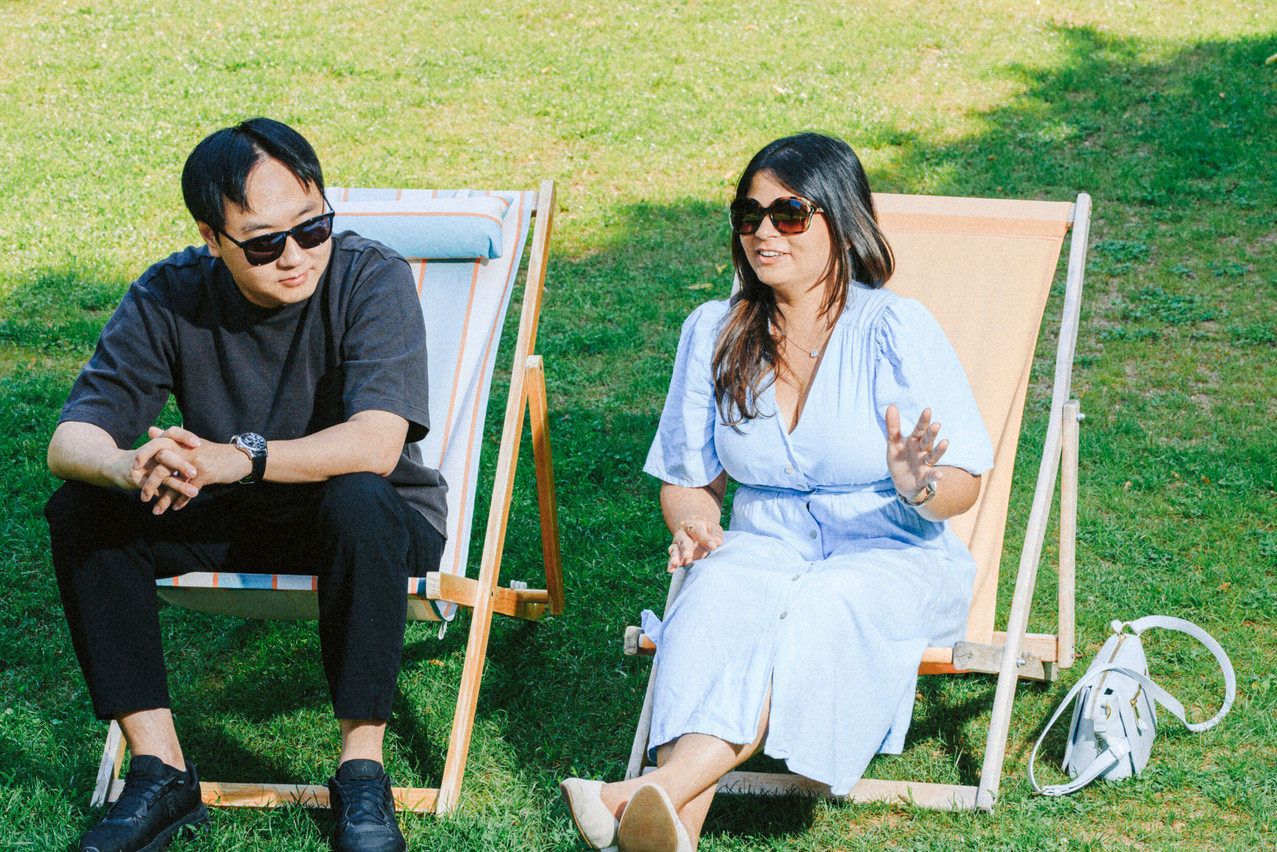
Could you introduce yourselves and tell us how your journeys brought you to Luxembourg?
Ben. – “I’m originally from South Korea and I’m Head of Business Development at Data Design Engineering, an AI company that recently moved its global headquarters to Luxembourg. We first came to Europe through a space project with a Swiss partner, where we met 
Anuja. – “I’m from India, and my background is in cancer research. After completing my PhD, I was looking for international experience, so I applied for positions across Europe without a specific destination in mind. Luxembourg turned out to be a happy coincidence. I found a role that suited my profile and moved here with my husband. Today, I work on brain cancer research at the Luxembourg Institute of Health. It’s also a deeply personal mission: I’m a cancer survivor, and that experience inspired me to dedicate my career to this field.
What was your biggest surprise when you first arrived?
Anuja. – “How international it is for such a small country. You hear several languages and meet people from all over the world every day. As an expat, I also found it very easy to integrate. From day one, I never felt like an outsider. People were welcoming and genuinely willing to help, which makes a huge difference when you’re settling into a new country. I was also struck by how responsive the authorities can be. I once wrote to suggest a bus stop closer to my home because the nearest ones were too far away. My husband laughed and said nothing would happen. Two months later, the stop had been built exactly where I’d suggested.
Ben. – “The diversity. It’s almost harder to meet a Luxembourger than an expat! I was also struck by how considerate people are. In Asia, driving is often much more hectic, whereas here drivers stop for pedestrians and patiently follow the rules. It took some getting used to, but I’ve come to really appreciate it.
Was it difficult to settle into life here?
Ben. – “Like any international move, there was an adjustment period. Luxembourg is much calmer than the large Asian cities I was used to, but my biggest culture shock was surprisingly simple. I arrived on a Saturday evening and, the next day, went out to buy a bottle of water. I quickly realised that, on a Sunday, my only option was a petrol station. That was quite an introduction to life in Luxembourg.
Anuja. – “For me, it was the little everyday things. In India, almost anything can be delivered late at night, whereas here everything closes much earlier. Then come the usual expat challenges--finding housing, dealing with administration and building a social circle from scratch. It takes time, but once you find your footing, it’s a wonderful place to live.
One thing you love about Luxembourg, and one you like a little less?
Anuja. – “The international environment, without a doubt. My colleagues introduce me to dishes I’d never heard of, and I get to share mine in return. I also love Luxembourg’s location in the heart of Europe, which makes travelling easy. If I had to mention one downside, it would be the limited opportunities in scientific research. Compared with larger countries, there are fewer institutions, which can make it more challenging to build a long-term career.
Ben. – “What I value most is the quality of life. Everything feels calmer, people seem happier, and even small things--like saying hello in the street or chatting in the lift--create a real sense of community. On the downside, things can move more slowly. In a fast-moving industry like AI, waiting two weeks for an email reply can feel like an eternity. The same goes for everyday services. I remember buying a washing machine shortly after arriving and being told delivery would take a month, even though I lived just around the corner. In the end, I loaded the 70-kilogram machine into my car and took it home myself.
Luxembourg has a reputation for being quiet. How do you build a social life here?
Anuja. – “It really depends on your stage of life. Coming from busy Indian cities, my husband and I were happy to slow down. And I don’t think Luxembourg is boring at all. In summer especially, there are open-air cinemas, concerts, festivals and plenty of cultural events. Most weekends, though, we’re just as happy taking a walk in nature. Sometimes, that’s all you need.
Ben. – “For me, it happens through networking. Luxembourg is small enough that you quickly start seeing the same people at different events, which makes building relationships much easier. After a while, you’re no longer introducing yourself or your company, and you can get straight into meaningful conversations and potential collaborations. In a bigger country, that rarely happens.
Do you have a favourite spot in Luxembourg?
Anuja. – “Without hesitation: the forests. Whenever I want to clear my mind or disconnect from work, that’s where I go. Bambësch is one of my favourite places because it’s close to both my home and my workplace. I also love walking along the Alzette and the streams that run through the city.
Ben. – “Surprisingly the National Library, even though I’m not much of a reader. We deployed one of our AI robots there and spent weeks fine-tuning it, which gave me the chance to experience the building in a completely different way. It’s an incredibly calm place, and the architecture, natural light and atmosphere make it genuinely inspiring.
Finally, how would you describe Luxembourg to someone who’s never heard of it?
Anuja. – “Give it time, it doesn’t reveal itself straight away. It’s a country of contrasts: some see it as quiet, while others discover a vibrant international community.”
Ben. – “I usually describe it as the ‘Singapore of Europe.’ It may seem intimidating at first because of its many languages and cultures, but it’s such an international country that you’ll quickly meet people who’ve been through the same experience. That makes settling in much easier than most expect.”
This article was written for the 13th edition of the Expat Guide, published by Paperjam, on 8 July. The content is produced exclusively for the magazine. It is published on the site to contribute to the full Paperjam archive. Click this link to subscribe to the magazine.
Is your company a member of the Paperjam Club? You can apply for a subscription in your name. Please let us know via club@paperjam.lu.