
Markets have moved on with remarkable speed. Just weeks after geopolitical tensions dominated investors’ thinking, Bank of America’s latest Credit Investor Survey noted that optimism has returned with force.
The easing of energy price concerns has encouraged investors to embrace risk once again, pushing expectations for a resilient global economy to record highs. Yet beneath the upbeat mood lies a new source of anxiety.
Rather than fearing oil shocks or private credit contagion, investors are increasingly focused on the possibility that enthusiasm surrounding artificial intelligence has become excessive. In other words, the biggest threat to today’s rally may be the optimism that is sustaining it.
AI replaces oil as top concern
The survey reveals a striking shift in investor priorities. Concerns over higher energy prices have virtually disappeared following the recent geopolitical de-escalation, while worries about spillovers from private credit have collapsed, with only 2% of respondents identifying them as their primary risk (see Chart 1).
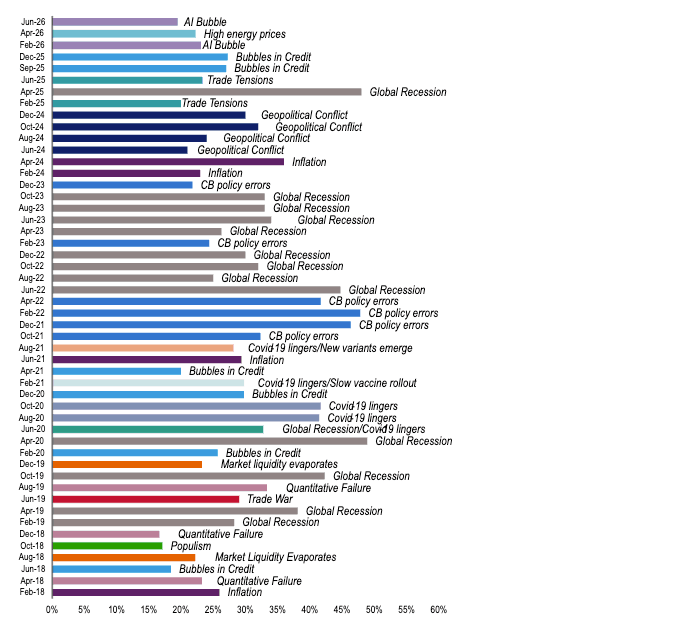
Chart 1: History of credit investors' biggest perceived risks (IG investors). % saying top worry Source: BofA Global Research. IG investors only. % of investors.
Instead, “AI bubbles” have reclaimed the top spot among investment concerns, particularly among investment-grade investors. Equity market corrections also rank highly, reflecting the sharp gains in technology stocks (see Chart 2) and growing unease that valuations may be running ahead of fundamentals. Even so, Bank of America stressed that conviction behind these fears remains unusually low, creating an environment that could continue to support markets over the summer.
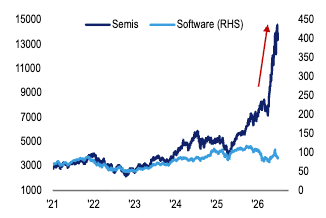
Chart 2: "AI Bubble" back as investors' top concern Source: BofA Global Research. Bloomberg. US stocks.
The rise of the “no landing”
Perhaps the survey’s most notable finding is the dramatic change in macroeconomic expectations. Nearly half of investment-grade investors now believe the global economy faces a “no landing” scenario (see Chart 3), meaning growth remains resilient without a meaningful slowdown. That proportion is the highest ever recorded in the survey.
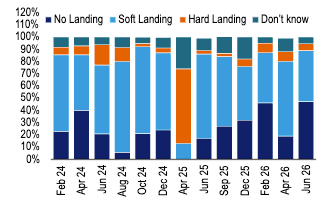
Chart 3: Investors say it's a "no landing" economy, post US-Iran peace Source: BofA Global Research.
Such a backdrop naturally favours cyclical sectors over defensive industries, while encouraging investors to favour high-yield credit over investment grade. The combination of easing geopolitical tensions and lower oil prices has strengthened confidence that economic momentum can persist despite elevated interest rates.
Central banks remain the wild card
If investors are comfortable with economic growth, they remain far less certain about monetary policy. The biggest catalyst for a potential market correction, according to both investment-grade and high-yield respondents, would be the US Federal Reserve restarting its tightening cycle.
Current market positioning assumes relatively limited additional Fed action, leaving portfolios vulnerable should inflation prove more persistent than expected.
By contrast, expectations for the European Central Bank are becoming more dovish, with some investors already anticipating rate cuts later in 2026. That divergence could continue supporting European credit markets through sustained investor inflows.
AI divides credit investors
Artificial intelligence is viewed as both an opportunity and a growing source of risk. Around one-quarter of investment-grade investors believe the rapid increase in AI-related corporate borrowing could create systemic vulnerabilities, while only a small minority expect AI to tighten credit spreads through stronger profitability.
The survey also highlights expectations for substantial debt issuance from hyperscale technology companies, with investors anticipating roughly $285bn-$295bn of issuance this year. Although estimates have moderated since April, financing the AI investment boom remains a defining feature of today's credit markets.
Hidden opportunities emerge
Despite the renewed appetite for risk, positioning across sectors remains uneven. Corporate hybrids have become a popular trade, yet subordinated bank debt has failed to attract similar enthusiasm despite improving fundamentals. Bank of America argued this divergence suggests bank credit may be under-owned, creating opportunities for contrarian investors.
Autos also stand out after years of persistent underweight positioning, while enthusiasm for crossover credits appears increasingly stretched. More broadly, investors remain overweight credit, cash balances have fallen, and fund inflows continue to support the asset class.
Optimism with a caution label
The survey paints the picture of a market that has rapidly rediscovered confidence. Investors are embracing stronger growth, favouring risk assets and looking beyond recent geopolitical shocks. Yet optimism is accompanied by growing concern that AI valuations, elevated equity markets and unexpected Fed tightening could quickly upset the prevailing narrative.
For now, confidence remains the dominant force. Whether that optimism proves justified may depend less on geopolitics than on inflation, central banks and the ability of the AI boom to deliver the earnings growth investors increasingly expect.