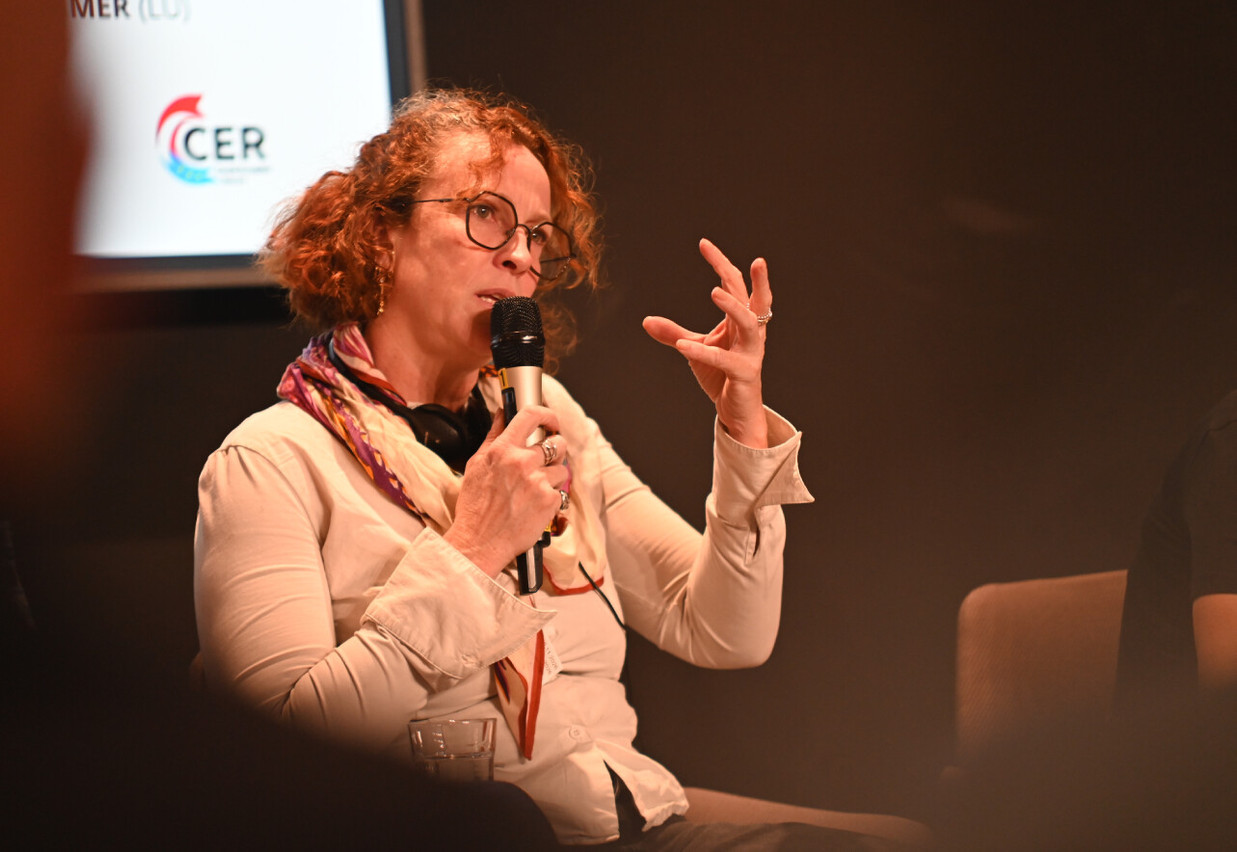
In an interview on 16 November ahead of a roundtable on European security in times of crisis organised by the Pierre Werner Institute, Christine Dugoin-Clément, associate researcher, risk department of the research laboratory at IAE Paris 1 Panthéon-Sorbonne, discussed the covert operations and technological rivalries reshaping European security.
The conversation ranged from US–China competition over artificial intelligence and semiconductor supply chains to cyberattacks, cryptocurrency payments, and the recruitment of people to carry out sabotage.
Dugoin-Clément argued that Europe must strengthen critical infrastructure and improve cooperation between governments, businesses, and intelligence services. She also examined Russia’s diplomatic objectives regarding Ukraine and the Kremlin’s portrayal of the country as a “besieged fortress.”
How could the Jensen Huang crisis at Nvidia affect the development of artificial intelligence and Europe?
Christine Dugoin-Clément. - “It depends on the perspective. Across the broader AI landscape, the United States and China are the leading powers, with extensive capabilities and long-term strategies.
China has made AI a strategic priority, investing across the technology chain. The United States also has substantial capabilities spanning data, software, computing infrastructure, and chip design.
Russia has sought to develop its AI capabilities, a priority reflected in Vladimir Putin’s declaration that whoever leads in AI will rule the world. But sanctions have restricted access to advanced computing equipment and key components, increasing Moscow’s dependence on China. Its war effort also forces choices between immediate military needs, including drones, and longer-term investment.
While US projects like Stargate announce colossal budgets, Europe lacks world-leading AI giants comparable to US tech firms (such as OpenAI or Anthropic, which rely on closed, licensed models) or China (which aggressively deploys ‘lightweight’ open models to create systemic dependency).
Europe nevertheless occupies an important position in the AI supply chain. Its companies provide critical components and equipment used in semiconductor manufacturing.
The Nvidia crisis raises concerns across multiple levels, from plunging market values to fears of foreign intelligence penetration, echoing anxieties over China’s 2017 intelligence laws.
This could further strain US-China relations, especially alongside Beijing’s proposed extraterritorial regulations restricting rare earth exports—requiring any global firm using more than 0.01% Chinese-origin rare earths to seek export approval from Beijing.
Following the reported increase in cyberattacks in October 2026, does Europe have the resources to protect itself?
“Cyber threats targeting systems can be grouped into three distinct tiers. The first is opportunistic crime. Attackers with limited technical skills can buy readily available tools and use them against vulnerable targets.
The second is sophisticated cybercrime, including ‘big game hunting’: attacks against major organizations from which criminals expect substantial returns. Revenue can come from ransom payments, the sale of stolen data, and the sale of access to compromised systems.
The third involves advanced, persistent operations pursuing strategic objectives, often with state support. Stuxnet, which targeted Iran’s uranium-enrichment programme at Natanz, illustrates how malware can be used for strategic sabotage.
AI can make some tasks easier, including drafting convincing phishing messages and adapting them for different audiences.
Rather than using vague terms like ‘hybrid warfare’, it is more accurate to describe this as a ‘shadow war’.

States also work with criminal groups and other intermediaries. These arrangements can combine geopolitical objectives with financial incentives while obscuring responsibility.
Some less experienced attackers use malicious operations to demonstrate their abilities and attract potential employers or collaborators.
Rather than using vague terms like ‘hybrid warfare’, it is more accurate to describe this as a ‘shadow war’. Hostile actors utilise every available tool below the threshold of legal war to weaken economic fabrics, erode public trust, and provoke political polarisation.
France has security requirements for designated critical operators, while the EU’s Nis2 framework establishes obligations for essential and important entities across multiple sectors. Regulation, however, does not guarantee resilience. Businesses outside these frameworks can also be targeted directly or affected through suppliers and customers.
Effective defence requires departments and agencies to share information, closer cooperation between public authorities and businesses, and sustained international intelligence collaboration.
How do cryptocurrencies facilitate cybercrime, sanctions evasion, and covert operations?
“Cryptocurrencies fundamentally replace institutional trust (banks and states) with algorithmic validation across a distributed network. While blockchain transactions use pseudonyms rather than total anonymity and can theoretically be traced, techniques like ‘layering’ — converting Ethereum to Bitcoin, then Monero, and so on—create complex hurdles for law enforcement.
Beyond ransom payments and sanction evasion, a critical emerging concern is the use of crypto payments to recruit ‘disposable agents’. These are low-skilled individuals hired for small sums to execute physical acts of sabotage or vandalism designed to fuel media narratives and destabilise target societies.
Examples include Moldovan operatives paid to spray Star of David graffiti in Paris to inflame social tensions, pig heads left outside mosques, or staged vehicle damages in Germany disguised as far-left activism.
China’s restrictions on cryptocurrency mining displaced some mining activity abroad. But imposing an outright ban raises different practical and political questions in Western democracies.
Distrust of traditional institutions can be one reason people turn to cryptocurrencies. States therefore need effective regulation, specialist investigative capabilities, and financial intelligence to address illicit activity.
What can be expected from proposed negotiations or a “Yalta 2.0” summit regarding Ukraine and European security architecture?
“Russian signals regarding security architecture negotiations brokered by the US are essentially a diplomatic arm-twisting tactic. Moscow is attempting to achieve through diplomacy what its military has failed to secure on the battlefield. Russia is not seeking a genuine peace agreement; its objective remains the total capitulation of Ukraine.
Enforcing a premature ceasefire that excludes Ukraine would merely grant Moscow time to rearm and expand its shadow war across Europe once the Ukrainian shield is compromised.
Doesn't Russia have a legitimate grievance regarding Nato's eastward expansion following the fall of the Soviet Union?
“That is a widely held perception, but it is fundamentally based on a misleading narrative heavily exploited by Moscow. Historically, there was no written, signed agreement between the West and Russia promising that Nato would never expand eastward.
The narrative of an ‘encircled fortress’ — often reinforced by calling Kaliningrad an enclave when geographically it is an exclave with open sea access—has been systematically cultivated by the Kremlin over the past two decades. This narrative served to divert domestic attention from political control while justifying authoritarian rule.
Eastern European nations voluntarily requested Nato membership not because of Western coercion but out of fear of Russian aggression. Framing Nato's expansion as aggressive encirclement is akin to a domestic abuser blaming the police when their victim seeks protection. Ultimately, Russia's strategic aim is to subvert international law and force Western concessions.”