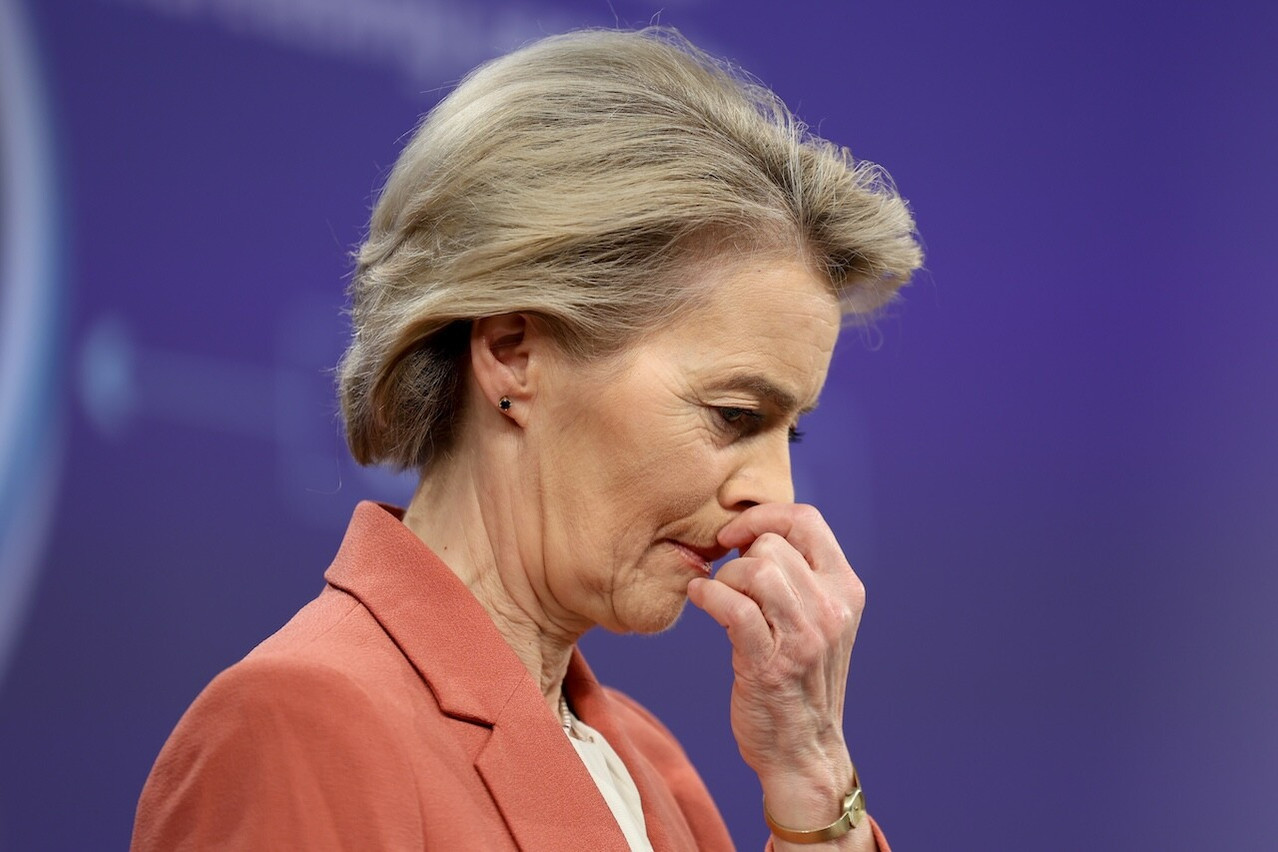
As Ursula von der Leyen’s next state of the Union address, scheduled for 16 September, draws near, one question springs to mind: what has become of the announcements made on 10 September 2025? At the time, the Commission president had placed European independence at the heart of her address. Defence, energy, industry, housing, social protection: the ambition spanned almost every area in which Europe is seeking to regain control of its future. To assess the outcome, we must distinguish between proposals, decisions and results. Brussels has the initiative, but often depends on the Parliament and the member states to deliver on its commitments. Here is an overview.
Ukraine: real resources, a different setup
Support for Ukraine has moved beyond the stage of mere intentions. The framework for a €90bn loan for 2026 and 2027 was finalised in April. An initial tranche of €3.2bn was paid out on 25 June, followed by the announcement that the disbursement of €3.9bn for the purchase of drones had begun.
However, the arrangement differs from the repair loan initially envisaged in relation to the liquidity associated with the frozen Russian assets. Belgium was demanding guarantees; the Prime Minister 
Another step towards European energy independence: the regulation adopted in January sets out the phasing out of Russian gas, scheduled for early 2027 for liquefied natural gas and in the autumn for pipeline deliveries. The phase-out has been enshrined in law, but still needs to be implemented.
Draghi: the economic urgency in the face of delays
The Draghi report, published in September 2024, was intended to guide the response to Europe’s economic weaknesses. Two years later, its implementation remains limited. According to the European Policy Innovation Council, 60 of the 383 measures identified were fully implemented in July 2026, representing 15.7%, compared with 11.2% in September 2025. Since January, only two further measures have been added to this category. Using a different methodology, the Institut Montaigne estimated this rate at 30% in June.
These figures are not directly comparable. The institute considered that Europe was broadly on track with the planned timetable, but was moving too slowly in the face of the economic downturn. Reforms requiring market integration and compromises between Member States remain particularly difficult.
Simplification: further estimated savings
The eight billion euros announced in September 2025 referred to expected annual savings. With 12 simplification packages, the Commission has now raised the estimate to at least €17bn. The scope is widening; the actual savings remain to be determined.
Decisions have nevertheless been taken. Adopted in February, the reform of sustainability reporting and due diligence reduces the number of companies affected, removes the requirement for a climate transition plan set out in the latter directive, and postpones its implementation until July 2029. Beyond the formalities, the simplification also reduces certain European requirements.
Investments: commitments, delayed results
The promise of “massive” investment in digital technology and clean technologies also needs to be assessed in the light of the timetables. The figures quoted cover different realities: public funding, expected private capital, funding agreements and proposals for the next European budget. Adding them together does not give a total of the sums actually invested.
In the field of artificial intelligence, the target of raising €200bn under the InvestAI programme had already been announced in February 2025. Its mention, again, in the September speech therefore did not represent a new funding allocation. The gigafactory project reached a milestone on 30 July 2026, with a call for proposals targeting up to seven facilities. Up to €10bn in European and national funding is expected to attract at least €20bn in private investment. However, the selection is expected in early 2027, with construction due to begin thereafter. Financial ambition still outstrips industrial capacity.
Clean technologies are seeing progress that is more directly enshrined in contracts. By March 2026, 54 projects from the Innovation Fund’s 2024 call for proposals had signed their grant agreements, totalling €2.7bn. These are concrete commitments, even if the disbursements and the completion of the facilities are spread out over time. They also illustrate the continuation of programmes that predate the policy announcement. As for the €409bn proposed for the future European Competitiveness Fund and Horizon Europe, this covers the period 2028–2034 and remains subject to budgetary negotiations. It cannot be counted amongst the achievements of the past year.
The Commission can therefore advocate for an increase in investment instruments. It has yet to demonstrate how quickly these translate into production capacity, infrastructure and funding that are actually accessible to businesses.
Housing, poverty, employment: effects that are still a long way off
The affordable housing plan was presented before the end of 2025, as promised. On 9 September 2026, the Commission extended it by means of a proposal for a regulation ensuring the safety of public interventions in areas under pressure, particularly with regard to short-term lettings and vacant properties.
The associated recommendation addresses supply and land use, without imposing any binding solutions. Decisions on trade-offs remain largely a matter for national and local authorities, whilst Brussels refers to existing funding. An additional framework, the effects of which on access to housing remain to be seen.
The anti-poverty strategy, adopted on 6 May, also responds to the 2025 announcement. However, the ambition to eradicate poverty by 2050 relies primarily on national coordination, recommendations and existing funding. Several measures are still to come, including a recommendation on in-work poverty in 2027.
The Quality Jobs Act, meanwhile, is still in the drafting stage. Consultation with the social partners runs until 28 September; the legislative proposal is expected thereafter. No new rights have yet been established as a result, and no firm deadline was mentioned in the speech.
Israel and democracy: the limits of collective action
With regard to Israel, the Commission had already presented the announced partial suspension of trade provisions on 17 September 2025. However, on 3 September 2026, European ministers remained divided. The commitment to put forward a proposal was honoured; a political agreement had not yet been reached by that date.
The European Democracy Shield, for its part, led to the launch in February of the European Centre for Democratic Resilience, in which Luxembourg is involved. Its activities have been documented; its effectiveness in countering interference remains to be assessed.
The speech on 16 September will need to meet this expectation: going beyond announcements and procedures, it must show what is actually changing for Europeans.