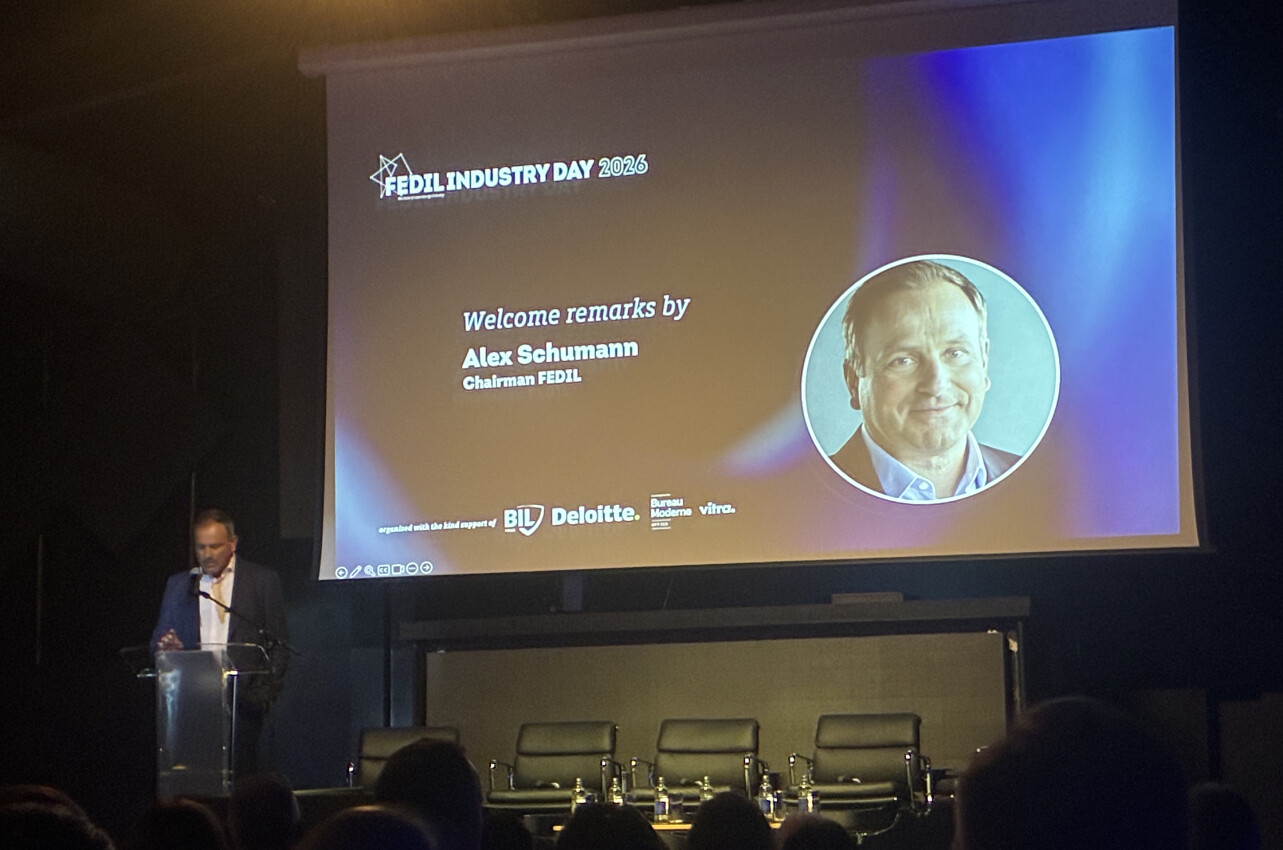
The diagnosis has been set out. It is accepted, quoted and repeated. But the European economy is not recovering at the same pace as the speeches made to save it. On Thursday 10 September, at the Chouchou event venue, the Draghi report featured in almost all the discussions at the Fedil Industry Day. The minister for Mobility and Public Works, 


With just one week to go before the European Commission president, Ursula von der Leyen, delivers her state of the European Union address, the Fedil president was not merely referring to a report from two years ago. He was describing a European paradox. Since September 2024, Mario Draghi’s conclusions have formed the basis of discussions on competitiveness: a lag in innovation, overpriced energy, misallocated savings, fragmented markets and strategic dependencies. European leaders have endorsed this diagnosis. They are still struggling to implement the remedy.
The figures vary. According to the European Policy Innovation Council’s tally, as cited by the Financial Times, 15.7% of 383 recommendations had been fully implemented by July 2026, and 41.3% had been partially implemented. The Institut Montaigne, which broke down the report into 567 general and detailed recommendations, estimates that around 30% had been implemented as at 1 May 2026. His calculation includes partial measures and certain non-binding instruments.
The Joint European Disruptive Initiative (Jedi), for its part, is narrowing its focus to 30 reforms deemed crucial. Its September tracker puts the implementation rate at 26%, compared with 14% a year earlier. Progress is being made: two-thirds of the measures monitored have been set in motion. However, none is considered to have been fully implemented, and fewer than a third are reportedly progressing with credible speed and ambition.
Political processes move more slowly than business processes
These figures are not contradictory. They reflect different stages of a legislative process that cannot happen overnight. European legislation must be drafted by the Commission, negotiated by the Parliament and the member states, amended, adopted and then implemented. Some directives still require transposition into national law. Two years is rarely enough to bring about a transformation of this scale and see it take effect within businesses.
The assessment cannot, therefore, focus solely on the number of regulations already in force. It must distinguish between texts where negotiations are proceeding as normal, recommendations that have been stripped of their substance, and those that have never secured the necessary political support. It is in this gap between the proclaimed urgency and the actual impact of the decisions that Draghi’s record is measured.
In Luxembourg, however, support had been wholehearted. In November 2024, the Prime minister 
Innovation is advancing at digital speed, whilst regulation is advancing at administrative speed.

Relinquishment of power
Two years on, progress on these initiatives has been made, but without reaching a conclusion. The package on market integration and supervision, presented in December 2025, is still stuck in the legislative process. The transformation of Esma into a more powerful European supervisory authority remains a matter of debate. The mobilisation of savings through supplementary pension schemes or investment accounts depends largely on the member states. The common European safe asset, designed to bring markets together and finance collective projects, remains blocked by the refusal to adopt a common debt.
This delay did not begin with Draghi. The Capital Markets Union dates back to 2015. The report did not uncover the obstacle: it quantified the cost of a decade of fragmentation. When it comes to implementing the reform, every capital city protects its own insolvency laws, tax system, supervisory authority, banks and market. Europe calls for the depth of a continental market without always accepting the relinquishment of power that this entails.
Luxembourg, too, epitomises this tension. Gilles Roth supports the deepening of capital markets, but opposes their centralised supervision by Esma. He believes that national authorities remain better placed to understand their own markets. This position defends the expertise of a specialised financial centre. It also illustrates why the consensus around Draghi begins to crumble as soon as his recommendations cease to be principles and instead become transfers of power.
A fourth thermometer in a week, with the same result
At Chouchou, however, the debate went beyond the scope of European legislation. Frederik Debrabander, head of the energy, resources and industry sector at Deloitte Belgium and co-author of the follow-up to the Antwerp Declaration, presented another barometer. Of the 29 competitiveness indicators examined, 83% have stagnated or deteriorated since 2024. This scorecard does not measure legislative output. It measures what it has not yet managed to drive forward: energy, infrastructure, investment, innovation, raw materials and regulatory complexity.
“The problem lies in execution and implementation,” Frederik Debrabander stated categorically. For industrialists, the final decision is not made when the European Commission publishes a package, but when boards of directors choose where to invest their billions. He cited a global group investing €13bn in green technologies in the United States, the Middle East and Asia, but not in Europe, due to the lack of a convincing economic case.
Even hundreds of millions of euros in subsidies cannot revive a project stifled by the cost of electricity, a lack of infrastructure or a lack of market opportunities, he explained. Companies then end up returning the aid and abandoning the investment. Europe can, therefore, press ahead with its procedures whilst continuing to lose ground in industrial decision-making.
Tanja Gönner, director of the BDI, the federation of German industries, summed up this race against time: “Innovation is moving at digital speed, whilst regulation is moving at administrative speed.” However, she did not call for a sudden proliferation of legislation. Referring to the Industrial Accelerator Act, she warned: “An accelerator must accelerate.”
Self-sufficiency, which goes hand in hand with competitiveness
The phrase hits the nail on the head. The EU wants to protect its industrial capacity, reduce its dependencies and promote domestic production. But it risks stifling this ambition with new reporting requirements, new delegated acts and new procedures. You do not achieve sovereignty by regulating a market that you are no longer able to supply.
Strategic autonomy comes up against a stumbling block here: competitiveness. Alex Schumann put it bluntly: wanting one without the other amounts to “wishful thinking”. Europe can reserve a portion of its public procurement contracts, impose stricter screening on foreign investment or support critical infrastructure. No amount of European preference will, in the long term, compensate for exorbitantly priced energy, endless permit processes and unprofitable investments.
The opposite pitfall would be to confuse speed with haste. A rule negotiated amongst 27 member states cannot be finalised just a few weeks after a 400-page report. A poorly thought-out reform would only add instability to the weakness it purports to combat. But legal procedures cannot become the universal excuse for wasted time. Ten years after the launch of the Capital Markets Union, the failure is no longer down to a tight timetable. It is down to a persistent political deadlock.
The presence of Yuriko Backes, Marc Spautz and Xavier Bettel at the Fedil Industry Day demonstrated not only that strategic autonomy is no longer merely a Brussels abstraction, but also the government’s interest in its industrial sector. For Luxembourg, this marks a delicate balancing act: building a Europe capable of defending its industries, technologies and supply chains without closing off a national economy fuelled by trade, capital and international alliances.