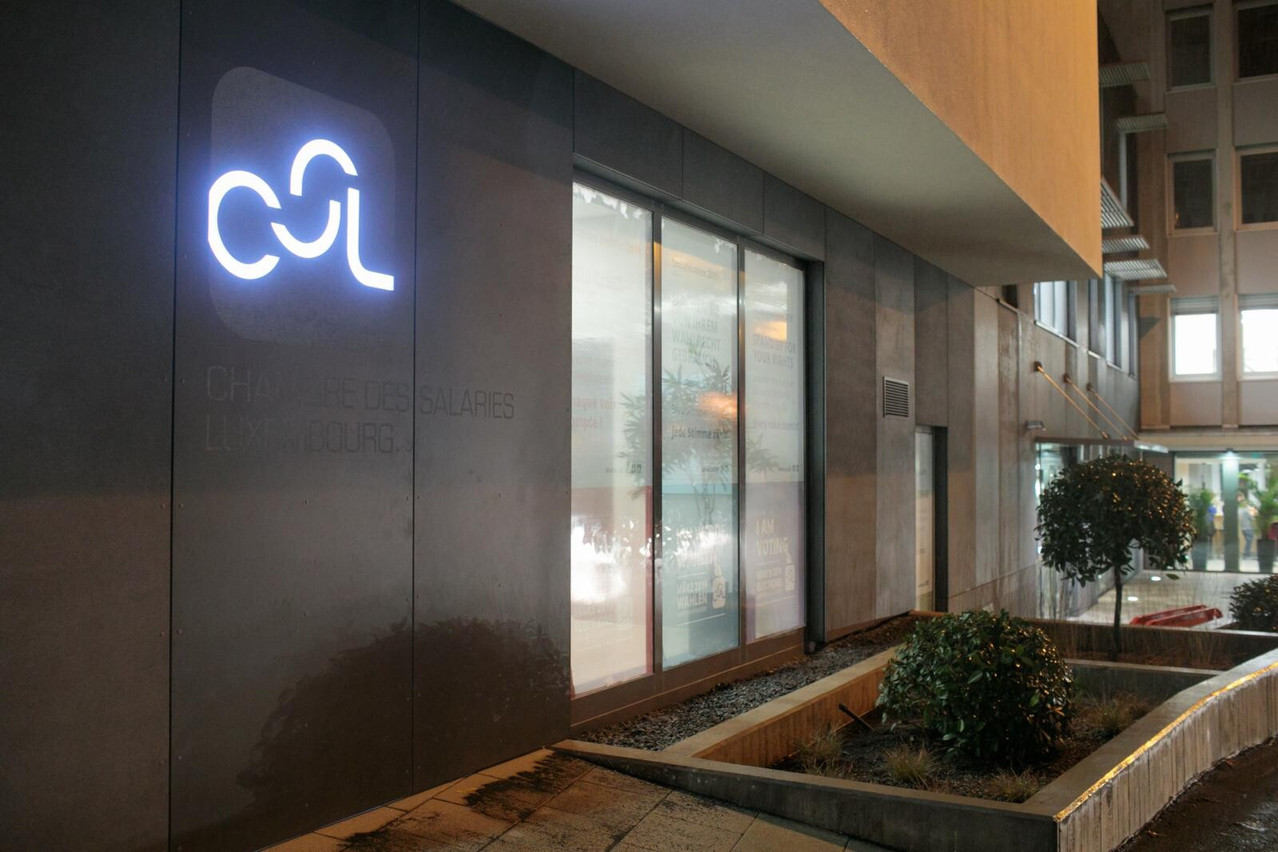
Reducing the local authority income tax (IRC) rate from 16% to 15% would cost the State €56m in 2027, and then €70m per year from 2029 onwards. According to the draft budget… By applying the rate reduction to an unchanged tax base, the Chamber of Employees (CSL) estimates that the shortfall would be closer to €300m per year in the long term. In its opinion of 19 November on the 20247 draft budget – an opinion adopted unanimously – it rejects this further reduction, whose economic benefits it considers to have been insufficiently demonstrated, and calls on the government to provide details of its calculation assumptions.
The CSL also objects to what it regards as yet another handout to businesses, namely the removal of the 17-year limit on the carry-forward of tax losses and the increase in investment allowances without prior assessment. It wants aid to businesses to be linked to verifiable objectives relating to investment, employment and the green transition. This requirement also applies to the Employers’ Mutual Insurance Scheme, to which the State is set to pay more than €400m in 2027.
The Chamber proposes setting the public contribution in advance in order to prevent the State budget from automatically covering the Mutualité’s deficits. A Mutualité which the government has used to partially absorb the cost of the 3,8% increase in the minimum social wage scheduled for 1 January via a budget of €48.3m.
These ‘gifts’ are not going down well, whilst, conversely, personal income tax and VAT will account for 49,7% of central government revenue in 2030, compared with 48.6 per cent in 2026. The CSL is reiterating its call once again this year for part of the tax burden to be shifted from labour to wealth and capital income.
It welcomes the adjustment of the tax scale by one index-linked bracket in 2027, whilst considering this insufficient to make up for the shortfall relative to inflation. It also calls for the amounts and eligibility thresholds for tax credits to be adjusted and for the compensation currently granted to taxpayers in class 1a to be retained in the single tax scale planned for 2028.
Affordable housing in La Défense
Despite a projected central government deficit of nearly 1.95 bn in 2027, the CSL considers public finances to be generally sound. It notes that the current budget remains in surplus and that borrowing is used to finance investment. It therefore considers it ‘unacceptable’ that central government’s direct and indirect investment is set to fall from 4.497 bn euros in 2026 to 4.467 bn in 2027. Their share of GDP would also fall over the programming period, whilst an increasing proportion is being allocated to defence.
Adjusted expenditure from the Special Fund for Affordable Housing is expected to be around €570m in 2027 and 2028, before falling to €465m in 2030. Over the period 2026–2030, expenditure from the Military Equipment Fund is projected to exceed that of the Affordable Housing Fund by 1.2bn. For the CSL, this gap reflects a choice of priorities at a time when construction is struggling to get back on track and advertised rents rose by 5,8% year-on-year in the second quarter of 2026.
The Chamber wants the State and public developers to build more, in addition to acquiring private projects. It proposes establishing land reserves, imposing higher taxes on the hoarding of building land and vacant properties, and tightening controls on the statutory rent cap. It rejects the reintroduction of accelerated depreciation at 6% for new rental properties, which it believes risks favouring landlords capable of making multiple acquisitions, without any guarantee of affordable rents.
The CSL is campaigning for the index and more stable jobs
The revision of the national accounts reinforces the CSL’s assessment. Growth for 2024 has been revised upwards from 0,36% to 2,06%, and that for 2025 from 0,64% to 1,39%. Over the period 2019–2025, real GDP grew by an average of 1,44% per year in Luxembourg, compared with 1,18% in the eurozone. The Chamber dismisses the notion that the country is falling behind over this period and notes that operating income has grown faster than wages. It advocates maintaining full indexation and wishes to rely on collective bargaining to ensure a fairer distribution of the benefits of growth.
The CSL welcomes the €45-a-month increase in child benefit per child and the near-doubling of funding to tackle youth unemployment, from €23.3m to €45.2m. It calls for the effectiveness of integration schemes to be assessed in terms of access to permanent contracts and continued employment after twelve months. In light of recruitment difficulties, it also calls for a review of the wages and working conditions on offer. Finally, it calls for support to reach groups that are still poorly served, particularly young people, and calls for a sustainable improvement in wages and pensions.
The green transition within reach of low-income households
Expenditure from the Climate and Energy Fund on national measures – primarily grants for renovation and electric mobility – is expected to fall from €254m in 2026 to €210m in 2027. The CSL has criticised this reduction, given that emissions from residential buildings rose by 5% in 2025.
It proposes to broaden access to grants for renovation and low-carbon transport, to reintroduce the zero-interest climate loan for low-income households, and to require landlords to contribute towards energy bills where properties are energy-inefficient. She also calls for funding for a national plan to adapt working conditions to climate change, to be drawn up in consultation with the social partners.