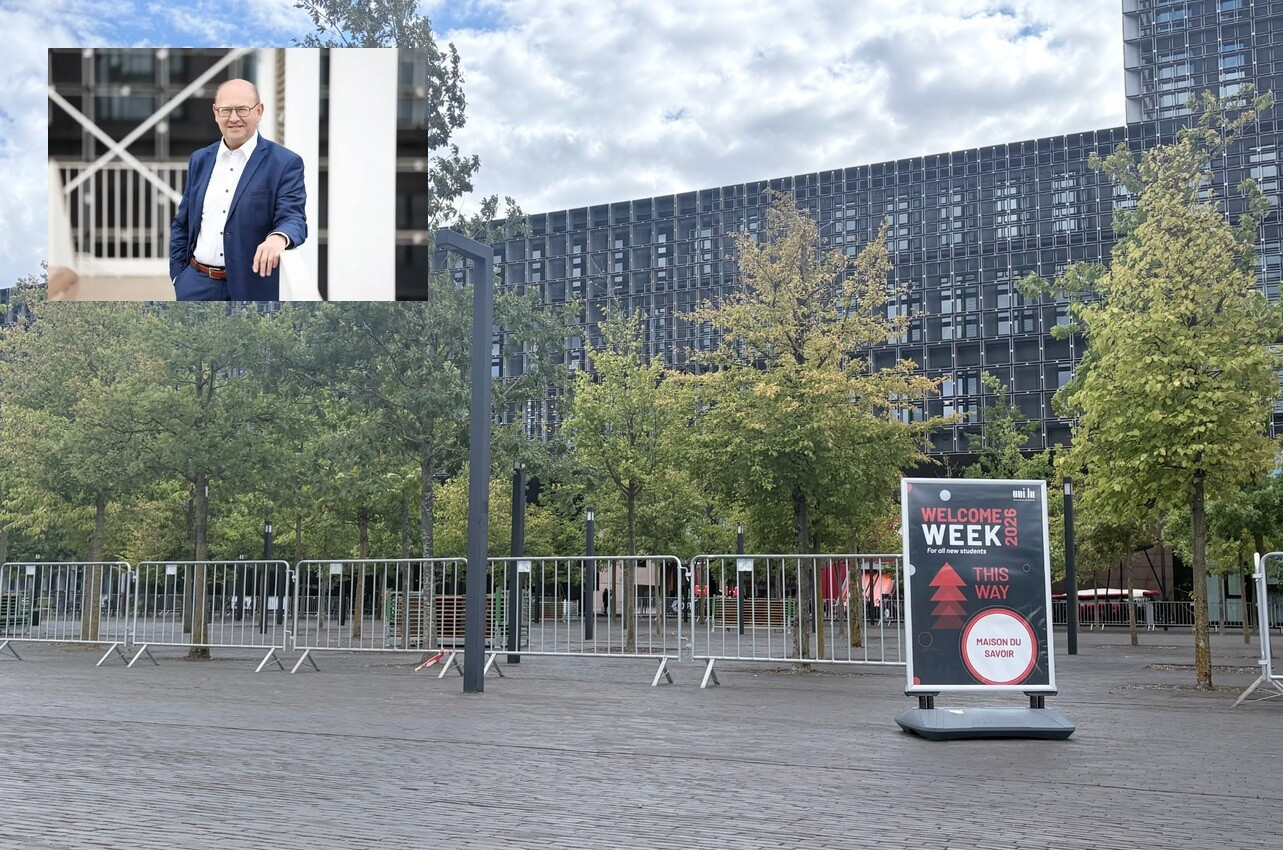
Barriers guide those who might be lost towards the Maison du savoir, where ‘guides’ sit with a smile, ready to answer any questions. Children are playing outside on an interactive screen, with wooden toys or on a huge bouncy castle – still too young to attend the University of Luxembourg. On the 18th and top floor, the vice-rector for Academic and Student Affairs, Philippe Hiligsmann – the university’s ‘Back-to-School Man’ – alternates between meetings and public addresses to describe what this new academic year has in store. The interview was barely interrupted by twelve emails and three phone calls.
What are the prospects for the new academic year?
Philippe Hiligsmann. – “It’s always a very exciting time to see all these new students arriving on campus. This year, we’ve introduced something new: a Welcome Week. It allows us to welcome students before lectures actually start, whilst offering them workshops on key topics: artificial intelligence, sustainability (including climate murals) and student engagement. It also helps to build connections right from the start within an extremely multicultural community comprising over 140 nationalities.
How many students are you taking on for the new academic year?
“Around 1,500 students are taking part in Welcome Week. In total, we expect there to be around 2,800 new students across all degree programmes. At present, we already have 2,500 confirmed new enrolments: just over 2,000 on bachelor’s and master’s programmes, and more than 500 on certificate programmes.
How do you explain the discrepancy between the 1,500 participants in Welcome Week and the total of 2,800 expected?
“Some of the international students are still arriving or awaiting their visas. Others had prior commitments or are taking part in preparatory activities specific to their course. It has been a real organisational success, involving lecturers and administrative departments, and we already have ideas on how to improve it further next year.
What does the student body as a whole represent?
“The university has a total of 5,876 undergraduate and postgraduate students (3,769 undergraduates and 2,107 postgraduates), plus 1,091 PhD students, making a total of 6,967 students enrolled on these degree programmes. This represents a particularly high PhD student-to-student ratio (approximately 1 PhD student for every 5 Bachelor’s/Master’s students) compared with the average for European universities. Nearly 70% of Bachelor’s students are from Luxembourg, confirming the impact of partnerships with the country’s secondary schools. More than three-quarters of Master’s students (68%) and almost all PhD students (87.5%) come from abroad, with a significant proportion of non-EU nationals (39.2% on Master’s programmes, 41.5% on PhD programmes).
70% of graduates find their first job in Luxembourg
What is the overall trend in staff numbers?
“We are seeing an increase of around 5% in student numbers. Whilst demographic trends across Europe are leading to an overall decline in university student numbers, the University of Luxembourg continues to grow. This is due to the creation of new degree programmes, an excellent staff-to-student ratio (a very favourable ratio of lecturers to students), strong appeal to non-EU students and the vitality of the Luxembourg labour market.
Have you noticed any changes regarding students from Luxembourg and the Greater Region?
“This year we have seen a significant increase in the number of students from Luxembourg, driven by closer links with local secondary schools. Domestic students account for around 60% to 70% of the undergraduate student body. Furthermore, with our 2,800 staff members and nearly 150 nationalities represented, the university is a true multicultural hub.
What is the trend in recruitment and integration into the Luxembourg labour market?
“Around 70% of our graduates stay on to work in Luxembourg for their first job (and this proportion remains the same for their second job). This is a particularly significant figure, which demonstrates the University of Luxembourg’s role as a genuine driver of the country’s economy and integration.
Which degree programmes are the most popular, and how do you envisage the future of the humanities?
“Degree programmes in finance, economics, law and education remain in high demand. Whilst the humanities have experienced something of a lull in Europe in recent years, I am convinced that the advent of AI will trigger a shift back in favour of the humanities. At the same time, cutting-edge courses in computer science (HPC, AI) and engineering are proving highly successful.
How can we encourage more women to pursue careers in science and technology?
“Attitudes change slowly, which is why it is essential to take action at a very early stage, starting in secondary school. We are running targeted initiatives such as the Scientist Lab and the Girls in Science programme to break down stereotypes and show schoolgirls the full potential of these courses.
Two new Master’s degrees
What are the main academic changes for the new academic year?
“Two new Master’s programmes are being launched. The Master’s in Actuarial Science (led by Professor Christophe Ley): accredited at European level, it meets a very specific need within the financial and insurance sectors for expertise in statistical modelling and decision-making. The Master’s in Primary Education: designed in collaboration with the Ministry of National Education, this two-year programme enables practising primary school teachers to have their prior learning recognised (up to 60 ECTS credits) to obtain their Master’s degree in one or two years whilst continuing to teach. In the field of healthcare, we are continuing our specialised programmes in nursing and midwifery (with around 25 places per year per course), training a multilingual cohort tailored to the country’s specific needs.
How can you balance your studies with a part-time job or voluntary work?
“A student’s primary role is, of course, to study, but we recognise that part-time work is often a financial necessity. Our dedicated service organises student job fairs every term. Furthermore, we place great value on extra-curricular engagement through our Certificate for Student Engagement and Leadership (10 free ECTS credits). Getting involved in a student society, serving as a student representative or holding a student job helps develop soft skills, as well as time management and stress management skills, which often make all the difference to recruiters.
The University needs to review its assessment methods
What is the situation regarding student accommodation?
“The university has a stock of around 1,000 accommodation units, meeting 15% of demand (with average rents of €450 per room and €700 per studio flat). This is a good European average, but the Luxembourg property market remains very tight. Thanks to the new law on affordable housing and public-private partnerships (notably with local authorities such as Esch-sur-Alzette), new projects are set to emerge by 2029, in close proximity to public transport, in addition to the forthcoming redevelopment of the Maison des Dominicaines (over 70 homes).
Given the widespread use of AI amongst students, how is the university adapting its methods?
“The emergence of AI is forcing us to fundamentally rethink our assessment methods. On the one hand, this involves teaching students to use the technology critically and ethically. On the other hand, we need to bring face-to-face oral examinations back into the spotlight. Direct dialogue enables students to defend their point of view and demonstrate their mastery, whilst placing human interaction at the heart of education.
What message would you like to send to new students?
“I’d like to welcome them! Make the most of these years of study: this is a unique opportunity to develop discipline, build your career, and forge strong friendships that will last a lifetime.”