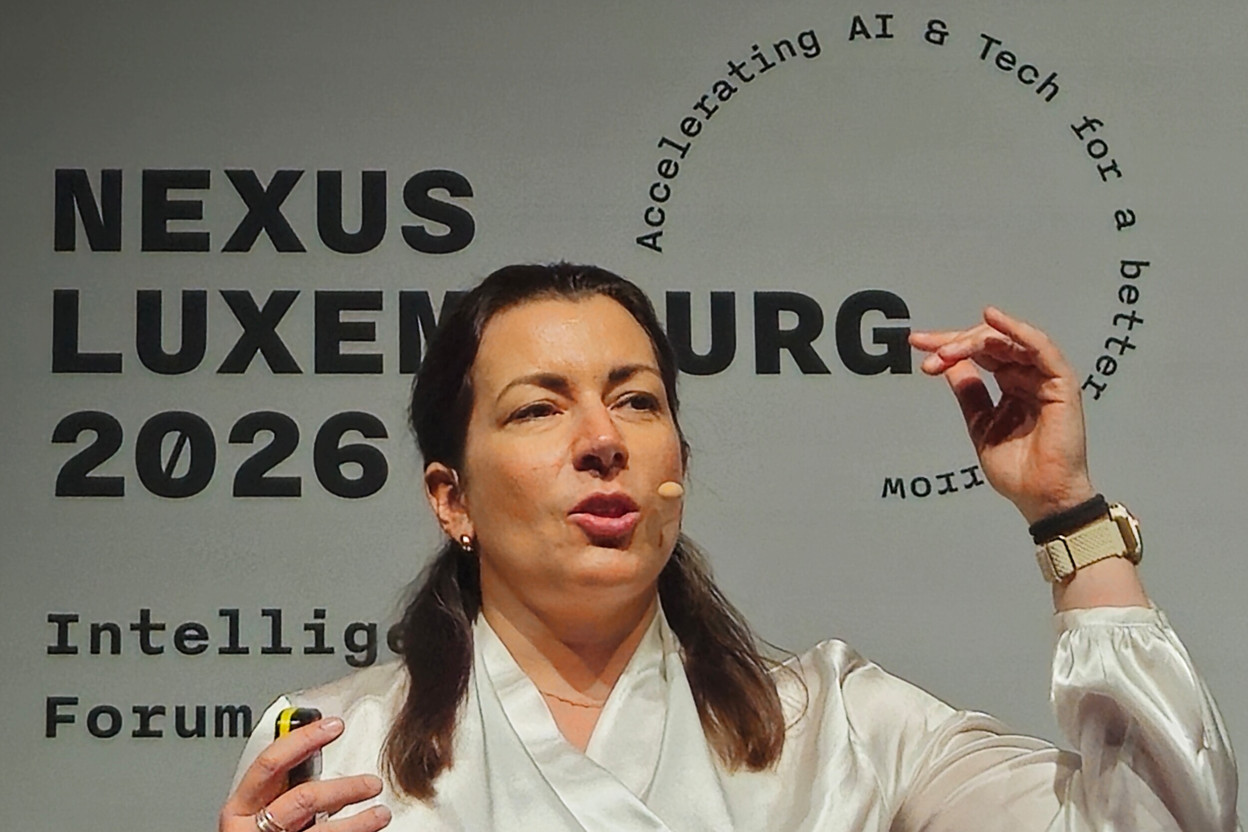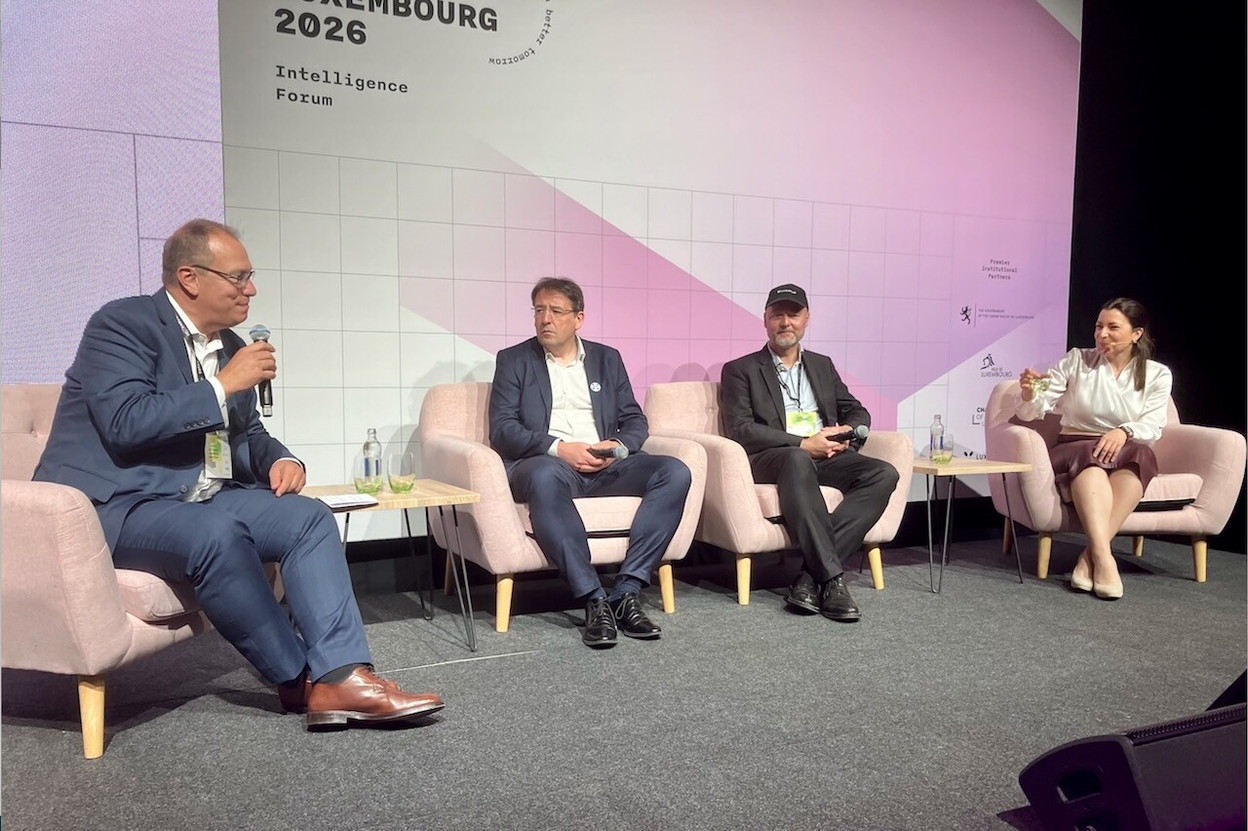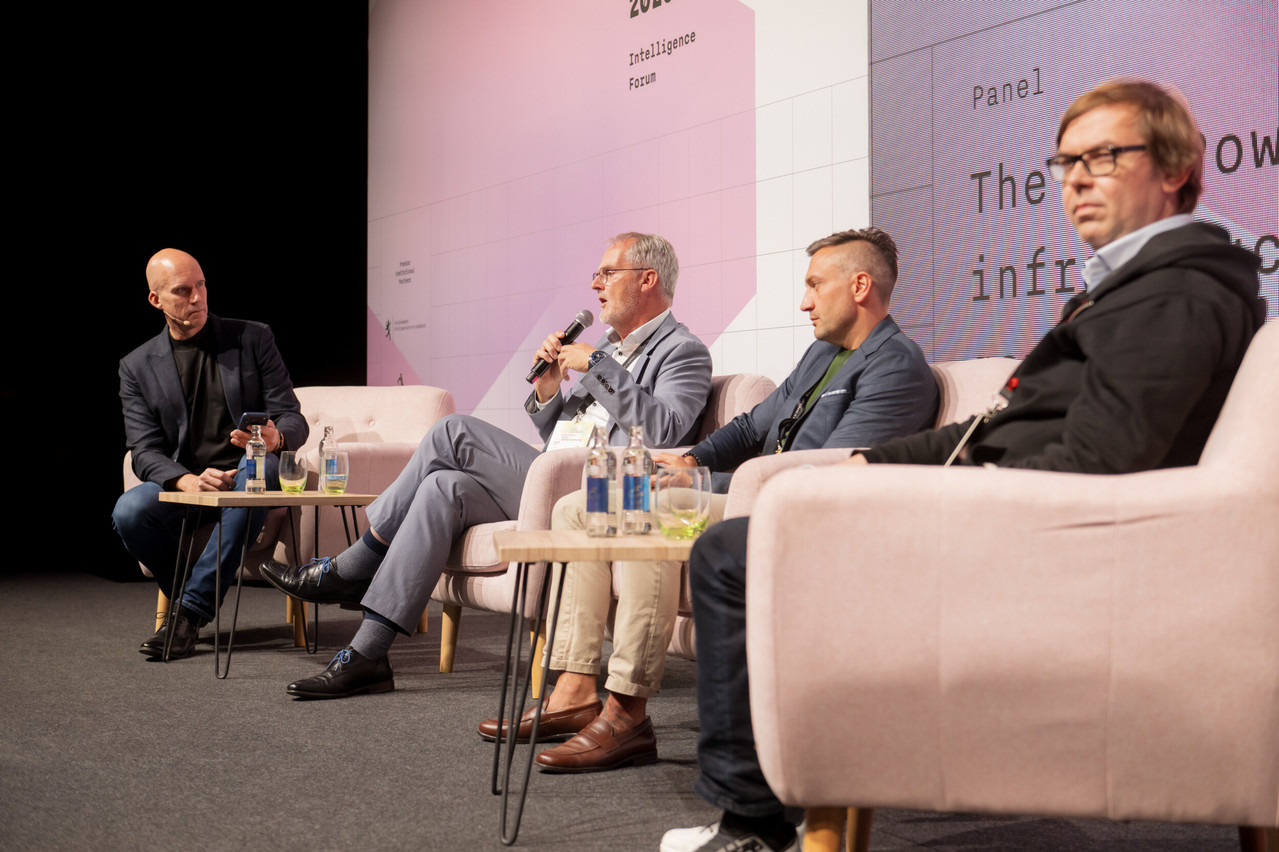
“We’re going to talk about the shift in power,” said 
At his side, 


Arnaud Lambert, CEO of LuxProvide, pointed out that Meluxina had been conceived as a strategic European project designed to provide supercomputing capabilities to businesses, and not just to research centres. “The aim is really to provide a trusted environment,” explained Mr Lambert. He highlighted Luxembourg’s unique selling point: a supercomputer housed in a Tier IV data centre and fully ISO 27001-certified, enabling banks, insurers, pharmaceutical groups and start-ups to train AI models on sensitive data.
The CEO of LuxProvide also pointed out that this infrastructure had been designed as a tool for European digital sovereignty. “Normally, this type of infrastructure is only accessible to research centres or very large companies,” he explained, emphasising that Luxembourg had chosen to open up these advanced computing capabilities to a much broader economic sector.
The future “Meluxina AI” system is set to enable Luxembourg to take things to the next level. “It will be ten times more powerful than what we have today,” said Arnaud Lambert, adding that the new infrastructure would be specifically optimised for artificial intelligence, unlike the current system, which is designed as a general-purpose machine.
The head of LuxProvide says he is already training language models for banks, insurers and pharmaceutical companies that handle sensitive data. “We specialise in training models when companies have secure or confidential data,” he explained.
GCore, edge AI
Xavier Buck then handed over to André Reitenbach, whom he introduced as one of Europe’s pioneers in low-latency networks originating from the gaming industry. “You have built one of the fastest backbone networks in the world,” the host noted, referring to Gcore’s more than 200 points of presence worldwide.
The CEO of Gcore advocates a decentralised approach to AI, where computing is distributed as close as possible to users and connected devices. “We defined the term ‘edge’ even before it existed,” he said. For André Reitenbach, “edge AI” represents the next stage in the market. “Traditional infrastructure is essentially a data centre concentrated in a single location. Edge AI is a distribution layer,” he explained. In his view, future industrial applications, autonomous robots or connected vehicles will require local data processing for reasons of latency, cost or sovereignty.
The executive also stated that he is already working with Nvidia on this ‘AI grid’ concept – a global network for distributing computing power, similar to an electricity grid. “There should be a common standard for how tokens are issued and how the chips operate,” he explained.
Xavier Buck then invited Loïc Didelot to speak on behalf of client companies. The CEO of MixVoip, described as “a Luxembourg entrepreneur at the heart of the telecoms sector”, already uses LuxProvide’s infrastructure for AI projects in the field of telephony. “Working with LuxProvide was easy,” explained Loïc Didelot. “They are flexible and are starting to operate like a proper service provider.” The CEO did, however, express regret at the administrative delays surrounding certain projects funded by the public authorities. “Instead of a year, perhaps the approvals could be finalised in two or three months.”
Not enough power, not enough GPUs
But behind these prospects, the speakers mainly described a market that is already under severe strain. “There isn’t enough capacity, not enough power, not enough GPUs,” summarised André Reitenbach. The executive claims he could immediately sell an additional “50,000 GPUs” if they were available this year.
The CEO of Gcore mentions customers requesting up to 5,000 GPUs at a single site and energy requirements of up to 10 megawatts. “It is very difficult to find 10 megawatts of available capacity this year,” he explained, pointing out that building new data centres now requires investments of several billion euros.
Arnaud Lambert agrees. “Two years ago, I would have said that the main issue was skills. Today, it’s really energy,” said the head of LuxProvide. In his view, energy availability is becoming the central constraint on European AI, even ahead of issues such as talent or funding. The executive even believes that some major international projects could be slowed down due to a lack of available electricity. “I wouldn’t be surprised if some investments were scaled back simply because of energy constraints,” he warned.
Xavier Buck also asked his guests about Luxembourg’s ability to accommodate more data centres despite the cost of land and energy constraints. Arnaud Lambert confirmed that several projects are currently in the pipeline, mentioning in particular “several projects in the pipeline”, as well as “the famous Google project”. The CEO of LuxProvide sought, however, to reassure Luxembourgish companies. “For any company in Luxembourg wishing to take the next step in AI, there will be a solution in Luxembourg with one of the existing providers,” he assured.
Europe’s dependence on American technology remains, however, as strong as ever. Xavier Buck pointed out that Europe still does not produce GPUs capable of competing with the American giants, despite the European Chips Act. Arnaud Lambert confirmed this dependence. “For the foreseeable future, GPUs will not be European,” he acknowledged.
When it comes to the practical applications of AI, Loïc Didelot has adopted a much more cautious tone than the general enthusiasm seen across the sector. The head of MixVoip argues that technological demonstrations are often more convincing than actual deployments. “I want to be completely honest,” he warned before discussing the current limitations of conversational AI. “We can resolve 80%, sometimes 90%, of cases. But imagine that ten customers call and just one gets angry. A human then has to take over the case, and that creates more work, not less,” explained Loïc Didelot.
According to him, AI already works effectively at summarising calls, automatically populating a CRM system or measuring the quality of interactions, but is still not reliable enough to completely replace human interaction. “AI works perfectly well for assessing quality. We just shouldn’t use it to respond to customers just yet,” he remarked wryly.
Industrial projects at a very advanced stage
André Reitenbach, for his part, says he is seeing much more advanced industrial projects emerge. In particular, he mentions clients wishing to deploy private, isolated AI infrastructures to prevent their industrial data or intellectual property from being exposed on the public internet. “This is the future of industrial applications,” he believes.
Arnaud Lambert also identifies several very concrete use cases. “The main use today is code generation,” he explained. He also cites applications relating to regulatory compliance, document classification, and environmental and agricultural analysis. The LuxProvide executive does, however, urge caution regarding returns on investment. “Numerous MIT studies show that the majority of AI projects do not yet have a ROI,” he pointed out, comparing the current situation to previous major waves of IT transformation.
In conclusion, Xavier Buck gave his guests a glimpse of the next stages in artificial intelligence, ranging from humanoid robots and autonomous vehicles to an explosion in data volumes. “The amount of data that will be generated is no longer growing exponentially; it’s growing at an even faster rate,” he said. For André Reitenbach, this development will profoundly transform global industrial organisation. “The factories of the future will be built for robots, not around humans,” he explained.
The discussion eventually turned to European regulation. Loïc Didelot was particularly critical of the European AI Act. “Europe wanted to solve problems before they even existed,” he said, referring to the administrative difficulties encountered in demonstrating the regulatory compliance of his AI tools.