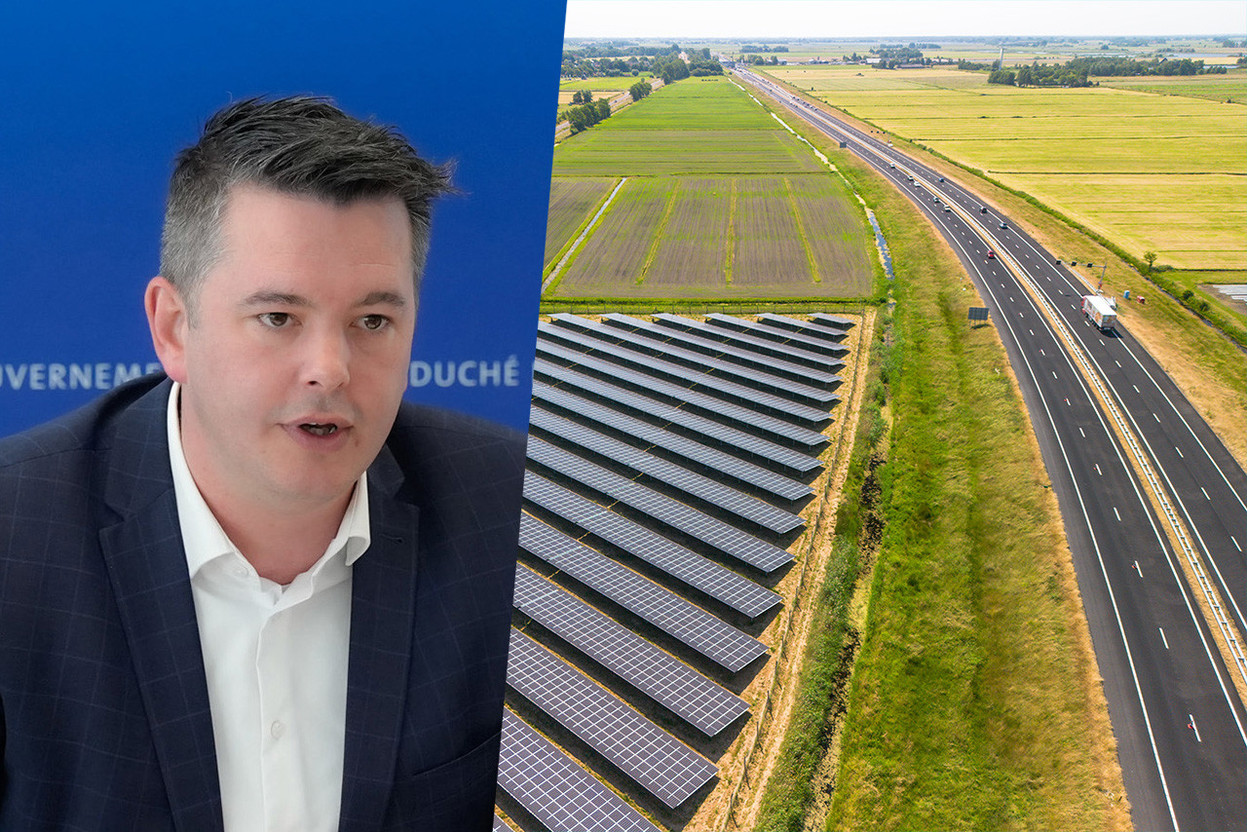
A few days ago, the government announced 51 new measures related to renewable energy. Among them is a new subsidy for batteries for existing photovoltaic installations. “Until now, you could only get a subsidy for a battery if you bought photovoltaic panels at the same time,” said economy minister 
What does one of the main players in the sector think? Namely, Teseos, a subsidiary of Encevo and provider of technical and energy services and which has 21 sites in Luxembourg, Germany and France. “Of course subsidies help motivate people to turn to renewable energy,” comments 
100,000 users for Electris
“Via Electris,” says Santinelli, “we are currently developing this leasing model for the general public, called energy-as-a-service (EaaS), which can be combined with subsidies, as is already the case today with electric cars. Through our subsidiaries, we are ourselves installers or--like Minusines (another independent subsidiary of Teseos)--distributors of these components under the Luxproof concept, accessible to all professional installers in the grand duchy. But it’s not enough simply to sell and install a system in someone’s home: it has to work intelligently. Of course, there’s self-consumption and user comfort, but we can go much further thanks to home energy management systems, or HEMS, and artificial intelligence, in particular by optimising electricity bill costs via the tariffs offered by energy suppliers and network operators.”
Models are being tested today at various people’s homes, including that of Electris’s own CEO, Vincent Lekens. Enovos, like other energy suppliers, offers advantageous tariffs at certain times of the day, which are currently fairly low. This intelligent system would make it possible, for example, to recharge one’s car at the best times. Electris is developing systems that can be integrated into existing installations by adding a storage battery, a heat pump, etc. But the Teseos subsidiary is also developing systems that can be integrated into new installations.
Electris has a staff of 50 people (up from six when it was founded in 2022), achieved sales of more than €11m in 2024 and has 100,000 users on its platform. “Electris will operate a bit like a one-stop shop for the general public,” says Santinelli. “If you want your heat pump, your photovoltaic panels, your storage battery and your electric car charging point to work together, Electris will advise you, take care of everything and also offer you HEMS. These solutions, under the Luxproof concept, will also be directly accessible via Minusines for its professional installer customers. We want to share our solutions and drive forward the energy transition with all the players in Luxembourg.”
Batteries, a market in the making
Battery storage is currently a fledgling market for Teseos, with 132 systems sold in 2024 for 1,5MW of storage capacity, but current and future subsidies should “naturally help to boost this market,” says Santinelli “People are moving forward with their installations step by step: first a charging point, then photovoltaics, a heat pump and finally a battery, because of its still high cost. For example, a small battery with a capacity of 5 kWh costs between €6,000 and €10,000. “But the energy transition inevitably has a cost. The most important thing is to invest your money in this transition in the most intelligent way possible.”
The Teseos CEO, who is also a member of the executive committee of the Encevo group, also says that his subsidiary PWF (480 employees), which specialises in large technical installations and renewable energies, will “certainly be installing large batteries for industry, the tertiary sector or large energy consumers in the near future.” These large batteries are of a completely different calibre, he says, to those intended for private customers, with a capacity of up to 350 MW. “You always have to bear in mind that there are two markets: the energy market and the grid market--two dimensions that interact with these batteries. But we’re still only at the beginning of all these topics.”
According to the latest Teseos business report, the operational holding company, a subsidiary of Encevo--previously named Enovos Services until 2022--achieved sales of €200m in 2024, with a net profit of €10.7m and a workforce of 961. Through its various subsidiaries, Teseos has installed 12.08 MW of photovoltaic panels and sold 18,000 photovoltaic modules, as well as 342 public charge points with an installed capacity of 8 MW.
This article was originally published in French.