Paperjam: The debate on pension reform largely revolves around the first pillar. The second and third pillars, which concern supplementary pensions, are rarely addressed. Are insurers being heard?

Luxembourg is no exception. We must now consider reforms that include the complementary pillars. The second and third pillars are not meant to replace the first, but to accompany and strengthen it. They are essential shock absorbers to ensure a balanced and sustainable system.
What are your expectations regarding the future evolution of the first pillar?
Like any citizen, I want the first pillar to remain strong and to continue ensuring intergenerational solidarity. But we must be clear-eyed: the current system cannot be maintained without adjustments. The choices ahead will be difficult, but postponing them will only make them more painful. We still have an opportunity in Luxembourg to implement reform gradually. We must not let that chance slip away.
In his State of the Nation address, prime minister 
The government has shown courage in acknowledging the objective findings concerning the future of the first pillar. It has acted accordingly by proposing to extend the contribution period. This is an important step, and it is the right direction. However, the contribution period was not the only significant point in the prime minister’s speech. The introduction of new options for phased retirement also seems to us a promising idea, offering flexibility for those who wish to take advantage of it.
What is your takeaway from Frieden’s comments on supplementary pensions? Do you feel your concerns have been acknowledged?
The expected reform should focus primarily, and in the first instance, on the first pillar. But as I mentioned, we continue to believe that the second and third pillars are important shock absorbers. The prime minister also announced measures aimed at making the third pillar more attractive, and we naturally welcome this ambition.
Can we really encourage citizens to turn to the second or third pillar without them having a clear idea, early on, of what they will receive in retirement?
This is a crucial point. At present, the pension projections provided by the National Pension Insurance Fund (CNAP) are only available from the age of 55. This lack of visibility prevents effective planning. We are advocating for every citizen to be able to know their estimated entitlements from the age of 35 or 40. The data exists; it simply needs to be made accessible. Better information would help people prepare and would also make it easier for them to accept the reforms that lie ahead.
All employers should be required to offer a supplementary pension scheme.

In Belgium, for example, such a tool already exists…
Exactly. The mypension.be portal gives people access to a personalised pension estimate from a much earlier age. It’s a model we could certainly draw inspiration from.
Is there a risk in providing figures that may no longer be valid in 25 years’ time?
Yes, there is a risk--but it already exists for today’s retirees. That’s no reason to do nothing. We can provide projections, clearly stating that they are indicative. The most important thing is to inform and educate. Many people believe the state will always be able to cover everything. But when they learn that public pension reserves will be depleted by 2047 if nothing changes, they begin to understand the urgency of the situation.
The second pillar remains underdeveloped in Luxembourg. How can it be strengthened?
All employers, regardless of sector, should be required to offer a supplementary pension scheme. Much is said about individual responsibility, but awareness must also be raised at company level. It is important for businesses to understand that this is a real issue--especially in terms of attracting and retaining talent. Even without employer contributions, every employee should have the option to contribute voluntarily.
Some argue that a second pillar scheme only makes sense if the employer contributes. What is your view?
I share that view. The second pillar is primarily designed for employer contributions. But what matters is offering flexibility, enabling employees to combine the benefits of the second and third pillars. The second pillar should also be better integrated into the management of personal circumstances--such as during a difficult period, unemployment or a property purchase. It should be possible to use it as a precautionary savings tool or an investment lever.
How can the tax system be used as a lever?
Strengthening incentives is essential. For example, young people could be granted higher deductibility limits up to a certain age, followed by a catch-up mechanism for years in which they did not contribute. This type of practical measure would help stimulate long-term saving. It would also be worthwhile to negotiate with neighbouring countries so that capital received at retirement--built up within a second pillar scheme--could be exempt from tax. If such an opportunity exists, we must seize it. This would enable workers to build savings they can draw on in retirement, even as non-residents, to meet their needs.
And how can the third pillar be made more attractive?
Here too, tax incentives are the main lever. At present, many people reach the deductibility ceiling of €3,200 but choose not to invest beyond that. If the tax benefits were stronger, they would be more inclined to invest more--and over a longer term. This would also pave the way for investment in the real economy: businesses, infrastructure, the energy transition. Retirement savings can play a central role in financing the future.
Are there any European countries that can serve as inspiration?
Yes, countries like the Netherlands and Denmark have highly effective supplementary pension systems. But their models must be viewed in context: in those countries, the first pillar is less generous than it is in Luxembourg.
Ultimately, would you favour a less generous first pillar?
That’s not for me to decide. Our model is based on a strong foundation of solidarity, and that should not be called into question. But to ensure its long-term viability, it is necessary to embrace a greater reliance on the complementary pillars.
What role can the European Union play in this process?
Europe can encourage member states to implement harmonised incentives. But beyond that, it must also promote financial education. Today, there is a significant gap between Europe and the United States when it comes to financial literacy. Education must start early, in schools, and be supported by a broader educational ecosystem, including the media. At Aca, we already visit schools to raise awareness amongst young people about these issues. These initiatives need to be scaled up.
Through its capital markets union project, the EU aims to channel more of European citizens’ savings into the real economy. Do you see this as a “game changer” for the insurance sector?
It’s a fundamental challenge for Europe. It’s about investing in infrastructure, in strategic sectors such as defence, the energy transition and emerging technologies. This is a matter of economic sovereignty: building a European cloud, supporting innovation and strengthening our autonomy in the face of other global economic blocs. Insurers, along with banks and asset managers, have a key role to play in this transformation. Through our long-term savings products, we can contribute meaningfully to this project.
How can insurers contribute to Europe’s rearmament as investors?
Insurers are, by nature, long-term investors. They manage commitments that span several decades, particularly in the context of life insurance and pension products. A significant portion of their investments is directed toward the real economy. Today, a large share of property assets in Europe--including in Luxembourg--is owned by insurance companies. The EU’s recent decision to strengthen its defence capabilities opens up new investment opportunities, including in sectors that had previously been excluded on ESG grounds. We are seeing a shift in the investment policies of major financial groups. Some insurers are also reintegrating the defence sector into their strategies.
We are losing market share to Ireland in the life insurance sector.
Is this trend visible in Luxembourg as well?
For the time being, it’s mainly a trend we’re observing at the European level. But major developments that emerge elsewhere tend to eventually make their way to Luxembourg. It’s clear that local market players are watching these evolutions closely. In life insurance--particularly with high-net-worth clients investing via Luxembourg--we’re seeing increased interest in private equity. This type of investment spans the entire real economy, including companies active in the defence sector, both large and small.
What are the main challenges currently facing the life insurance sector?
Luxembourg’s life insurance industry is primarily focused on the international market. Its clientele mainly consists of high-net-worth individuals. The key challenge for our sector today is competitiveness. And in this regard, Ireland is a direct and serious competitor. We are losing market share to Ireland. This is already the case in Italy, which is the second largest market for Luxembourg’s international life insurance. Our concern is that this competition will soon extend to our primary market: France. Admittedly, we enjoy a closer cultural affinity with the French, but that alone is no longer enough. We need to remain attractive and responsive.
What needs to be done, concretely, to maintain competitiveness against hubs like Dublin?
We must remain at the forefront of innovation. That means embracing digitalisation and adopting new technologies, such as AI. However, we are still hindered by a major obstacle: professional secrecy in its current form. As defined in Luxembourg, this secrecy restricts our ability to modernise our systems. It also limits our participation in technology projects within the international groups our companies belong to. For example, we are required to obtain written consent from each client before using certain software or platforms--even when they are secure. This puts us out of step with practices in other European countries.
Don’t banks face similar constraints with banking secrecy?
No, they have greater flexibility. For instance, they do not have an individual contract with each client for basic services. They can unilaterally amend their general terms and conditions, simply by informing the client. In life insurance, a contract is signed between the insurer and the client. Any modification now requires a written procedure. This makes it difficult to work with technology providers. We struggle to outsource certain functions. Integrating insurtech solutions is also a challenge. Yet this kind of flexibility is essential if we want to continue innovating and meeting the expectations of a demanding clientele. At Aca, we’ve been working on this issue for several years. Progress has already been made, but we need to go further. This is a critical matter if we are to maintain our position as a centre of excellence in life insurance.
Profession: life insurer
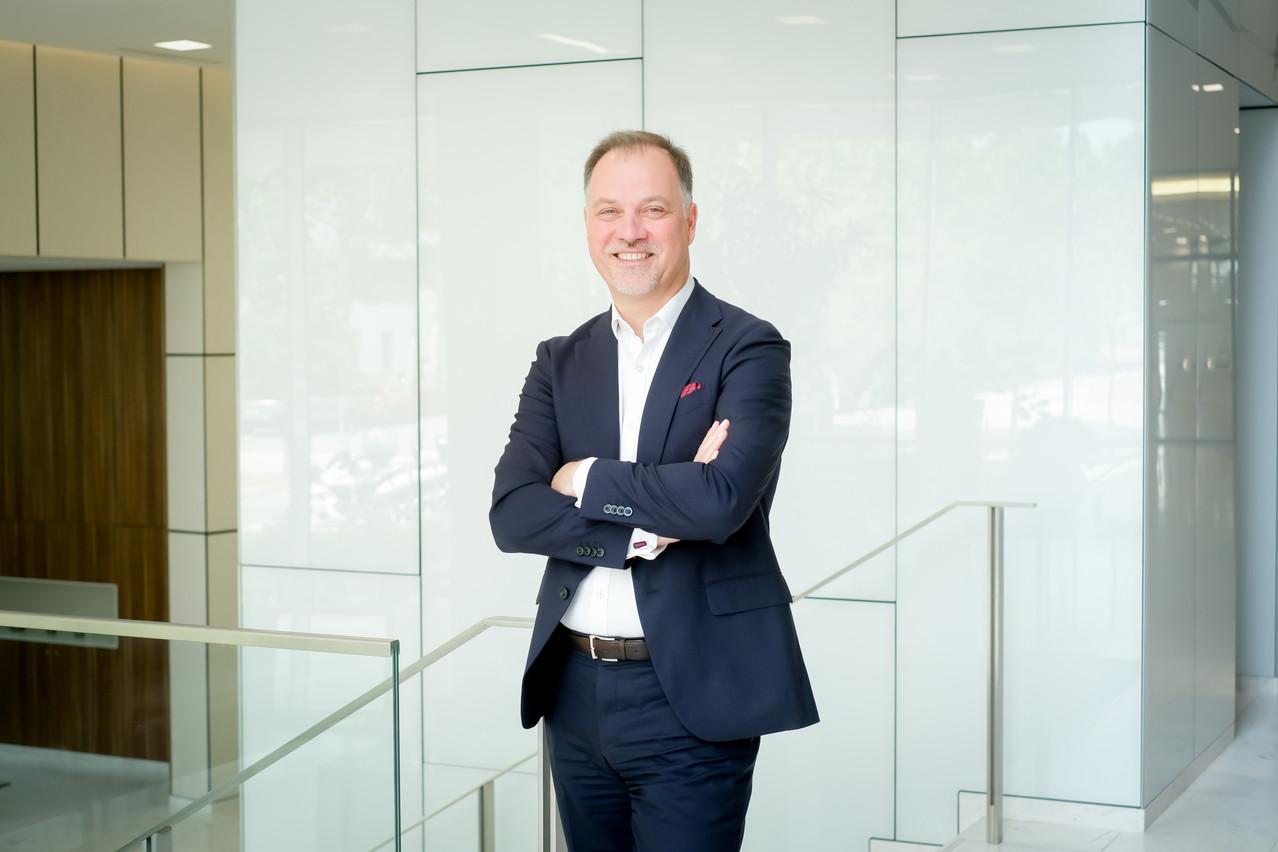
In March 2025, Nicolas Limbourg succeeded 
+51%
Between 2019 and 2023, the annual amount of premiums collected in international non-life insurance grew by 51%, according to Aca.
Non-life insurance: a growth driver
Whilst life insurance remains a key pillar of Luxembourg’s financial centre, non-life insurance has seen strong growth--particularly in the wake of Brexit. For Nicolas Limbourg, this segment has the potential to become a genuine growth driver for Luxembourg: “International non-life insurance has grown significantly in recent years. Luxembourg is ideally placed to support this expansion. The country has extensive experience in the cross-border distribution of insurance products--both life and non-life.”
International players that have chosen to establish themselves in Luxembourg have quickly recognised the strength of its ecosystem. The Aca president continues: “Everything is in place to support their development: an administration that understands the dynamics of international insurance, a regulator dedicated exclusively to the sector--the Commissariat aux assurances--and a culture of dialogue that encourages constructive exchange between the private sector, the regulator and public authorities. Another asset lies in political commitment. Successive governments have consistently aimed to attract foreign investors, including life and non-life insurers as well as reinsurers.”
Climate risk: a future growth area
With what results? Limbourg points to a recent example: a major US group already active in Luxembourg, FM Global, has chosen to set up its European research centre for loss prevention in the Cloche d’Or district. This laboratory--specialising notably in materials resistance--will host several highly qualified engineers.
“This illustrates the country’s attractiveness and the ability of its institutions, such as Luxembourg for Finance, to bring in global leaders in insurance,” he notes.
Within the non-life sector, Aca sees insurance against climate-related risks as a key area for future development. “Recent climate events, such as the floods of the past few years, clearly demonstrate the rising threat of climate risks. It’s an increasingly prominent topic in our sector, and it ranks among Aca’s key priorities,” says its president.
“There’s a growing awareness: unfortunately, these extreme events are set to become more frequent. The sector must adapt to these emerging risks. That means rethinking products, pricing models and also prevention strategies.”
This article was written for the Nexus 2025 issue of Paperjam magazine, published on 12 June. The content is produced exclusively for the magazine. It is published on the site to contribute to the full Paperjam archive. Click this link to subscribe to the magazine.
Is your company a member of Paperjam Club? You can request a subscription in your name. Let us know via club@paperjam.lu