
Between 2007 and the present day, there has been no disaster or particularly profligate government to point the finger at. But there has been a succession of shocks, fiscal stimuli and political promises. Taken in isolation, each measure was justifiable. But as none of them has ever been withdrawn, the fiscal space has gradually narrowed.
30%, or virtue with variable standards
There was a time when Luxembourg’s public debt was little more than a statistical footnote. In 2007, it stood at less than 8% of GDP. Then came 2008. The bail-out of Fortis and Dexia-Bil, followed by economic support schemes, caused the ratio to more than double in the space of a few years: it exceeded 20% at the start of the following decade. It has never really fallen back down to that level. According to the 2027 draft budget presented on 7 October by the Minister for Finance, 
This threshold is not enshrined in any law or treaty. It emerged in the early 2010s, following discussions between the Treasury and the credit rating agencies. The reasoning was simple. The 60% ceiling under the Stability Pact was so far off that it imposed no real constraints. The 30% ceiling, on the other hand, allowed for real fiscal manoeuvre whilst safeguarding what mattered most: the AAA rating, a manageable interest burden and a reserve of borrowing capacity for the day when an ageing population would take its toll.
An unwritten rule, then, but one that has been observed – until now. For in the political debate, this notional ceiling is now being questioned, circumvented, or even openly challenged. As the Chamber begins its examination of the 2027 draft budget, the question deserves to be asked frankly: should Luxembourg commit to a path of structurally higher debt? The short answer is no. The long answer is more interesting.
The budgetary mille-feuille
The deterioration in Luxembourg’s public finances is by no means a coincidence. It is more like a process of erosion: slow, silent and all the more difficult to detect because, taken in isolation, no single year appeared to be cause for alarm.
Three factors have contributed to this. Firstly, underlying growth has slowed. The country, which was recording growth rates of 4% before the financial crisis, is now forecasting, following a virtually stagnant 2025, for 1.2% in 2026 and 1.9% in 2027 – well below the average of 2.8% recorded between 1995 and 2025. Secondly, social spending has been called upon with every shock: indexation, tripartite agreements, energy price caps, housing support. Each measure was justified in the name of ‘social peace’, and none has been withdrawn once the shock had passed. Finally, investment needs have piled up: transport, housing, the energy transition and, now, defence spending, which has risen to 2.1% of gross national income – amounting to nearly €1.4bn in 2027.
On the revenue side, the tax base remains narrow and volatile, heavily dependent on corporation tax and the health of the financial sector. The 2025 financial year ended with a central government deficit of €2.15bn, which is €570m more than forecast. The first nine months of 2026 show an improvement, but this is partly due to exceptional inheritance tax receipts, and expenditure is rising almost as fast as revenue.
The 2027 draft budget confirms this assessment. The central government deficit for 2026, previously announced as €1.49bn, is now estimated at €1.89bn. In 2027, it is expected to reach €1.95bn, which is €450m more than forecast in the previous budget plan. The overall general government balance appears more favourable, with the deficit falling from €1.05bn in 2026 to €570m in 2027, or 0.6% of GDP. However, it is the social security surplus that is making up the shortfall, and this surplus is shrinking, from €952m in 2026 to €147m in 2030. From 2028 onwards, the public deficit would rise again to nearly one billion, at a time when the flat tax and accompanying measures would reduce revenue by €880m a year.
The Luxembourg budget thus functions like a mille-feuille: layers are added, but never removed. No government has ever questioned the overall strategy; each has simply superimposed its own priorities onto it. The result is not a crisis. It is more insidious: the gradual disappearance of any room for manoeuvre.
What the maths tells us
The standard analysis of debt sustainability boils down to an equation that every economics student has come across at some point:
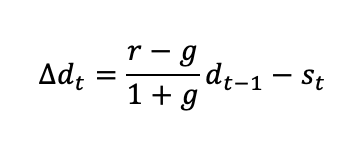
The change in the debt ratio d depends on the difference between the apparent interest rate r and nominal growth g, applied to the existing stock, and on the primary balance s, that is, the budget balance excluding interest payments.
Those in favour of higher debt levels are quick to cite the first argument. As long as growth exceeds the interest rate, the debt reduces itself: this is the famous ‘free lunch’ popularised by the French economist Olivier Blanchard. The argument is not wrong. But for a country with a debt-to-GDP ratio of 30%, with a favourable spread of one percentage point, this ‘free lunch’ yields 0.3% of GDP per year. It is more of an appetiser than a banquet.
Everything therefore hinges on the second term. A permanent primary deficit of 1% of GDP, even with growth one percentage point higher than the interest rate, causes debt to converge towards 100% of GDP. With a two-point gap, it converges towards 50%. In other words, the question is not whether Luxembourg can borrow, but whether it can sustainably finance its current expenditure through borrowing. The arithmetic answer is unequivocal.
And both indicators are moving in the wrong direction. Underlying growth is slowing, and interest rates are no longer at zero: the interest burden, which stood at 0.2% of GDP in 2022, was set to more than double by 2027, and this trend is continuing: according to the multi-annual programme, central government interest payments are set to rise from €439m in 2026 to €934m in 2030. Above all, an ageing population will put pressure on the primary balance. According to the OECD, pension expenditure is set to rise from 9.4% of GDP in 2024 to 17.5% in 2070, the sharpest increase of any European Union Member State. The number of pensioners is expected to more than triple, as the generations of cross-border workers who have entered the labour market since the late 1980s will in turn reach retirement age. The National Council for Public Finance had already calculated that, if policy remains unchanged, debt would exceed 60% of GDP in the 2050s.
It is against this backdrop that the government’s pledge to keep debt below 30% must be viewed. In euro terms, it would continue to rise, from €28.1bn to €33.7bn by 2030; the ratio only stabilises because GDP is expected to grow even faster, with real growth rising to 2.4% by the end of the period. The structural balance, still in surplus at 0.6% of GDP in 2027, would slide towards a deficit of 0.5% in 2030. And the government’s own simulations speak for themselves: with growth half a percentage point lower each year, the public deficit would reach 2.2% of GDP in 2030 and debt would stand at 32%. The 30% threshold is therefore not maintained by fiscal discipline, but by a growth assumption.
It will be argued, quite rightly, that Luxembourg has considerable assets, starting with a pension reserve equivalent to around a third of GDP. That is true, and it is valuable. But this reserve is earmarked for future pensions; it is not a piggy bank to be used to plug the central government’s deficits. Counting the same money twice is an accounting trick that has never impressed the financial markets.
A small country, big risks
What is sustainable for a large country is not necessarily so for a small one. Luxembourg faces a number of vulnerabilities which are precisely why it needs to exercise greater caution than the European average.
The first relates to volatility. In an economy dominated by financial services, tax revenues fluctuate in line with the markets, sometimes quite sharply. What appears to be a structural margin during prosperous times can evaporate within two quarters.
The second relates to implicit liabilities. The banking sector’s balance sheet is a multiple of GDP. The experience of 2008 demonstrated that a financial crisis can cause public debt to double within a few years, without any government having passed a single spending programme. The margin below the 30% ceiling – which will be reduced to 0.7 percentage points by the end of 2026 – is therefore not a reserve to be drawn upon. It is an insurance policy.
The third factor relates to the measure itself. A significant proportion of Luxembourg’s GDP is attributable to non-residents, cross-border workers and foreign shareholders. When viewed in relation to gross national income – which provides a better measure of the country’s ability to pay – the debt appears considerably less modest.
Finally, a small issuer has a narrow investor base and less liquid securities. In calm times, this comes at no cost. In times of crisis, the risk premium can soar much more rapidly than for a large country whose debt is a must-have in every portfolio.
The AAA: an asset, not a trophy
For the time being, the credit rating agencies remain unconcerned. The five major agencies have confirmed Luxembourg’s AAA rating for 2026, all with a stable outlook. Fitch noted at the end of 2025 that the country had the second-lowest debt-to-GDP ratio amongst AAA-rated sovereigns, well below the median for this group, which stands at around 39%. But the agencies’ reports read like school reports: it is in the ‘areas for concern’ column that the key information lies. Year after year, this column highlights rising expenditure, an ageing population and dependence on the financial sector.
A credit rating isn’t lost all at once. It’s lost in the way Hemingway described bankruptcy: gradually, then suddenly. First comes a negative outlook, then a downgrade from one agency, then from another.
It may be argued that France, the United Kingdom, the United States or Austria lost their AAA ratings without collapsing. That is true. But for those countries, the rating is merely a footnote. For Luxembourg, it is part of the economic model. A financial centre sells, above all, confidence: the stability of the state in which it is based is the ultimate guarantee of that. The sovereign rating effectively caps the ratings of public issuers, such as Spuerkeess, and weighs on the cost of financing for the economy as a whole. It also determines the eligibility of securities under many investment mandates.
A country the size of Luxembourg does not rely on its critical mass for funding, but on its reputation. Yet a reputation takes decades to build and can be squandered in the space of a few financial years.
An Irish folktale
Once upon a time, there was a small, open economy that was highly prosperous, welcoming to multinationals and boasting a substantial financial sector. It ran budget surpluses and had a debt level of around a quarter of its GDP. It was held up as a model in every European capital.
In September 2008, Ireland guaranteed virtually all of its banks’ liabilities, a commitment amounting to more than twice its GDP. The subsequent recapitalisation pushed the deficit to over 30% of GDP in 2010. Debt increased nearly fivefold and approached 120% of GDP. In November 2010, Dublin was forced to seek an €85bn assistance programme from its eurozone partners and the IMF.
Three years of austerity followed: quarterly reviews by the troika, tax rises, cuts to public sector pay, unemployment exceeding 15% and mass emigration of young graduates. Ireland has recovered remarkably well from this. But for three years, a key part of its fiscal policy was decided elsewhere than in Dublin.
The moral of the story is not that Luxembourg is Ireland. The two countries differ in terms of the structure of their banking sectors, their geography and their demographics. The moral lies elsewhere: a low initial level of debt was not enough to protect Ireland, because the real risk lay off the government’s balance sheet. It is precisely for this reason that a small financial economy must keep its margin intact.
There is a delightful epilogue. Today, Ireland is running surpluses thanks to its corporation tax revenue and is channelling part of it into sovereign wealth funds earmarked for an ageing population and infrastructure. The once-troublesome pupil has become top of the class. Luxembourg would do well to take a leaf out of today’s Ireland’s book rather than re-enacting the Ireland of yesterday.
Finding a way out of the impasse without breaking the bank
It is easy to criticise; it is harder to offer solutions. There are four possible approaches that would enable us to return to a sustainable path without sacrificing either investment or social cohesion.
1. Set the anchor in stone. The 30% ceiling deserves better than merely being a verbal agreement. Enacted as part of the Financial Planning Act, it would be accompanied by a simple spending rule: primary expenditure must not grow faster than nominal potential growth. The National Council for Public Finance would be responsible for ensuring compliance, in accordance with the ‘comply or explain’ principle.
2. Borrow to build, not to pay the bills. Debt is justified when used to finance productive investments that will benefit future generations: rail, housing and energy networks. It is not justified when used to finance current transfers. A ‘golden rule’ applied within the 30% limit would make it possible to reconcile the two.
3. Repair the roof whilst the sun is shining. Pension reform costs less as long as the reserve is full. A gradual link between retirement conditions and life expectancy, announced well in advance, would be fairer than the abrupt reform that a crisis would force upon us.
4. Focus on specific areas rather than spreading resources thinly; save the bargains. Social harmony is best maintained through targeted transfers to those in need rather than through blanket measures. And one-off revenues, such as exceptional inheritance tax receipts or unexpected corporate tax revenues, should be channelled into a stabilisation fund rather than used for recurrent expenditure.
Conclusion: convenience comes at a price – and with interest
Taking on debt seems like the easy way out. It allows you to finance everything at once without having to make any tough decisions. But it does not eliminate the need to make choices: it merely postpones them, with interest, to a time when they will have to be made under worse conditions, and perhaps by others – be it the financial markets, credit rating agencies or Brussels.
Luxembourg does not have a debt problem. It has a problem with its fiscal trajectory. This is excellent news, because this is precisely the moment when it can still be resolved without any pain: when it is merely a problem with its fiscal trajectory.