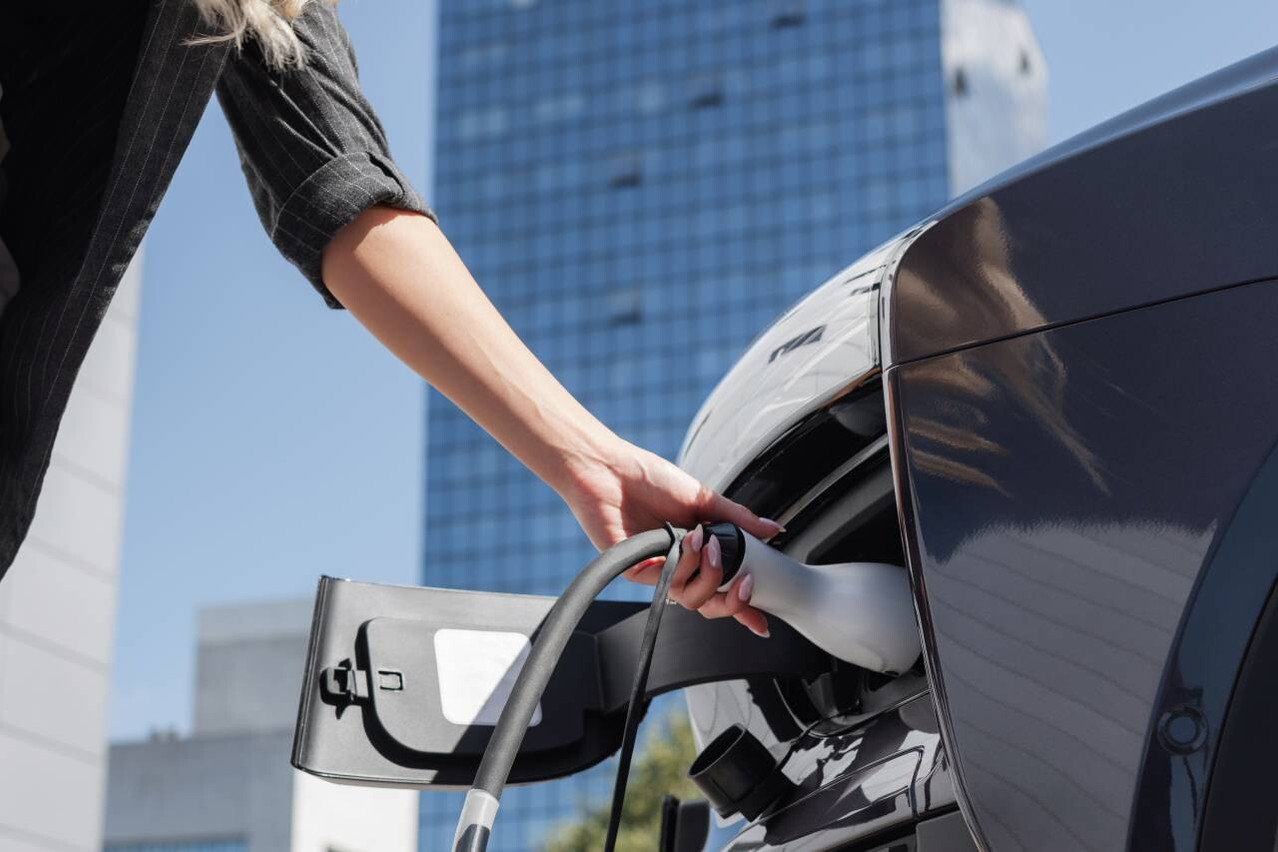
The tax break for certain plug-in hybrid company cars would reduce annual tax revenue by €5 million, according to the proposal’s authors, whose estimate the Chamber of Employees (CSL) cites. The CSL proposes abandoning the tax break and directing more funding towards social leasing instead.
Together with Mouvement Ecologique, it welcomes the principle of the scheme, which the government plans to launch on 1 January 2027. It aims to allow vulnerable households to lease an electric car at reduced monthly payments.
Benefit-in-kind valuation rate would fall from 2% to 1%
The draft Grand Ducal regulation would lower the benefit-in-kind valuation rate from 2% to 1% for plug-in hybrid company cars with official type-approval emissions of no more than 50 grams of CO₂ per kilometre. The proposal provides for this rate during 2027–2030, followed by a rate of 1,5% from 2031, subject to contract and registration dates.
This percentage determines the monthly value of the car’s private use, which forms part of the employee’s taxable income. For the same vehicle, a reduction from 2% to 1% would halve this taxable benefit, without halving the employee’s total tax bill. The proposal would also extend the favourable rates of 0,5% and 0,6% for fully electric cars until the end of 2030, depending on their energy efficiency.
Conflicting incentives, the organisations argue
The CSL and Mouvement Ecologique point out that plug-in hybrids have not qualified for direct Klimabonus Mobilitéit grants since 2022 and are not eligible for the forthcoming social leasing scheme. In its opinion dated 7 October, the CSL argues that the tax reform reopens “a preferential route for vehicles that remain, in actual use, partly dependent on the combustion engine”.
Citing a government response to a parliamentary question, the Chamber reports that plug-in hybrids monitored in Luxembourg produce around 3,5 times their official type-approval emissions. “The environmental value of plug-in hybrids therefore depends above all on their actual use,” it stresses. It consequently proposes examining whether benefit-in-kind valuations could take account of real-world emissions after a period of use, to reflect how much the vehicle actually operates in electric mode.
Redirecting funding towards lower-income households
The CSL describes the €5 million in annual forgone revenue as “a public resource that could be used differently”, particularly to support social leasing. Citing Statec data, the Chamber notes that 8% of employees had a company car for private use in 2018.
It wants tax incentives also to benefit “households for whom switching to electric mobility remains financially out of reach”. It also suggests stricter taxation for the most polluting company cars. The additional revenue could fund social leasing or charging infrastructure.
Broadening access to the scheme
For social leasing, the two organisations want access extended to all households that meet the criteria for the cost-of-living supplement, without requiring them to actually receive that benefit. They also call for cross-border workers to be eligible, the removal of the one-contract-per-household limit, and arrangements that do not disadvantage single-parent families with three or more children.
Their demands also include a larger budget, additional support for charging and transparent calculations to ensure affordable monthly payments.