The last quarter of 2025 confirms a change of era: the Luxembourg property market is no longer overheating, but stabilising. According to atHome. lu, sales prices remain generally calm, rental activity is holding up well, and industry players are talking about a return to "healthier" negotiations, with a better balance of power between buyers and sellers.lu, in its document "Trends in the last quarter of 2025" published this Friday 9 January 2026, based on data from its portal.
On sales, the bottom line is there: older homes are falling back slightly, but not letting go. In the fourth quarter of 2025, existing houses and flats each fell by 0.9% compared with the previous quarter. At the same time, new-build property prices fell even more: by 3.6%, back below the symbolic threshold of €10,000 per square metre. This sends out a clear signal: it is still difficult to justify the new-build premium when uncertainty prevails and financing is still an issue.
A trend confirmed by the latest figures also published on Friday 9 January by Eurostat on house price trends in the EU Member States in the third quarter of 2025. Compared with the previous quarter, prices fell in five Member States and rose in twenty-one. Luxembourg recorded the biggest fall (-3.1%), ahead of Finland (-2.2%) and Slovenia (-1.1%).
Regional differences
The most striking thing is that despite these short-term adjustments, the annual trend remains positive across all segments: +5.5% for existing houses, +3.1% for existing flats and +1.7% for new flats. In other words: the market is slowing down, but not collapsing. It is digesting.
This stabilisation is far from uniform. Regional differences continue to tell different stories. Over one year, the West and the Centre are clearly pulling up the prices of old houses (+6.9% and +6.7%), while the East has fallen sharply (-6.2%). In the case of existing flats, the Centre is up slightly (+1.9%), while the West is down (-1.5%). Luxembourg property remains a patchwork: same market, different realities.
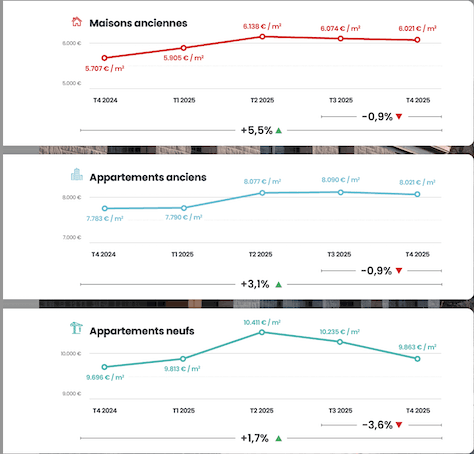
Annual change in advertised sales prices per square metre by region. (Photo: screen capture)
The rental sector, meanwhile, is moving along a ridgeline, but holding its course. In the fourth quarter of last year, rents for houses rose slightly (+1.9%), while those for flats fell marginally (-1.3%). Over a year, the increase remains moderate: +2.7% for houses and +2.2% for flats. Here again, stability, but not homogeneity.
In detail, the West stands out with a strong annual rise in house rents (+11.6%), while the East falls sharply (-10.6%) and the North also declines (-2.5%). For flats, trends are smoother, with increases in the north (+2.3%) and south (+3.2%). The rental market remains "balanced", according to the atHome.lu document, but the differences in tension are shifting and becoming more concentrated.
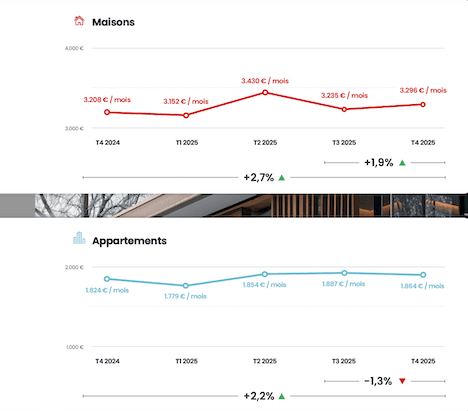
Changes in advertised rents by quarter. (Photo: screenshot)
No flash rebound expected for 2026
Behind these figures, what is really changing is behaviour. Professionals are seeing a gradual return to demand for existing properties, but with buyers taking more time: a longer consideration phase and longer lead times. And there is a clear divide on the buy-to-let market: projects close to completion are attracting buyers, while those with uncertain delivery dates continue to stall. The new-build market is not taking off all at once, but in dribs and drabs.
Another key factor is the end of the government measures that briefly boosted rental investment. As a result, the market is once again dominated by buyers of primary residences, while investors are retreating. For some observers, such as 
For 2026, the scenario that is taking shape is less spectacular, but clearer: activity could remain sustained in existing properties, prices contained, and a slow recovery in new-build property - subject to structural parameters such as financing, land and supply policies. We don't expect a lightning rebound, but a gradual normalisation. And above all, the return of a criterion that had all but disappeared during the euphoria: the actual quality of a property - location, age, standard of construction - is once again a determining factor in price.