The consumer continues to see shop windows, sometimes more than before. New shops are opening, others are closing, and retailers are changing. At first glance, the offer seems abundant, even dynamic. However, the data from the Retail Report 2026 show that this impression masks a deeper transformation: the retail offer is not expanding, it is becoming denser.
At the end of the third quarter of 2025, the total sales area of the stores studied reached around 1.09 million square metres. On a per capita basis, this represents 1.58 square metres per inhabitant, the lowest level observed since the launch of the Retail Register in 2019. At the same time, the number of sales outlets continues to rise, with an increase of 1.1% in the retail sector and 3.4% in the on-trade over the last twelve months. Consumers are therefore faced with more shops, but in a more constrained space overall.
This contraction has a direct consequence on supply. Smaller surfaces mean shorter assortments, a reduced depth of range and a selection more focused on fast-moving products. The Retail Report is not talking about a decline in the number of stores, but about a change in model: retailing is developing through fragmentation rather than expansion. For consumers, this means a tighter offer, where the best-selling references take precedence over diversity.
"The Retail Report 2026 confirms that retail is evolving in a rapidly changing environment. These changes require us to continually adapt our framework for action. Our priority is to support businesses in a targeted way, in particular through aid aimed at accelerating digitalisation and the adoption of artificial intelligence, via SME Packages, the Fit4 programme and the Luxembourg - AI Factory, among other things, but also through support for innovative commercial concepts and by simplifying administrative procedures to ease the burden on SMEs. Our aim is to ensure that commerce is modern, competitive and firmly rooted in our territories," said Economy Minister Lex Delles.
The illusion of choice
The most dynamic sectors clearly illustrate this development. Since 2019, food retailing in the broad sense has grown by 18.9% in terms of the number of outlets, while hard-discount sales areas have increased by 39.4%. This growth has been concentrated on standardised formats, designed for efficiency and speed. It has not led to an equivalent increase in retail space per inhabitant, but has contributed to a densification of the offer around comparable products and very clear prices.
For the consumer, this densification creates a form of illusion of choice. There are many shops, but their offerings tend to be closer together. Under pressure from local competition and limited floor space, retailers are focusing on tried and tested ranges, reducing the space available for niche products or more specialised references. The choice is still there, but it is shallower and more interchangeable.
The faster turnover of shops is another direct consequence of this development. The Retail Report 2026 shows that the growth in the number of establishments is not being accompanied by greater stabilisation of the retail fabric. Smaller, less capital-intensive formats are easier to open, but also more fragile. For consumers, this means more frequent brand changes, a less sustainable offer over time and a gradual loss of landmark stores, even when retail cells remain occupied.
This transformation of the offer is reinforced by demographic pressure. Since 2019, the population of the Grand Duchy has increased by almost 10%, a rate higher than that of the expansion of retail space. This means that every retailer has to capture the attention of a more demanding consumer, in a denser and more competitive environment. Here again, the effect is not a visible scarcity of shops, but a silent intensification of competition for an increasingly standardised offering.
Instant consumption
Town centres are a particularly good illustration of this phenomenon. While retail activity there remains stable overall, the share of retail trade has fallen from 37.5% in 2019 to 32.2% by the end of 2025, to the benefit of services and hospitality. For consumers, this means fewer places dedicated to buying goods and more spaces geared towards immediate consumption. The offer is moving, not out of the city, but towards quicker uses and less focus on product diversity.
The Retail Report 2026 therefore does not describe a trade in decline, but a trade under constraint. For consumers, the issue is not the disappearance of shops, but the transformation of what they actually offer. More shop windows do not necessarily mean more choice, but often a more compact, standardised and unstable offer. This silent shift is redefining the everyday shopping experience, without always being perceived as such.
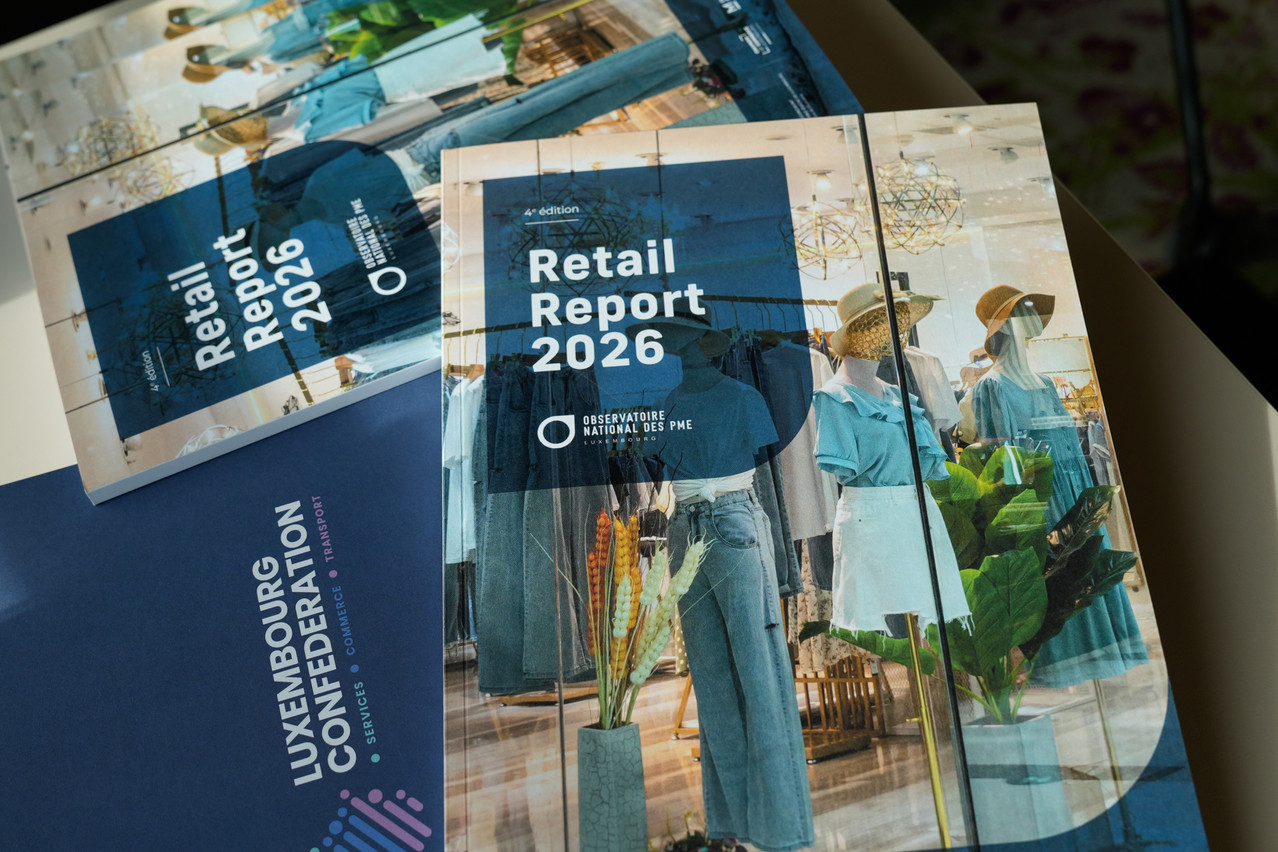
“The RetailReport is a key resource for understanding the evolution of retail in Luxembourg. It provides structured analyses and strategic lessons that are essential for guiding the sector’s future actions. Complementing the Retail Register, it provides precise figures on the development of the retail fabric, regional dynamics, consumer trends and the structural changes underway. Together, these tools provide a solid factual basis to inform decision-making, strengthen the competitiveness of Luxembourg commerce and support its transition in the face of economic challenges", commented Tom Baumert, President of the GIE Observatoire national des PME and CEO of Luxembourg Confederation,