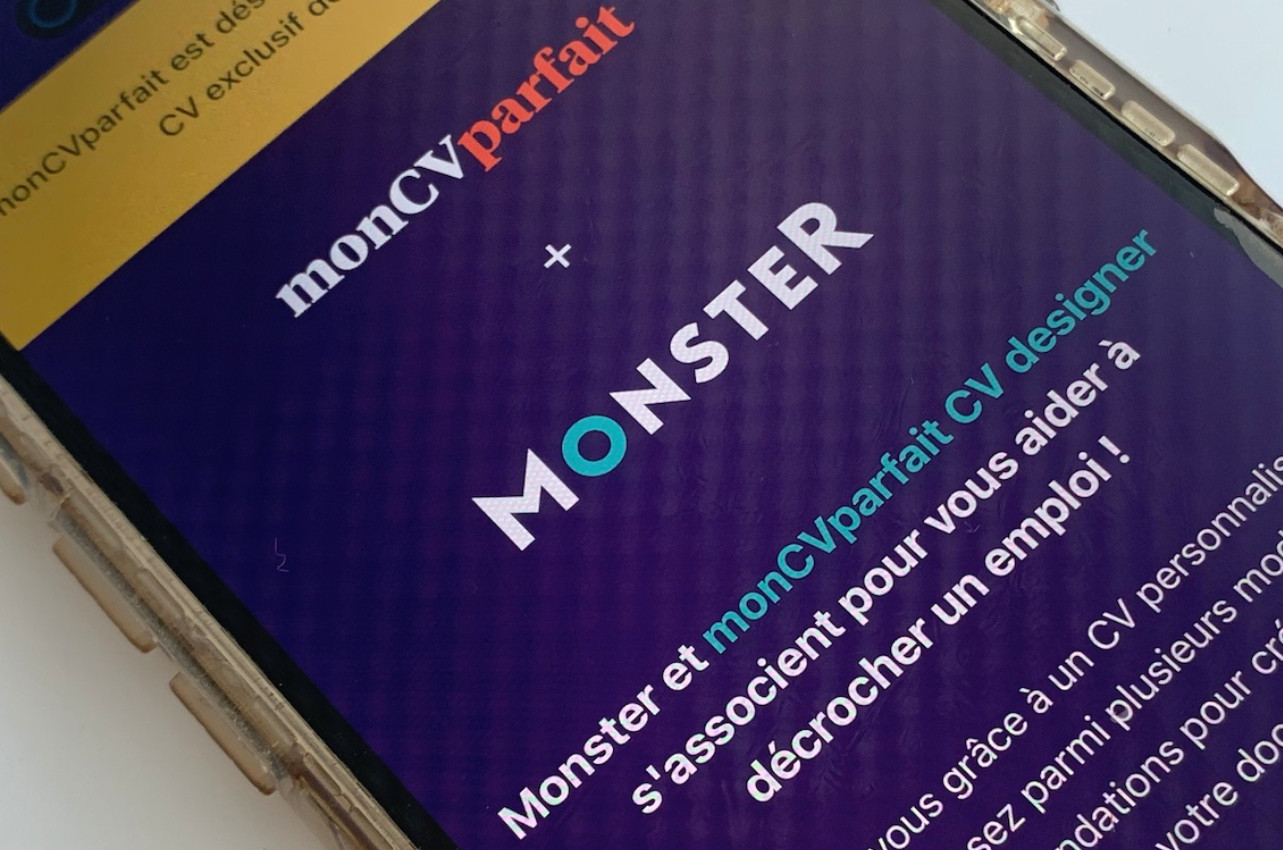
Where a certain French president, Emmanuel Macron, was inviting people to cross the road to find a new job, the late 1990s and early 2000s had marked the arrival of new players to be able to stay at home... and still find a new challenge. Monster and CareerBuilder were pioneers and leaders in online job hunting in the late 1990s and early 2000s. Monster.com, founded in 1994, had even become a household name, popularised by landmark campaigns (including adverts shown at the Super Bowl) and symbolising the rise of internet job boards.
Faced with declining relevance and growing financial difficulties, Monster and CareerBuilder attempted to join forces to survive. In September 2024, the two companies merged into a joint venture called CareerBuilder + Monster, owned by US investment fund Apollo Global Management and Dutch recruitment group Randstad. The alliance between Apollo (which has owned CareerBuilder since 2017) and Randstad (which has owned Monster since it was acquired in 2016 for $429 million) was aimed at creating a new champion of online recruitment. Between them, the 20th and 21th global platforms according to Sia, could have dreamed of getting closer to the giants of the sector (Linkedin $8.6 billion in revenues, Recruit Holdings owner of Indeed, Glassdoor, or StepStone via Axel Springer, includes Totaljobs, Jobsite, $1.60 billion).
But less than a year later, the company resulting from the merger declared bankruptcy in the United States. On 24 June 2025, CareerBuilder + Monster filed for Chapter 11 bankruptcy protection (restructuring proceedings) and announced its intention to sell its assets to pay off its debts.
In documents filed with the Delaware bankruptcy court, CareerBuilder + Monster then revealed the extent of its financial difficulties: only $50 to $100 million in assets for $100 to $500 million in debts according to Reuters. The company said it had secured temporary financing of $20 million to continue its operations during the proceedings. CEO Jeff Furman explained that the company has faced "a difficult and uncertain macroeconomic environment" and believes that a court-supervised sale is "the best way to maximise the value of our business and preserve jobs". Furman and the new owners point to unresolved long-term challenges: the heavy debt inherited from CareerBuilder, as well as increased competition from other online job platforms such as Indeed, ZipRecruiter or professional social networks.
Auction: Monster bought for $28 million
After the declaration of bankruptcy, an auction process was quickly set in motion under court supervision. Initially, the company had already identified potential stalking horse bidders for its various divisions: in June 2025, CareerBuilder + Monster announced a provisional agreement to sell its main job board business to JobGet, a start-up specialising in gig economy jobs, as well as its software services division for public administrations to the Canadian company Valsoft, and its media websites (such as Military.com and Fastweb.com) to the Canadian group Valnet. However, these initial bids were only a starting price: they could be outbid by other bidders at the auction held in July.
This is precisely what happened for Monster's core business. In the final auction, a new player took the prize: US company Bold Holdings won the acquisition of job boards Monster and CareerBuilder for 28 million dollars, almost four times the original bid. By way of comparison, JobGet, the initial bidder, had to push its bid up to $27 million but remained second on the list of potential buyers. Bold Holdings, the surprise winner, is a company founded by former Monster.com employees that already owns several online employment-related services (CV and cover letter creation tools, AI-assisted job search platforms, etc.).
At the same time, other CareerBuilder + Monster assets have also found buyers. The portfolio of websites Military.com (information portal for military personnel and veterans) and Fastweb.com (scholarship platform) will be sold to the Valnet Group for 27.25 million dollars, while the HR software division for governments (Monster Government Solutions) will be sold to the Sherrill-Lubinski LLC & Eti-Net Inc. consortium for 13 million dollars. In total, the company resulting from the Monster-CareerBuilder merger should reap around 57 million dollars from these asset sales, an amount higher than the 35 million envisaged at the start of the procedure. However, these proceeds will remain modest given the company's accumulated debt (almost $392.5 million owed to creditors). Above all, it illustrates the massive devaluation of these former giants: for the record, Randstad paid $429 million in 2016 to acquire Monster alone, while in 2025 the combined Monster + CareerBuilder is being sold off for a fraction of that price.
Bold Holdings, the purchaser of the job sites, has undertaken to retain some of the workforce in order to ensure continuity of service. Under the agreement presented to the court, Bold will take over 350 CareerBuilder + Monster employees out of the 935 the company had when it filed for bankruptcy. However, this redundancy plan in the US means that around 60% of current employees will lose their jobs. Management has acknowledged having to make "difficult but necessary decisions to reduce costs", including redundancies, in order to facilitate a smooth transition of operations to new owners.
European consequences: sites cut, Monster.lu goes out of business
While a partial solution has been found for Monster's US operations, the fate of its international operations - particularly in Europe - remains in doubt. No buyer came forward at the auction for Monster's foreign subsidiaries, which augured the worst for the company's offices and websites outside the US. CEO Jeff Furman informed his employees that "no buyer came forward for our international business operations" during the process, saying that the company would explore options for those entities that remained without a buyer. In reality, in the absence of a buyer, the parent company had no choice but to abruptly suspend operations in Europe.
On 30 July 2025, all of Monster's European websites were deactivated. Monster has 'paused' all its services in Europe: in fact, local sites such as Monster.fr, Monster.de, Monster.be - and of course Monster.lu in Luxembourg - have no longer been accessible since 30 July 2025. This technical closure has been presented as temporary, but with no known timetable for reactivation, which in fact amounts to a pure and simple extinction of these online outposts. For European users and customers, this means that it is suddenly no longer possible to consult or publish offers via Monster in their countries, with traffic being interrupted and the sites returning error messages or remaining unreachable.
Behind the shutdown of the sites also looms a social drama for Monster's European teams. Around 200 Monster employees in Europe will be directly affected by the closure. Unlike their American colleagues, some of whom will be taken over by Bold, these European employees face considerable uncertainty. This is because Bold Holdings has not included Europe in its takeover scope: the 350 retained jobs announced relate solely to Monster/CareerBuilder's North American business, with no European employees being taken on by the new buyer.
Monster's local entities (in France, Germany, Austria, Italy, Luxembourg, etc.) should therefore be put into liquidation, as they are unable to operate independently. Partner Randstad, which held 49% of the Monster-CareerBuilder joint venture and historically managed the European branches, has so far declined to intervene to save these subsidiaries. As a result, Monster's European teams have been left out in the cold, with only the hope of possible compensation or a last-minute buyer for certain countries - a scenario that, at this stage, remains highly unlikely.