Adem director 

This deceleration is accompanied by a rise in unemployment. After remaining relatively stable in the first half of the year, the unemployment rate reached 5.9% in December 2024 (+0.4 points over one year). Statec projections predict that it will remain at this level in 2025, before falling slightly to 5.9% in 2026. In May 2025, unemployment was holding steady at 6%.
A sign of persistent tension, the number of jobseekers rose in all age categories, with a marked increase in profiles with higher education qualifications (+16.6%) and people registered for more than 12 months (+15.4%). At the end of the year, Adem counted 19,532 jobseekers (an increase of 7% over one year) for just 5,935 vacancies.
Schlesser notes: “Last year, more than 40,000 people registered with Adem. It’s not always the same people; there’s a constant coming and going.”
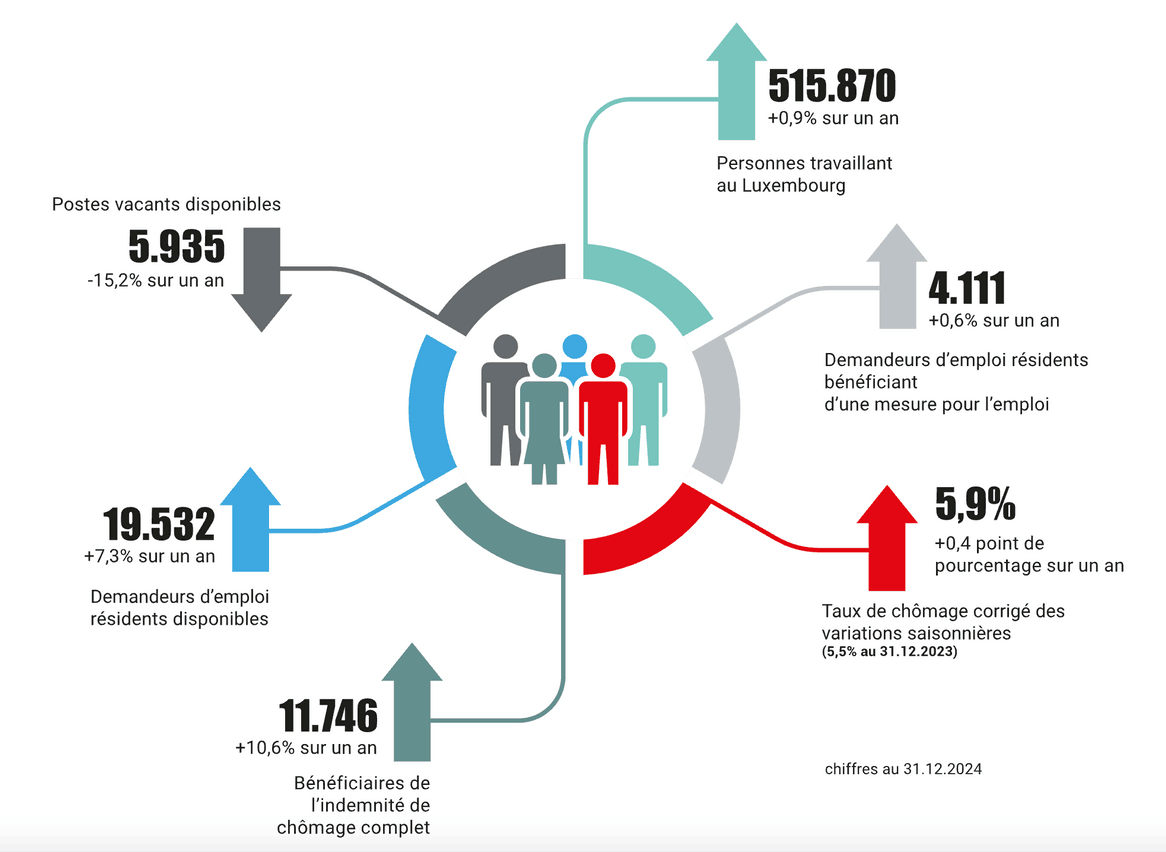
Key figures for 2024 for the Luxembourg job market. Image: Adem
The profiles most affected are people aged over 45, young people with no experience, and more and more higher education graduates (+16.6% over one year). Nearly 40% of resident jobseekers in 2024 had been registered with Adem for more than a year. Conversely, only 30% had been registered for less than four months. This breakdown shows that long-term unemployment is becoming increasingly entrenched, with a large proportion of people struggling to re-enter the labour market on a long-term basis. The number of claimants registered for more than 12 months also rose sharply (+15.4%).
A persistent imbalance between labour supply and demand
The rise in unemployment does not mean that all companies are finding the profiles they are looking for. The gap between available skills and market needs remains yawning. In 2024, 22 occupations were classified as being in “very short of supply”: IT, accountancy, health, social work and building trades are at the top of the list.
On the other hand, some sectors are suffering from an excess of applicants: secretarial work, industrial cleaning, road transport or mass distribution. This mismatch is fuelling a skills gap that companies are struggling to fill, despite the growing number of jobseekers.
In 2024, 36,707 vacancies were declared to Adem, including 32,240 ordinary jobs, 2,290 temporary jobs and 2,177 subsidised employment measures. This volume represents a fall of 5.9% compared with 2023. At the end of December, the stock of vacancies still open stood at 5,935, down 15.2% year-on-year. Although notification is legally compulsory, only around 25% of actual recruitments are actually notified to Adem. This reflects a structural discrepancy between the actual job market and the official statistics. Despite this, the report states that 142,040 recruitments took place in 2024.
Schlesser pointed out, “the paradox is that we have qualified IT specialists unemployed, even though some companies are still looking for them.”
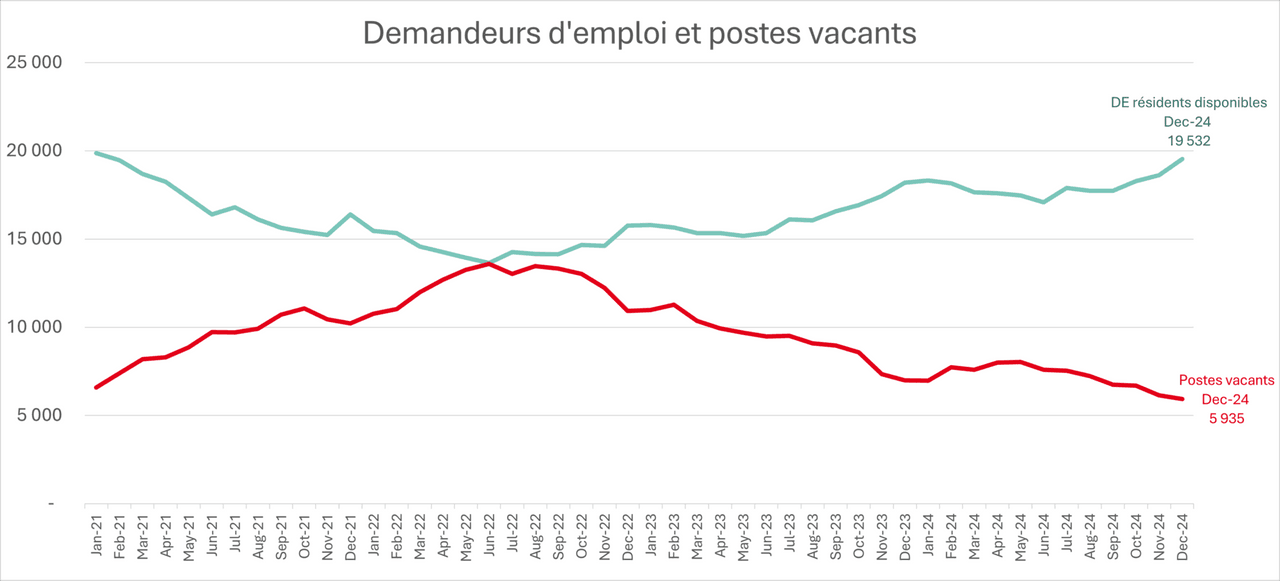
The jobseeker rate continues to rise in contrast to the vacancy rate. Graph: Adem
The director of Adem also mentioned the growing impact of artificial intelligence, which is changing the demand for skills without a clear consensus emerging in companies. “Some no longer need traditional developers. Others, on the contrary, are still actively looking for these profiles.”
A targeted response: train, anticipate, digitalise
To meet these challenges, Adem has stepped up its efforts on several fronts. In 2024, more than 14,000 training participations (including 9,170 jobseekers) were recorded. Language courses, digital skills training and sector-specific schemes--particularly in low-carbon construction--have been stepped up. Adult learning is also seeing an unprecedented surge, with more than 1,000 people engaged in this type of pathway. This is in line with the framework of a partnership with the UEL, renewed for 2024-2027, which aims to bring training and practical needs even closer together.
The goal: to prevent people from falling into unemployment or remaining there for long periods. For the labour minister, a change of approach is needed. As Mischo said, “the challenge is no longer just to support jobseekers, but to intervene further upstream, in the companies themselves.”
The cooperation between the ministry and Adem is also intensifying on international recruitment, via the list of shortage occupations. In 2024, 4,000 certificates were issued to enable the hiring of talent from outside the European Union, particularly in the tightest sectors.
Adem’s transformation is also digital, with fewer branches across Luxembourg. A new digital portal allows jobseekers to consult and filter training courses online, and soon to submit their entire claim for unemployment benefit via MyGuichet. For people less at ease with digital technology, “e-Adem spaces” have been set up in the country’s three branches (Hamm, Esch-Belval and Diekirch) with staff dedicated to providing support.
This article was originally published in French.