In 1955, at the height of his fame, Marcel Pagnol was commissioned by a major women’s magazine to write a serialised account of his childhood. As he wrote, the child he once was began to emerge. From this dialogue between two stages of life, Sylvain Chomet, director of “Les Triplettes de Belleville” and “L’Illusioniste”, has crafted a meditation on memory, which was screened at Cannes in May 2025, then at Annecy, and released in France last autumn.
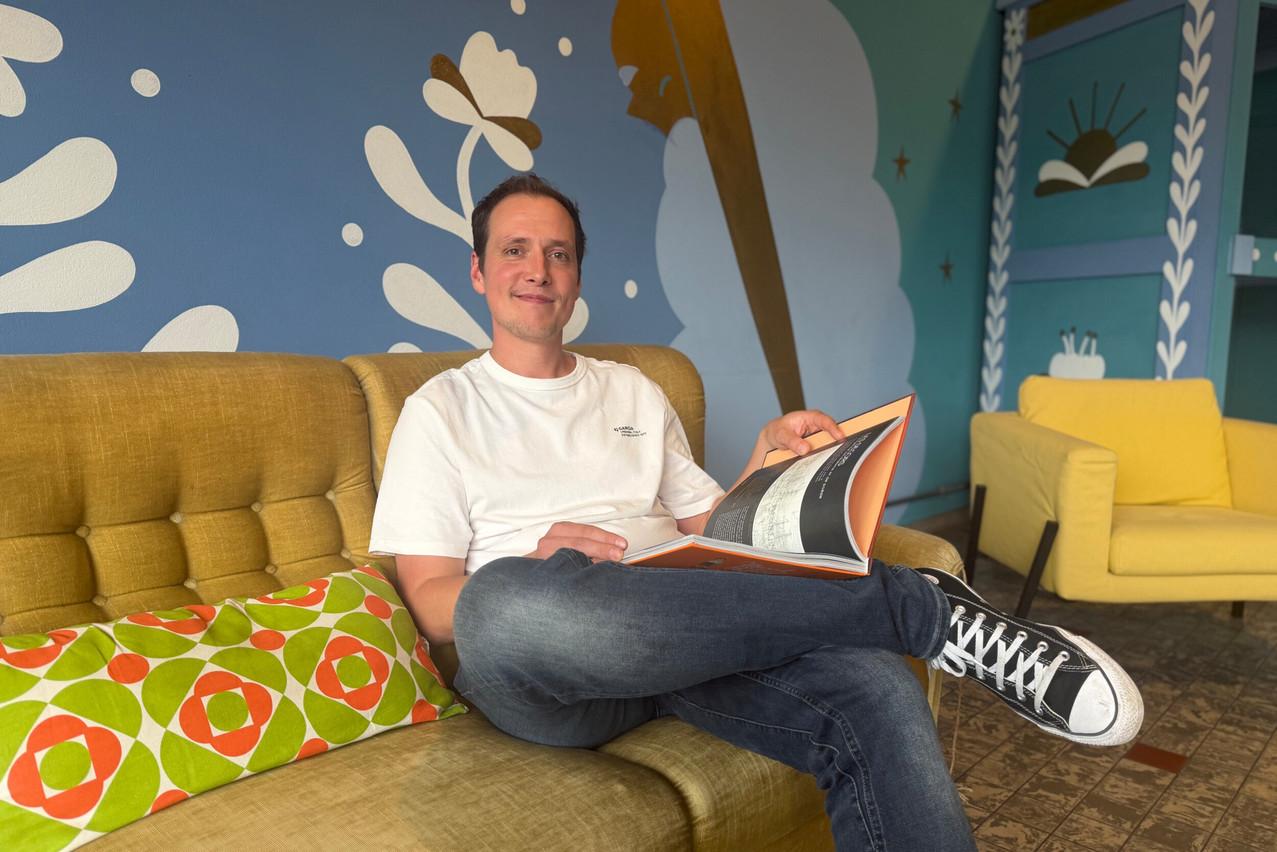
Distributed in Luxembourg by Tarantula Distribution and produced here by Bidibul Productions with the support of the Film Fund, this Franco-Belgian-Luxembourg co-production owes a great deal to Doghouse Films, based at the 1535° Creative Hub in Differdange, which created some of the sets and animation. François Spreutels supervised the colour set design there. Having arrived in Luxembourg in 2017 after stints in Paris, Angoulême and Belgium, he spent 20 months on this film, creating a Provence that none of his team were from.
You’re a colour supervisor. What does that actually involve?
François Spreutels. – “That’s what lies behind animation, behind everything that moves. Think of the old Disney films, with celluloid: the characters were drawn on transparent sheets, and everything that was painted behind them formed the backdrop to the film [the environments, the sets]. I’m in charge of the colour work. The reason the job is broken down into such specific parts is because it’s an industry and we’re trying to make each stage cost-effective. First there’s the script, then the storyboard – a sort of comic strip version of the film, shot by shot. All of this is put together into an animatic, which helps to work out what needs to be produced, and thus to secure funding for the film. Then, just like on an assembly line, each stage slots into the next: first the line art backgrounds – what we call the “layout” – then the coloured backgrounds, which are produced in parallel with the animation.
Assembly-line work, then?
“A little, but whilst retaining an artistic touch. Nothing is automated. We paint everything ourselves. For Pagnol, all the sets were drawn by hand, using Photoshop and a graphics tablet. I’ve come across people who, seeing me working on a computer, thought that everything was automated and that I wasn’t actually doing anything. Whereas I’m actually drawing.
How much work does a film like that involve?
“Twenty months, and around 800 sets. The film is divided into sequences, and for each one, we get a reference approved by Sylvain Chomet – which sets the mood, the lighting direction and the colour palette. We can then divide the work amongst the team, with everyone working on their own sequence. We produced around 200 reference images. In production, a standard set takes eight to ten hours to create. Research can take up to 20 hours, because when you’re researching, you make mistakes, and making mistakes takes time. If the project took 20 months, it’s also because the full team only worked for five months. The rest of the time, there were just the two of us.
In an arthouse film with such a distinctive style, how much leeway does a studio like yours have?
“It was a bigger job than usual on this film. When we started, nothing had been done in colour at all. Sylvain Chomet focused mainly on the linework because he pays a great deal of attention to that in his films. He’d already worked on ‘Les Triplettes’ and ‘L’Illusionniste’ in terms of colour, but he had different ideas this time round. So we put forward a whole host of ideas, carried out all the visual research, and interpreted his requests.
In a co-production in Luxembourg, […] we’re really just one link in the chain. With the Pagnol project, we were actually able to play an artistic part.

Usually, we have a colour script – a sort of colourised storyboard that sets out all the moods of the film. In this case, we didn’t have one. That’s quite unusual: in co-productions in Luxembourg, we usually receive a concept that’s already very well developed, and we tend to be more of an executor in the chain. On the Pagnol project, we were really able to play an artistic part, under the guidance of the Paris team and the production designer, Sébastien Morin. It was stimulating.
Part of the film is set in Provence. How do you recreate that light when you’re working in Differdange?
“Sylvain Chomet wanted brighter colours than in his previous projects, and much more detail, because Pagnol’s life was meant to be teeming with life. We started with a reference he’d given us: the colour palette from ‘101 Dalmatians’. He was also keen to ensure it wasn’t a sad film. The real challenge was to distinguish between Paris and the South of France: the intention was to depict a cold Paris and a warm South. Lots of orange and blue, tiled roofs, and a slightly vibrant light. And we had to achieve this even though nobody on the team was from the South.
Not worried about the postcard?
“Not particularly, because it’s intentional. We play with it. The yellow hues, the bright light, the olive trees, the game of pétanque. It’s the same for Paris: the Eiffel Tower, Gare de Lyon, a church at night. It immediately puts the viewer in the right frame of mind. And animation is precisely what allows us to play with all these elements. It also enables us to tackle very difficult subjects and make them accessible to a wider audience.
The inevitable question: where do you stand on artificial intelligence (AI)?
“We don’t have any productions featuring art created by AI, and that’s not something we’re planning at the moment. Instead, we’re working on arthouse films and socially conscious films: it’s difficult to address environmental issues or humanitarian crises in a film made using AI. What would suit us would be for AI to take care of the technical tasks: cutting out sets, exporting files, naming layers, and upscaling textures. However, at the moment, it’s the AI that would create the image and we’d be the ones having to clean it up afterwards. Artistically speaking, that doesn’t appeal to us. It also struggles with continuity and with a truly personal colour palette: in the films of a director like Sylvain Chomet, that’s a challenge. And what bothers me most is having to hand over control of an entire production pipeline to someone outside the studio.
The aim is to bring our own productions with us, with the idea that Doghouse will be the parent studio and Luxembourg the main production studio.

You’ve worked in Paris, Angoulême and Belgium. What keeps you in Luxembourg?
“It’s the only place where high-quality projects have come one after another. You can stay in the same place without having to wait six or seven months between films. In France, the animation industry slowed down after the Covid boom, and there are a huge number of schools, meaning a huge number of artists are graduating every year, whilst the number of jobs hasn’t changed. Here, a dynamic is taking shape: we’re working with Germany, the Netherlands and Belgium, and the next film will be made with Denmark. Funding is now available for pre-production within the Benelux region. We’re creating a somewhat alternative hub, without the major countries. And there’s a desire to bring our own productions to the table, with the idea that Doghouse will be the parent studio and Luxembourg the lead production studio.
After spending 20 months on it, do you still want to see it?
“I saw it in Annecy, but not yet with my team, who weren’t there. So yes, I’m really pleased it’s coming out and that we’ll be able to watch it together. You never forget, anyway; you remember all the films. The risk in an artistic profession is that your work becomes your passion. The relationship becomes ambiguous; you have to be able to switch off when you get home. It’s a question of balance.”