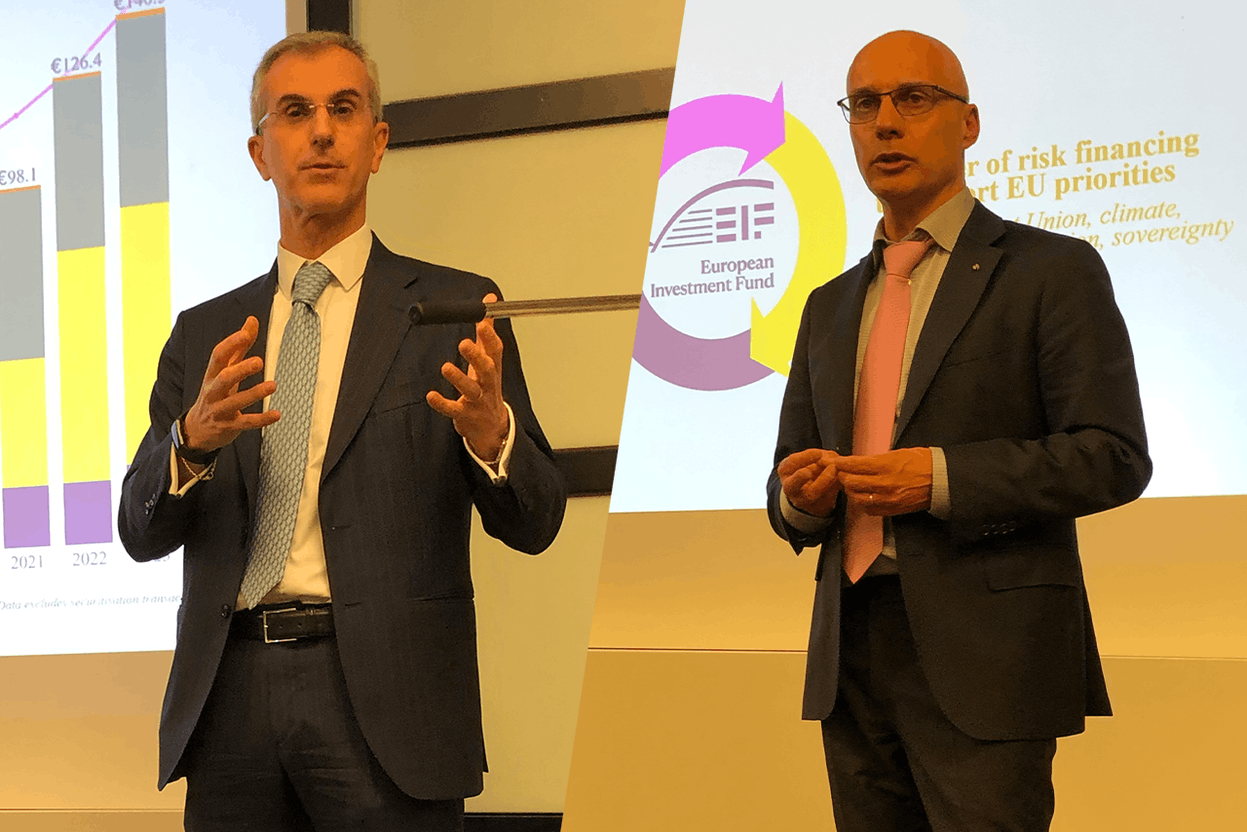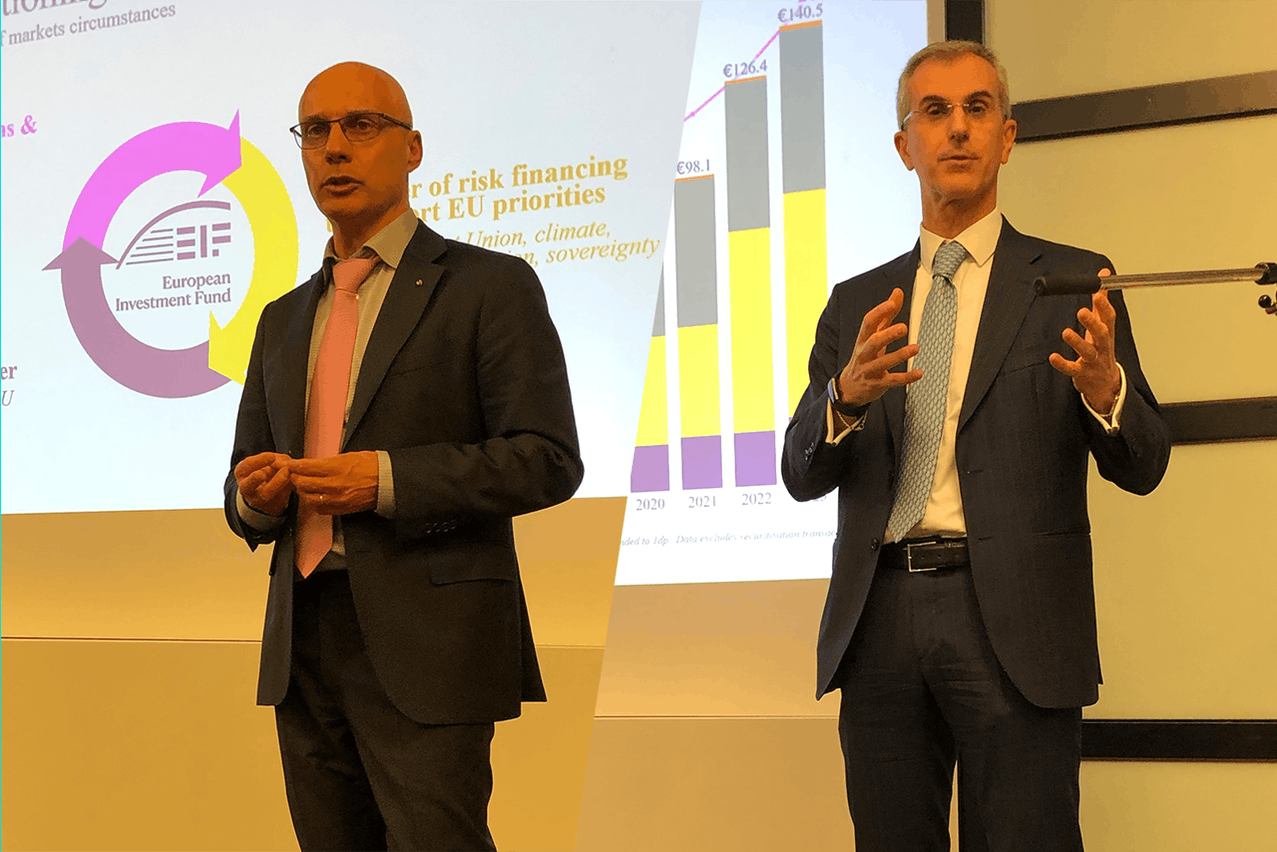
Marco Natoli, head of sustainable growth and investments at the European Investment Fund, commented that the EIF’s shareholding (European Investment Bank: 59.8%, EU: 29.7%, 38 financial institutions: 10.5%) reflects the public-private partnership nature of its mission. It also supports the “very strong credit rating” of the fund which is crucial for the “guarantee” business.
Natoli was speaking at a CFA Society Luxembourg conference late last month.
Leveraging up capacity
Natoli explained that financial resources of the EIF (€140.5bn through 204 mandates) come mainly from the EU and then the member states of the European Union, the EIB and private institutional investors. Their financial support is boosted by a multiplier effect (five to one, on average) as they provide a portion of the money (one euro) invested by the intermediaries (fund managers) which raise additional funding from other market participants (four euros).
Its 204 different products carry different policy objectives and return requirements dependant on risk appetite.
Given the “bank’s perceived higher risk of small companies,” the EIF boosts its support by providing guarantees “in exchange for the commitment by the intermediaries to lend to the beneficiaries with better terms,” stated Natoli. The guarantee “covers, to a certain extent, the performance of the portfolio.” The guarantees are designed as either a full first-loss coverage, a proportional loss sharing scheme or to cap or uncap losses.
On the securitisation side, a portfolio of loans can be structured with tranches displaying different levels of risk with an EIF guarantee on the riskiest tranches while the less risky tranches are left in the hands of the intermediaries.
The risk position of the EIF can sometimes be upside down. Natoli explained that this is the case with private credit funds where the first loss tranche will be covered by their clients while taking EIF will take the lower risk tranche. This enables the EIF to increase the total investment capacity.
On the private equity side, the EIF simply acts as a conduit to invest directly in funds managed by intermediaries (sometimes not accessible to some institutional investors) which are also raising cash from the private sector to invest in different strategies, such as in venture capital, private credit, private debt and infrastructure.
Going big on ESG but maybe not as first mover
Initially managed by the EIB, greenfield sustainable infrastructure projects were recently transferred to the EIF and increased six-fold in two years while it is expected to grow two-fold again this year. More generally, Natoli noted that the EIB and the EIF plan to have 50%+ of their businesses link to climate actions.
It is very difficult to make investors understand that if you have money to allocate, this is exactly the moment [to invest]
Moreover, Natoli explained that the transition will occur through more investments in “human capital, through upskilling, to reskilling… and the measurement of the impact of their actions.”
Impact of high interest rates on EIF funds
Natoli noted a reduced investment appetite on riskier strategies (“venture capital is almost impossible”) that is confirmed by the lowest fundraising since 2008. He observed that investors are rather focusing on private credit and on “optimised return infrastructures” whereas the interest on private equity “depends on the perceived level of risk.”
Given the recent valuation adjustments, “it is very difficult to make investors understand that if you have money to allocate, this is exactly the moment [to invest],” said Natoli. Moreover, the incumbent institutional investors are also under a cash squeeze given the “delayed pace of repayments that we're seeing in the last few years due to the lower exit activity.”
Besides, Remi Charrier, head of institutional client relationship at EIF, noted that European investors are confronted with several restrictions such as a limited allocations to the alternative sector. “When you talk to North American investors, they are focused on absolute return, there’s a moment to invest and there is a moment to divest... that is the only way they play,” Charrier stated at the same CFA Society Luxembourg conference.
Natoli calculated that around 50% of the value created in the portfolio is “through bottom line increases” and the other 50% reflects the difference between the exit and the entry “Ebitda multiples,” which he did not define. He believes that the “Ebitda multiple” is the “most representative indicator to price the value of a company.” A greater multiple at the exit may, among other reasons, reflect a “strategic repositioning of the company--moving from #15 to #2 position in its industry.” He stated that “2% of the value created comes from leverage.”
Consequently, Natoli thinks that this focus (value creation) makes their companies “much more resilient in the longer term to economic cycles.” Despite the down pricing readjustments of the last two years, “private equity portfolios across all strategies have grown by 8% in 2022” and he stated that it has continued to grow in 2023 (figures not published yet).
Where has gone the leverage?
Delano questioned Natoli about leverage moving out of banking system into less visible part of the financial system because of the bank disintermediation. He recalled a “massive number of defaults among investors” who had investments in private equity and venture capital funds during the global financial crisis in 2008.
These investors “committed money, but they could not hold on their payments [on cash calls].” Natoli thinks that they may have been overexposed coupled with an excessive leverage to these funds.
He thinks that this is not happening in the “current crisis” as investors “understood better how to avoid overexposure, and to be more realistic on what they can do.” This is reflected in the limited number of default (“less than a handful over 1,000 investors”).
However, the “lack of repayments or the slowdown in repayments impact the projections of investors” and is resulting in a “slowdown in the pace of new commitments” for the sector.
Yet not all is blue sky. Natoli observed that some GPs decided to “recapitalise” some of their funds, also called “fund portfolio recap”, with loan facilities. The goal is to “accelerate cash repayments to investors,” to improve their cash position and DPI figure and to ease the next fundraising. Given the recent history, he admitted that it “can create dangerous overexposure.”
He noted that these financial operations used to be a rarity not later than 5 years ago. “Nowadays we receive one per week, and honestly, out of 10 that we receive, possibly only one of two are really justified by the circumstances of the fund while the rest would expose them to excessive risk.”
Consequently, the leverage that is building up in the funds is “very visible” to the EIF. Therefore, the vote of the latter would not necessarily steer the final decision, but the EIF plays an “influential role.”
“So, we need to be vigilant on the way the excessive leverage is materialised into the system,” concluded Natoli.
This article was published for the Delano Finance newsletter, the weekly source for financial news in Luxembourg. Subscribe using this link.