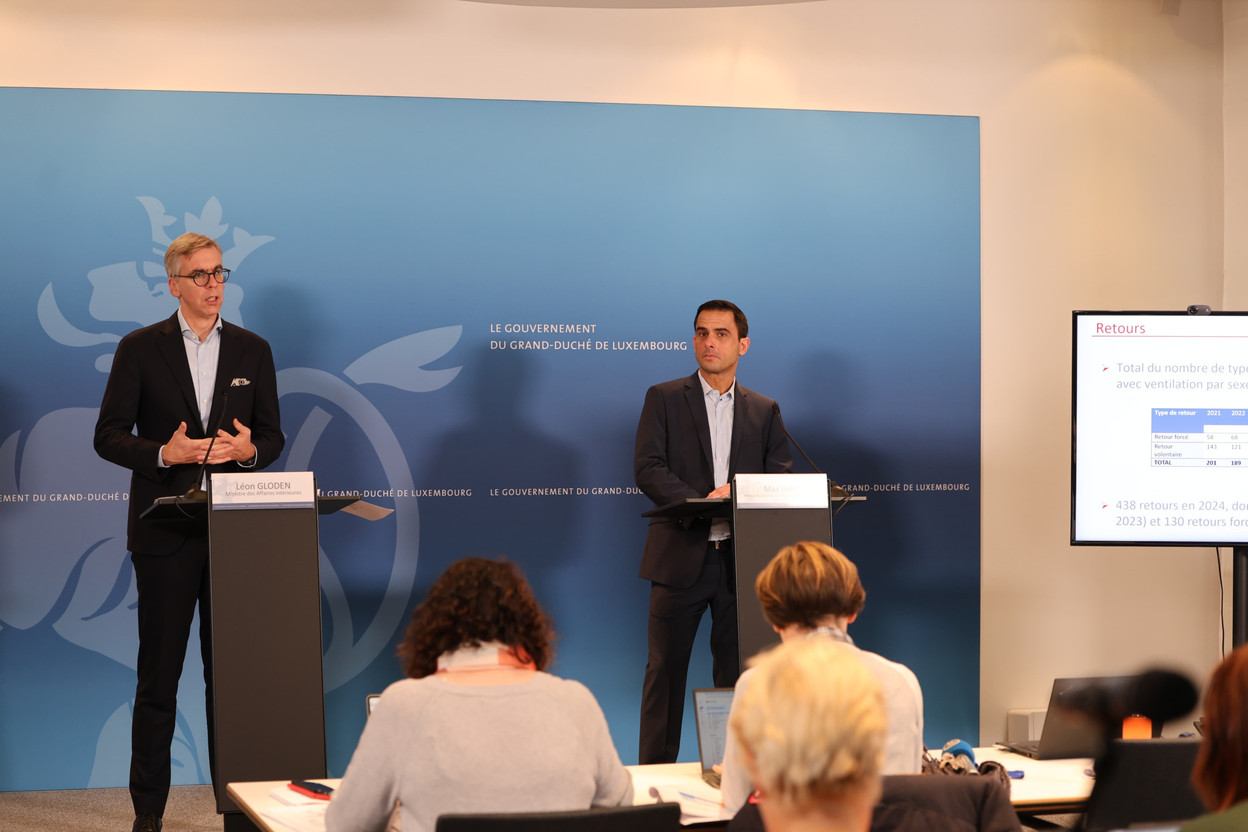
Interviewed by the Financial Times on border controls operated by Germany, you express criticism of Berlin and the European Commission. What is the state of play on this issue, which you have taken to heart?

We submitted draft bilateral treaties on police cooperation and immigration to the Commission in July, but we haven’t had any feedback yet. I think that these agreements provided for in the Schengen Treaty could serve as models for the European Commission and avoid similar problems in the future. It’s a long-term project.
What exactly is Germany criticising Luxembourg for? Is Luxembourg really a transit route for illegal immigrants? Do the German authorities give figures?
“They give figures for the number of illegal immigrants passing through Luxembourg. These figures are impossible to verify, because when the German police turn someone away, this does not trigger any reception procedure on our side. The person concerned turns back and crosses into Germany via another border. From what I’ve read in the press, it seems that the German authorities are finding it difficult to deal with this problem overall, even though they claim that illegal immigration figures are falling. Luxembourg is not the first country to be targeted by Germany’s measures. This is a purely domestic political problem to counter the rise of the AfD. We are suffering as a result, which is a pity.
I’ll say it clearly: the European Commission is not fulfilling its role as guardian of the treaties.

Germany is not the only one at fault. Let me be clear: the European Commission is not fulfilling its role as guardian of the treaties. I am in regular contact with the Commissioner for Home Affairs and Migration, Magnus Brunner, who tells me that the Commission is working on the issue. But there is no progress. Sometimes I get the impression that the big countries carry more weight than the small ones... There is hope, though: if the Pact on Migration and Asylum comes into force in June - we will be discussing this at the JHA Council - internal border controls will be much harder to install and I hope that this problem will be a thing of the past.
If, in the meantime, the situation does not improve, or even worsens in the future, could you consider taking the matter to the European courts?
“This is a question I am regularly asked. And the government’s position is clear: we have no intention of taking the matter to the Court of Justice of the European Union. Germany remains an important political and economic partner with whom we share many positions in many areas, particularly on immigration. Between friends, there can always be points of disagreement. That’s why it’s important to keep talking to find solutions. And these solutions are bilateral treaties.
Could Luxembourg take charge of these controls in order to provide the resources to put an end to the nuisance for border workers?
“Taking charge of these internal border controls would be tantamount to accepting them. It is against the spirit of Schengen and we will not do it. On the other hand, we have set up mixed patrols on trains and motorways. Flexible rather than stable controls, which help to avoid problems. We’ve seen this with Belgium and France. I say it every time: we are always willing to cooperate, but we are against static border controls.
I also believe that efforts must be made to better control external borders. The Member States must make greater use of existing mechanisms such as EES [the European entry and exit system], the results of which are very positive. The system works well. Since 12 October, we have carried out 26,625 registrations, a registration rate of 82.38%. Of these, 92% used biometrics. This means that the system is already performing very well. During this transitional phase, if the data recorded is not complete, the passport will continue to be stamped. It will be definitively abolished in April 2026.
If it’s just a matter of sending [the migrants] home, that won’t solve the problem and they’ll come back here or elsewhere.
Finally, I repeat, we need to review the visa policy. There are far too many third-country nationals arriving in Europe and Luxembourg without needing visas. We know this. Venezuela, for example, is a country whose nationals apply for asylum once they arrive here. Fortunately, our responsible and supportive immigration policy has ensured that, while on the one hand we accept a lot of applications, on the other, the number of applications is falling.
I also note that for several months now, the number of Ukrainian refugees arriving in Luxembourg under subsidiary protection has been increasing. This is a phenomenon that is affecting the whole of Europe. With the lowering of the conscription age, more and more young men are fleeing Ukraine, and humanly speaking, I can understand that. It does leave a strange feeling, though, because on the one hand, money and weapons are being sent to Ukraine so that the country can defend itself, and on the other, people are fleeing. It should be one or the other, you can’t do everything.
You have tabled a bill on the free movement of people and immigration and you are promoting the voluntary return of migrants. What is your policy on legal and illegal immigration?
“We have tabled a bill in which we are restricting family reunification somewhat. Why are we doing this? Because all the countries around us have restricted this right. The bill stipulates that asylum seekers can bring their close relatives - children and partners - and if they want to bring their parents or uncles, they must have accommodation and sufficient financial resources, like any other third-country national. And this project will make it possible to combat the abuses that we are seeing. Like marriages after arrival in Luxembourg or, in the case of countries that recognise polygamy, the arrival of several partners and as many children. It was untenable. In recent months we have identified 119 problem cases.
We have also just introduced the concept of voluntary return. Since the government took office, there have been 868 returns, 608 of them voluntary. We have had 3,948 applications for international protection, resulting in 1,660 agreements and 1,034 refusals up to November.
Do you see this as a restrictive policy or a humanist policy?
“It’s a responsible and supportive policy. People who meet the conditions or have a chance of meeting the conditions are supported and when status is granted, we do what is necessary to integrate them. But on the other hand, and this is a change from previous policy, if people don't meet the conditions, we don't want to give them false hope. That's why we act more quickly and try to repatriate them quickly to their own country or to another country. I don't want to have to take children out of school. That's why we have introduced the concept of voluntary return as an integral part of the procedure for applying for international protection. A welcome concept. We wanted to give the people concerned some perspective. If we just send them home, that won't solve the problem and they will come back here or elsewhere. That's why it was important to me that alongside financial aid, there should be real support here and there. We are working with European agencies and international agencies such as the International Office for Migration (IOM).
Asylum and immigration should not be confused. If someone wants to come and work in Luxembourg, they can.
Another important change: until last year, a single official dealt with a person's arrival and departure files. From now on, one official will be responsible for providing support during reception and another for voluntary return. The figures show that we are on the right track. But once again, people need to have a chance of finding a better life. This is also why, at the European level, we are discussing links with the countries of origin. Like almost all the other Member States, we are of the opinion that we should not only look at the link with the country of origin, but make this link more flexible, i.e. look at links with other third countries where the person concerned could have lived, had family, worked....
Faced with the planned shortage of human resources - the Chamber of Commerce says that 350,000 people - shouldn't the qualifications of people be taken into account when managing applications?
“Asylum should not be confused with immigration. If someone wants to come and work in Luxembourg, they can. We are an open country and we simplified procedures when we transposed the EU Blue Card [an EU residence and work permit for highly qualified third-country nationals] into Luxembourg law. 1,819 residence permits were issued under this scheme between 1 November 2023 and 30 November 2025. 3,706 salaried worker residence permits were issued during the same period.
Bill 8656 tabled on 21 July will increase the attractiveness of the salaried worker’s residence permit by reducing the processing time from four months to 90 days and specifying the conditions for third-country nationals with regard to the right to change employer.
Of course, we need immigrant labour. In theory, that's easy to say, but on the ground, I'm told that there are many difficulties, particularly because of language problems or lifestyle problems.
Luxembourg is a welcoming country. We have 39 new immigrants for every 1,000 inhabitants, which puts our country at the top of the OECD rankings. At European level, we are the second most welcoming Member State behind Germany and the third most concerned by secondary movements. We are also the sixth country in the EU in terms of asylum applications per inhabitant. It's an enormous pressure.”