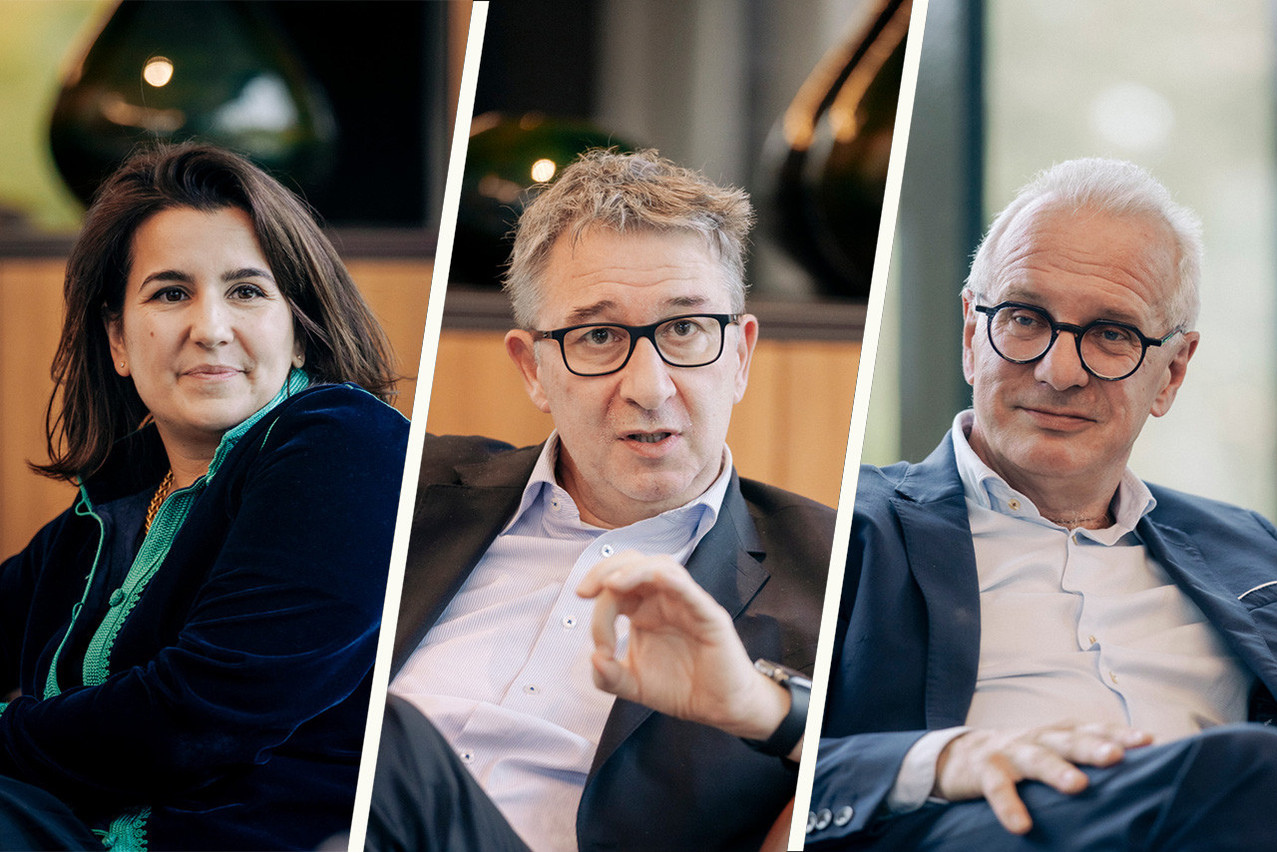
A peculiarity of Luxembourg is that four insurance companies account for 90% of the local non-life market. Behind the two national heavyweights, Foyer and Lalux, France’s Axa claims third place in the non-life market, a position that is contested by Switzerland’s Baloise. "On a like-for-like basis, excluding health, we are number three," says Baloise, pointing out that the company is not active in health in Luxembourg.
As part of its January Insurance supplement, Paperjam organised a roundtable discussion with 


How are each of you better than your competitors, in terms of products and benefits?
Octavie Dexant. — “We serve the same segments, with offers that are not necessarily extremely differentiating, but we each have our own touch. Axa’s is very much geared towards society: trying to revolutionise a bit what was done before, by integrating, within a standard product, cover or services that take things a notch further. This may involve new risks or societal needs. I would say that the little touch that sets us apart is probably in our culture.
Marc Lauer. – “Our ambition has always been to serve the whole of the Luxembourg economy. We do retail, but also a lot of risk for SMEs and industry. Our commercial positions are different, which is quite natural: each of us thinks we are stronger than our competitors in certain niches.
The question that also arises is why there are so few players in Luxembourg. Although we are in a single insurance market, many elements remain national, such as compensation rules. Settling a claim is not the same in Luxembourg as in Belgium, France or Germany. Our market is local, covering an area 80 kilometres long and 50 kilometres wide. So it’s a small area.
However, insurance is a sector that is making a lot of inroads into digitalisation and computerisation, which means high entry tickets. When I started my career [at the Commissariat aux assurances in 1989], there were 16 or 17 non-life insurers in Luxembourg. Today, four are really active in the market, although there are still a few niche players. Concentration has taken place in order to be able to provide customers with correct and modern services.
Christian Strasser. — “There are only four of us, it’s true. But compared with neighbouring countries, the quality of insurance in Luxembourg is very high. Precisely because the four players present each believe they are better in one area or another.
For us, what is essential is the quality perceived by the customer. I sincerely believe that in Luxembourg, customers have a real choice: four quality offers with different emphases. Even the one that compensates the least well here is already much better than the best abroad. So in terms of quality, customers are doing very well.
What is the added value of Lalux compared with Baloise, for example?
C. S. — “What has to be clear to everyone is that we are competitors. Personally, I have a real affection and human respect for the people around the table, but we are and remain competitors. And believe me, if I can steal a customer from Marc Lauer in the morning, my day starts off very well.
M. L. — “But if he took one from me, I’ve already taken three!
O. D. — “That’s what struck me when I arrived: there’s real competition, but it’s based on respect. A way of working together that remains healthy, for the benefit of the customer, and never to their detriment in the way we approach issues.
C. S. — “I come from the world of sport. In football, you’d say: ‘You play the ball, you don’t play the opponent’.
We don’t have the same strengths, but we all manage to attract new customers.

With 10.000 people arriving every year from a wide variety of backgrounds and nearly 200 countries, how do you, as a national brand, talk to them?
C. S. — “It’s clear that these 10,000 expatriates arriving in the country - and I hope there will be 20,000 tomorrow - will first get to know Axa or Bâloise. Indeed, when you are called Foyer or Lalux, it is perhaps more complicated for us, at first, to make a place for ourselves.
We have advantages and disadvantages. It’s up to us to play our cards right and make sure they get to know and like us as quickly as possible. If we can do that, we can attract those customers as soon as they arrive or gradually over time.
M. L. — “There’s a lot of talk these days, in modern parlance, about the ‘customer journey’. But what is the ‘customer journey’? He arrives in Luxembourg, he knows nothing. Then he says to himself: ‘Shit, I need insurance’. He then asks around: ‘Where are you insured?’
As we have a relatively large market share, the probability that people will answer ‘chez Foyer’ is around 40%. And I hope that, out of that 40%, 99.9% will say that they are well insured. There’s a lot of word of mouth. It’s a small ecosystem. In any case, people will find their way between the four players. Of course, each has its own means and its own way of promoting itself. There are also agencies that help newcomers settle in Luxembourg, and each of us is closer to one or the other, that’s obvious.
O. D. — “This is one of the things that surprised me when I arrived. As an international brand, when people arrive, they inevitably know Axa via their country of origin. So initially we have a competitive advantage over the brand.
But then there’s the question of the ‘trigger event’: at what point will people need insurance, and who will they turn to? Very often, they will talk about it with their neighbours or colleagues. And then, of course, there’s the law of large numbers. If you look, for example, at the number of Foyer branches: the more there are, the greater the likelihood, statistically, of coming across a Foyer branch down the road.
I think we have an advantage as an international brand, whereas Foyer and Lalux perhaps have an advantage in terms of the network, local knowledge and distribution. A balance is created: we don’t have the same strengths, but we all manage to attract new customers.
I sincerely think that in Luxembourg, customers have a real choice.

In mass retail, there is a reputation for quality among national players. Does this also exist in insurance, that moment when a customer says to himself: “I’ll go with a Luxembourg insurer, at least it will be good”?
C. S. — “It takes all kinds to make a world. Even if Leclerc isn’t number one in Luxembourg, look at its size, look at its added value: I love going there... but that doesn't mean I don't love going to Cactus.
Each of us has our own particular ‘touch’. By necessity, when you're an organisation like ours, which does 100% of its business in Luxembourg - or like Foyer, which does most of its business locally - there's bound to be a Luxembourg ‘touch’. But Axa Luxembourg also knows how things work here. Axa does not operate in Luxembourg as it does in Poland.
O. D. — “We are an international brand, but a local player. We come from companies that have been around for over 100 years. So there’s this local knowledge.
Then, customers will naturally turn to corporate cultures or campaigns in which they recognise themselves, in which they feel confident, above and beyond the price. It's something that can't really be explained: it's a matter of feeling. And that's how they'll gravitate towards one rather than the other.
Beyond the three of you and Baloise, who do you see as your main competitors today, in Luxembourg and elsewhere?
O. D. — “It’s extremely minor.
M. L. — “These are niche products. For the moment, that’s what the market is.
The concentration was done to be able to provide correct and modern services to customers.

Do you expect this four-way situation to continue? Do you see any new entrants coming in?
O. D. — “Given the size of the country, the scale we’re capable of achieving and the barriers to entry, particularly in terms of investment, you need a minimum number of customers to be able to invest. We also need a certain volume of policies to be able to invest in the tools and control functions we are required to have.
At some point, if we were still 16 or 17 players, with the levels now expected by customers, the regulator and the regulations, no one would be able to live.
M. L. — “I’ll do a very simple calculation. The automotive market in Luxembourg represents between 600 and €700 million in sales because it's the one that moves the most. We would all be delighted to have a 10% margin: on €600 million, that would represent €60 million in margin.
If a new entrant arrives and immediately wants to capture 20% of market share, that represents 12 million euros, or around 8 million after tax. And that’s assuming we don't react!
Maybe some people dream about it and we'd welcome them, but it would be an extremely difficult situation. We shouldn't forget that, normally, the European retail insurance market is very fragmented.
In the international life insurance sector, we are in a slightly different situation, where we operate above the fray with products aimed at ‘high net worth individuals’. There, we can sometimes ignore certain elements. But then again, players like Utmost, Wealins or Cardif sell very specific products, market by market.
We don’t know whether a new entrant will come along. It would probably be good for the competition. But the investment and courage required to enter these fragmented markets is very high compared to the expected returns.
O. D. — “Once again, this is a job that requires considerable resources. Developing a product isn’t just about designing it: it’s all about the work behind it. To do that without a minimum number of customers in front of it... With 670,000 inhabitants in the country, it's not a cake that could be shared by 20. No one could survive.”