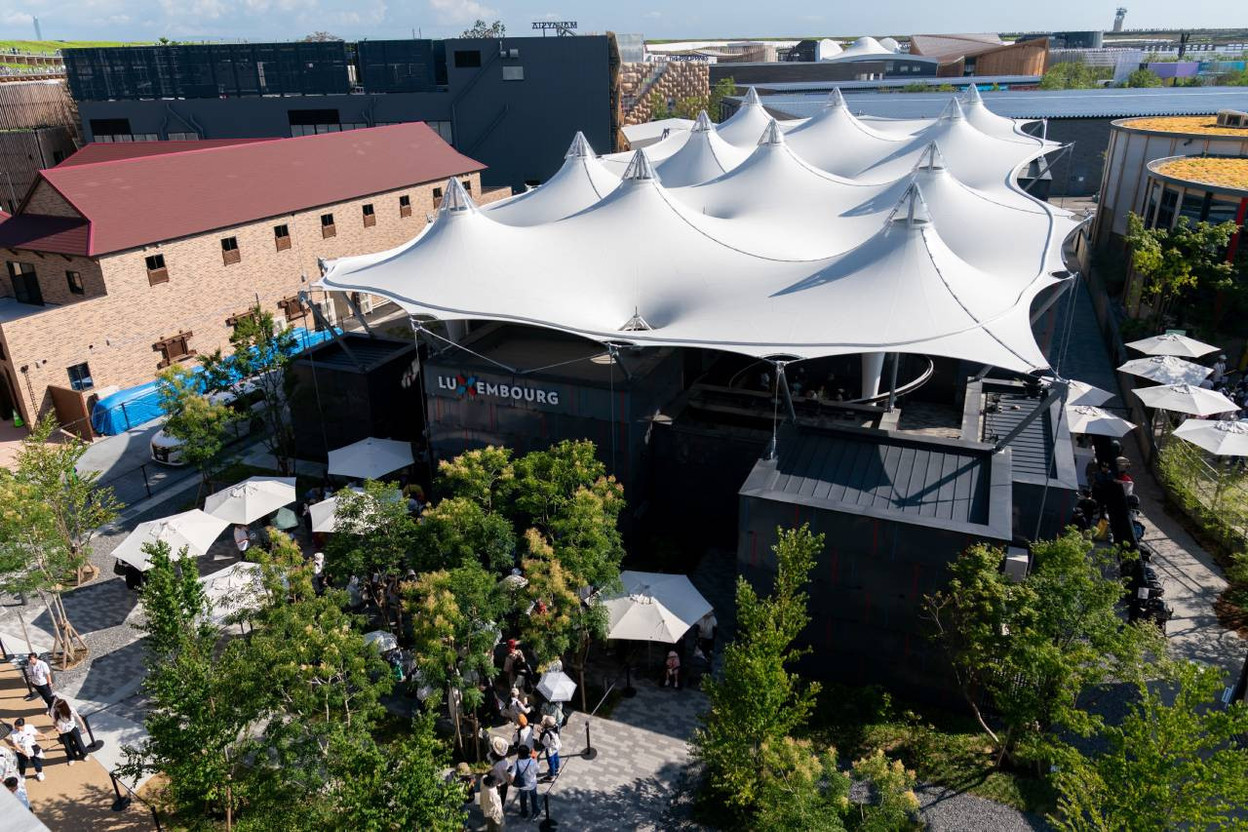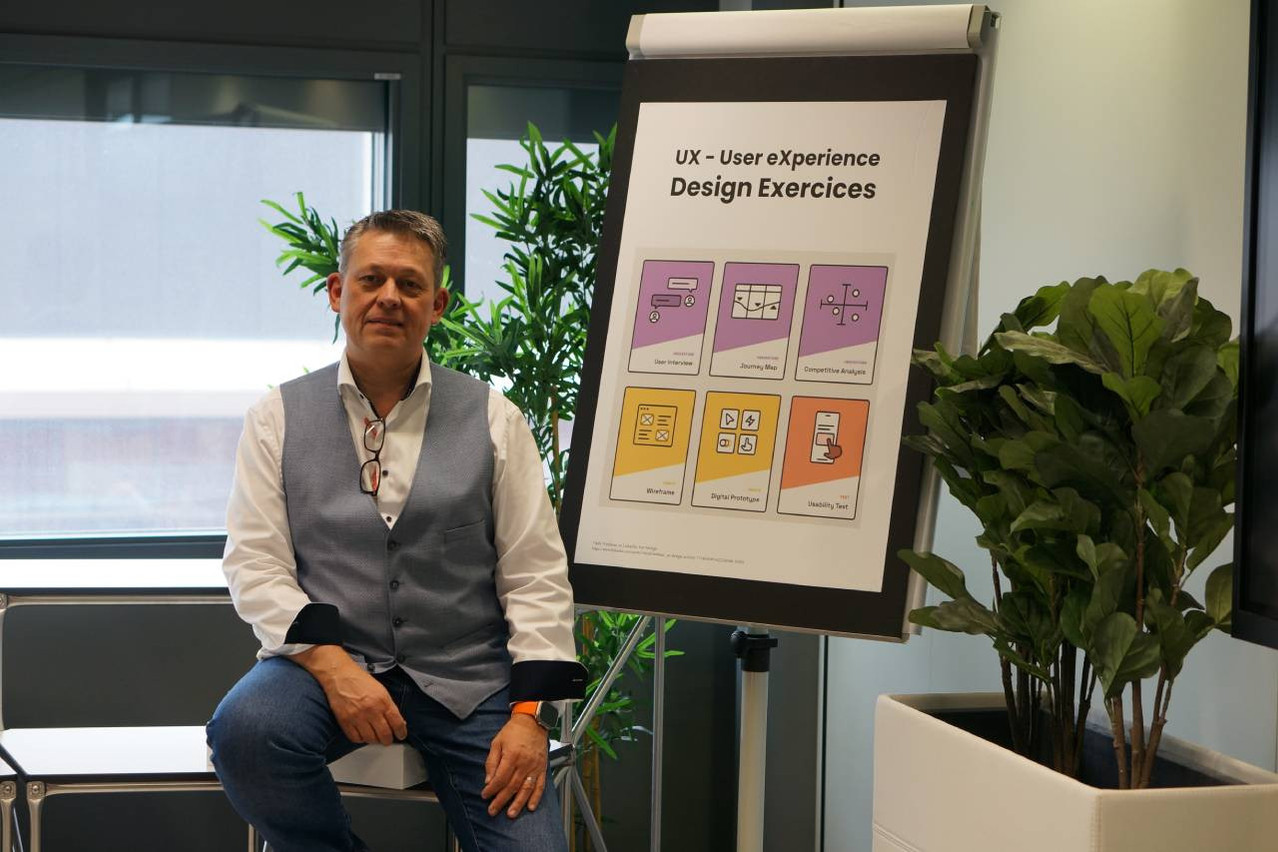
From November 12 to 16, the Luxembourg Design Festival will celebrate creativity and human-centered innovation. Among the speakers, Koen Cloostermans, Training Manager for Design Thinking at the Digital Learning Hub, explains how design thinking has become one of the most effective ways to drive innovation in companies as well as in public administration. Because in Luxembourg, where stability and trust are part of the culture, innovating means learning to collaborate, to experiment and sometimes to make “happy mistakes.”
For someone who has never heard of it before, what is design thinking?
Koen Cloostermans. – “It’s a mindset, a way of working together to solve complex problems. The word “design” often has a strong perception of aesthetics, and that’s a nice side effect because it makes solutions more desirable. But the big difference between art and design is that art is a free creation, while design is a solution for someone else. You need empathy. An architect, for example, doesn’t build a house for himself. He listens, observes, sketches, and tests ideas until it fits the needs of the people who will live in it.
It’s the same in product design and digital design. Applications and apps are very close to the user and the human factor has a very strong impact on whether a product is good or not so good. And a not-so-good product is a big risk in innovation and in a company’s budget. That’s why in digital design, the human experience is a very strong factor in the success of a product. Design thinking gives you a way to manage that complexity by testing, learning, and adjusting quickly.
You train professionals in this approach at the Digital Learning Hub. Do you feel that Luxembourg is starting to adopt design thinking as part of its innovation culture?
“Yes, more and more. Of course, we are not in Silicon Valley, where innovation has a very strong dynamic, but Luxembourg has its own strengths, a culture of stability and trust, especially in the financial sector. Some key innovation focus of Luxembourg are data and AI, quantum, cyber security, space tech, Hearthtech, Fintech… and except for space tech we as digital learning hub are quite involved in supporting this strategy with our offer of courses. The Ministry of Digitalization, for instance, works on simplification by organizing workshops with different departments to understand how things can be improved. That’s already part of the design thinking mindset, collaboration, iteration, prototyping, agility.
Design thinking helps balance both: it creates a space where you can explore, test, and learn without jeopardizing production.

What makes it sometimes difficult for organizations to apply this kind of thinking to innovation?
“Innovation needs resources, time, and trust. That’s not always easy. If at the end of the day your 100,000 products must be shipped, then it’s about production, efficiency, and risk management, and that’s not innovation. But it’s essential to keep the business alive and the lights on. Design thinking helps balance both: it creates a space where you can explore, test, and learn without jeopardizing production. It’s a different dynamic. You can’t run innovation with the same mindset as production.
And within public administration, do you see design thinking principles being used to foster innovation?
“It’s moving, yes. Change is not easy, but the awareness is there. In the Ministry of Education, for example, teachers are introduced to design thinking as part of their competencies. You also see it in the evolution of public services, like MyGuichet.lu. Now you can get your document in a few seconds, that’s simplification through digitalization and better collaboration. It’s happening both strategically and in a more agile way, which is good.
That’s also the theme of your workshop at the Luxembourg Design Festival, Happy Mistakes: Creatively Finding Solutions Together. What will participants experience?
“It’s a one-hour, hands-on session where participants will work in pairs. They start with a short interview to understand the other person’s needs, then they create a quick prototype. It’s fast, it feels chaotic, and that’s the point. Prototypes should be made as soon as possible, they’re communication tools. You show something rough, you get feedback, and you learn. A “happy mistake” is when something doesn’t work but helps you see things differently. That’s what design thinking and innovation are about: trying, learning, and improving together.
We’re not in Silicon Valley, but Luxembourg is finding its own way to innovate through collaboration and agility.

So, in the end, what does design thinking change in the way we innovate?
“It makes innovation more human and more collaborative. Whenever there is a problem, a complex problem, or even a problem of understanding, that’s where it starts. Do I really understand my colleagues? Am I open to making mistakes, and can they trust me to do the same? Innovation requires that kind of trust. We iterate, we work with each other’s talents. I don’t have to be the smartest person in the room. Everyone brings something valuable. And when that happens, the sum of the parts is greater than the whole. If you want to go fast, go alone. If you want to go far, go together.”
The Luxembourg Design Festival will run from November 12 to 16, bringing together creative minds from Luxembourg and beyond. Among this year’s highlights: the Design Awards and a programme full of talks, workshops and exhibitions. Discover the full schedule at www.designfestival.lu.