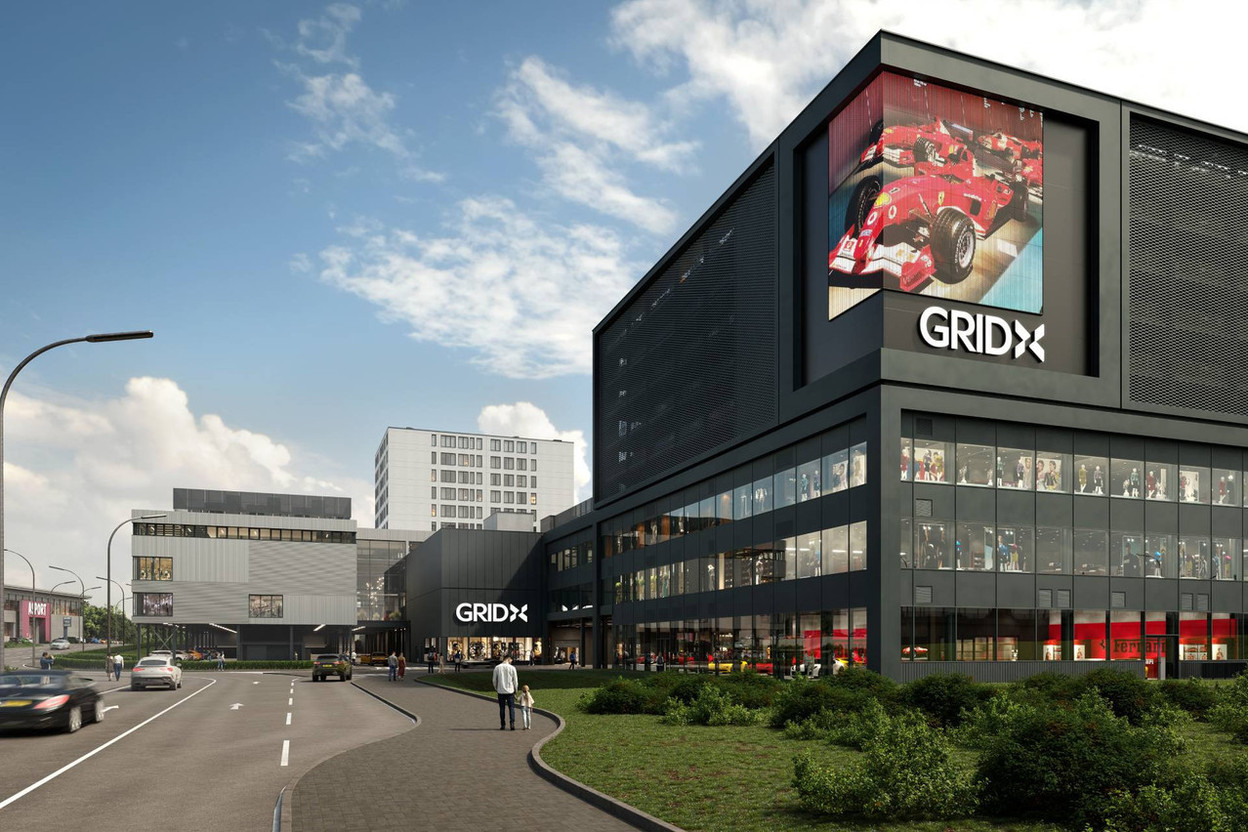
He was brought in to orchestrate what he calls an ecosystem: six pillars, a hotel, a food hall, two restaurants, an automotive and immersive digital museum, an event hall, retail and showrooms and a business centre, all on one site in Wickrange. Thorsten Endres has been project director of Gridx since January, after 14 years as managing director of the European Volleyball Confederation, and he has the manner of a man used to keeping several parties happy at once.
Nothing is denied outright, nothing is dramatised either. The construction works that spoiled the first months, the visitors who found shops closed on a Sunday, the brand that still needs explaining – he concedes it all, calmly, before returning each time to the same line: it is a long-term investment, and the site is being completed step by step. Interview.
You joined Gridx in January. Where did you come from, and what were you hired to do?
Thorsten Endres. – “My past is in sport and volleyball. For almost more than 14 years I was the managing director of the European Volleyball Confederation, which is also based here. So nothing to do with retail, but also a job where you deal with different interests. The family was looking for someone to orchestrate the entire ecosystem of Gridx, as it is a unique place, a unique concept, with different entities, different parties involved and obviously different interests. My job is to search for synergies, to see where we can work together, and in fact to write and to conduct this success story of Gridx. There are two objectives: to increase the footfall, so the number of visitors here, and to commercialise the entire site, including the partners, together with our tenants.
How many visitors has Gridx had in its first year?
“Actually, I was expecting this question. We installed a visitor tracking system a few weeks ago. I think the entire story of Gridx is that we opened step by step over the past years. Slowly but steadily, we are getting completed now, also with the offer we have here on site, and that includes this kind of statistical information. We start tracking now, so we will have the exact numbers soon. We know the figures for certain events, but the overall number in the first year, this is not existing. And I’m not able to give you a split in percentages either: from the data we have, it is mainly Luxembourgish people, Germany, France and Belgium. The target for this year is one million visitors, one and a half million next year. And obviously it’s important not only for media but also for our tenants and for us to know the exact number.
Is awareness a problem?
“That’s also what we have identified: the awareness of Gridx here in Luxembourg, we are working on this. There were a lot of things in the media, but after one year – and it’s normal, it’s a new project, a new concept – the goal is to increase the awareness of the Gridx brand. First creating awareness that Gridx is there, and then, when it comes to the offer, segmenting the target group, because there is not one target group. Gridx has an offer for everybody. If you’re a car lover, we have something for you. If you come at the weekend with your family, we have an offer. If you’re a teenager from the south of the country and you want to hang out with friends in the evening, we have an offer. So it’s not that it’s only for rich people, it is an offer for everybody. Because if you go out and say we have everything, it doesn’t work. We say: come for one thing and explore the other offers we have here on site.
Where does the occupancy rate stand today?
“In terms of retail surfaces we stand currently at 85%. We are really very satisfied with this. In addition, we have recently signed four more deals. Another important point in terms of offices: there are still three floors of office spaces to rent. We are currently in discussions and looking for tenants who also ensure the daily footfall. We are in very promising discussions, but obviously this is a negotiation back and forth. We want to complement the remaining available surfaces with really attractive partners, partners who attract people and visitors.
Gridx is out of this box.

What is opening next?
“Delhaize will open at the beginning of October. We have the opening of the restaurant of the hotel school (EHTL). And then we have Ltoys opening a shop here. They are currently based in Münsbach and they will join here because we have identified Gridx as a family destination. If you want to be a family destination, not only with playgrounds, kids’ care and pop-up activations during the weekend, you need also a certain retail offer. And then the next ones are Autodis with an additional brand and Joby City, an operator for kids’ experiences and kids’ care on 800 square metres.
A grocery brand was not what the family described at the start. Do you need to fill the space?
“No, no, no. A grocery shop is a huge trigger point. It creates daily footfall, and we are looking forward to having Delhaize on board because it will change the flow of the daily visitors. At the beginning, Gridx was developed as a motor world. But in the business world, you need to be ready to adjust your planning and the project if you realise that the circumstances have changed. Every day you watch the news and you see what’s happening around the world: consumer habits changing, the entire world changing, the economic situation changing. You can stick to your system, or you can adapt and be flexible.
Is the automotive identity still central?
“Definitely. The mobility part is one of our strong pillars, but it’s one of six pillars. It’s not the only pillar anymore. If you talk about risk management: you diversify the risk and you increase the offer, you’re not mono-oriented. Mobility is in our DNA and remains in our DNA.
Was the corporate side always meant to weigh this much?
“Yes, I don’t think it changed. It was the concept from the beginning, combining different parts. B2C was important, obviously, with the retail and the food hall, but B2B corporate was from the beginning a strong pillar of the project. So far, in the first year, we hosted 371 events here at Gridx (B2B and B2C combined). What makes Gridx attractive for companies is the variation of rooms and offer. It’s not a classical event hall only – yesterday we had a corporate event where the conference was at Giolabs, in the main immersive room, and in the evening the dinner was at Galleria 610, in the automotive museum, in between the rally cars. With the business centre we also offer team-building packages together with our tenants: clients have their off-site here, they discuss and meet, and in the late afternoon they go to drive together at the Emotion simulator or sing together at the Boom! Karaoke. This is really working well.
The positive news is that we are on track with the business plans.

And the hotel?
“We have a hotel manager, so I’m not managing the hotel itself, but I’m involved in operations to create synergies. The hotel is operating according to the business plan in terms of occupancy and also room rentals. As an event location it’s very attractive to offer not only the event space but also the hotel inside the centre. It is growing month by month. In July, according to the report, we had an occupancy of 85%.
How many people work on the site today?
“It depends how you calculate. If you consider the Gridx management and the Gio operations, everything linked to the family, we have approximately 250 people working here. If you consider all the tenants and the office space, we are talking about approximately 550 people currently working here.
People often say the food is great but there is nothing to do at Gridx. Is there a gap between what you promise and what people experience?
“That’s fair enough. In the first few months, there were the constructions, the accessibility, the highway works, the roundabout in front of the door, the signalisation inside, some stores still being fitted out, tenants moving in. So I fully understand that the perception was that the visitor experience was not as they expected. But in an opening phase, I think that’s a normal process. Step by step we are completing the offer, and you cannot compare Gridx now with Gridx a year ago, or even six months ago. We are listening to the feedback, we are aware of it, but we are strongly convinced that the offer and the promises we are giving reflect the reality. What we are doing now is convincing people who are maybe negative for the time being that Gridx is a complementary offer to what already exists in Luxembourg. We are not positioning ourselves against other commercial centres.
Have any brands or restaurants left the site since the opening?
“No. We had a pop-up store here in front of the food hall, and the Fast and Furious exhibition of movie cars in the corner, but those were pop-ups from the beginning. Other than that, all the tenants who were on board last year are still on board.
The food hall includes two restaurants in which the Giorgetti family is invested. Do all tenants pay rent?
“We have the fourteen food corners, and then two restaurants which are both part of the Gridx concept, where the family is also invested: Jane, the classical restaurant, and The Studio, the chef’s table. The internal clients (Engelhorn, Giolabs, Koru) are treated like all the other tenants and have to pay rent too. We don’t make a difference between family-invested entities or not. Each agreement is negotiated with each tenant, but overall the tenants are all treated equally. I can confirm and guarantee that all the tenants pay rent. Otherwise it would be difficult to commercialise the centre.
We opened step by step over the past years.

Do visitors understand what Gridx is?
“I think it’s a fair question, and I think no. It needs explanation what Gridx is. If you say commercial shopping mall, everyone knows what to expect. Gridx is out of this box. And normally everything that is out of the box, out of your experience, is a little bit suspicious. Our job is to build awareness and create curiosity around Gridx to make people want to visit us.
Access is still mostly by car, and the tram is not expected before 2030. How much of a handicap is that?
“Obviously it is not ideal. But we are accessible by public transport, you can also come by bus – there is a connection, twenty minutes from the central station in Luxembourg. The tram connection will change the overall situation, but that’s out of our control. There is an anticipated date for 2030, which was in the media, and we hope this is a realistic timeline. We know the commune has a strong plan and is pushing for it. We are located in the centre between Luxembourg and Esch, on the highway, and you should not underestimate the capacity of the south of the country. Commuters going back home in the evening can stop here, do a training session at Koru, do their grocery shopping and continue on their way home instead of sitting in the traffic jam. I think that’s a similar situation for all shopping centres, more or less. Traffic is an issue in Luxembourg.
Alex Giorgetti said Gridx wanted to become an international destination. Where are you on that, and is the investment on track?
“If you ask me for the next twelve months, the greater region is the main target. But we definitely have international exploitation on the map as well: we go to international fairs to promote Gridx, and we work with tour operators to bring international tourist groups here when they travel south, for a stopover with a concrete offer. It has been a great investment by the Giorgetti family, and it is not an investment where you can say that after one year you have a return – it is a long-term investment. But the positive news is that we are on track with the business plans, and we are seeing positive trends on all levels.”