For those unfamiliar with Engelhorn, how would you define the brand?
Peter Eberle. —“Engelhorn is a German company founded 135 years ago in Mannheim. The company has always developed a close connection with the city, with the conviction that the success of the shop and that of its environment go hand in hand. Initially positioned on the premium segment, it gradually structured a broader offering, notably with a major sports division, before moving into the luxury segment.
Will the concept be identical between Germany and Luxembourg?
“No, there will be some notable differences, starting with the size. In Mannheim, the shop currently exceeds 12,000m². In Luxembourg, the surface area will be just over 5,000m². As well as size, positioning also varies. In Germany, the range is broader and covers a very wide spectrum, both in terms of price and style, with a significant depth of assortment. In Luxembourg, we have made a more targeted, narrower choice, clearly oriented towards premium/luxury. These are two models adapted to different markets and expectations.
Why did you choose the Gridx site?
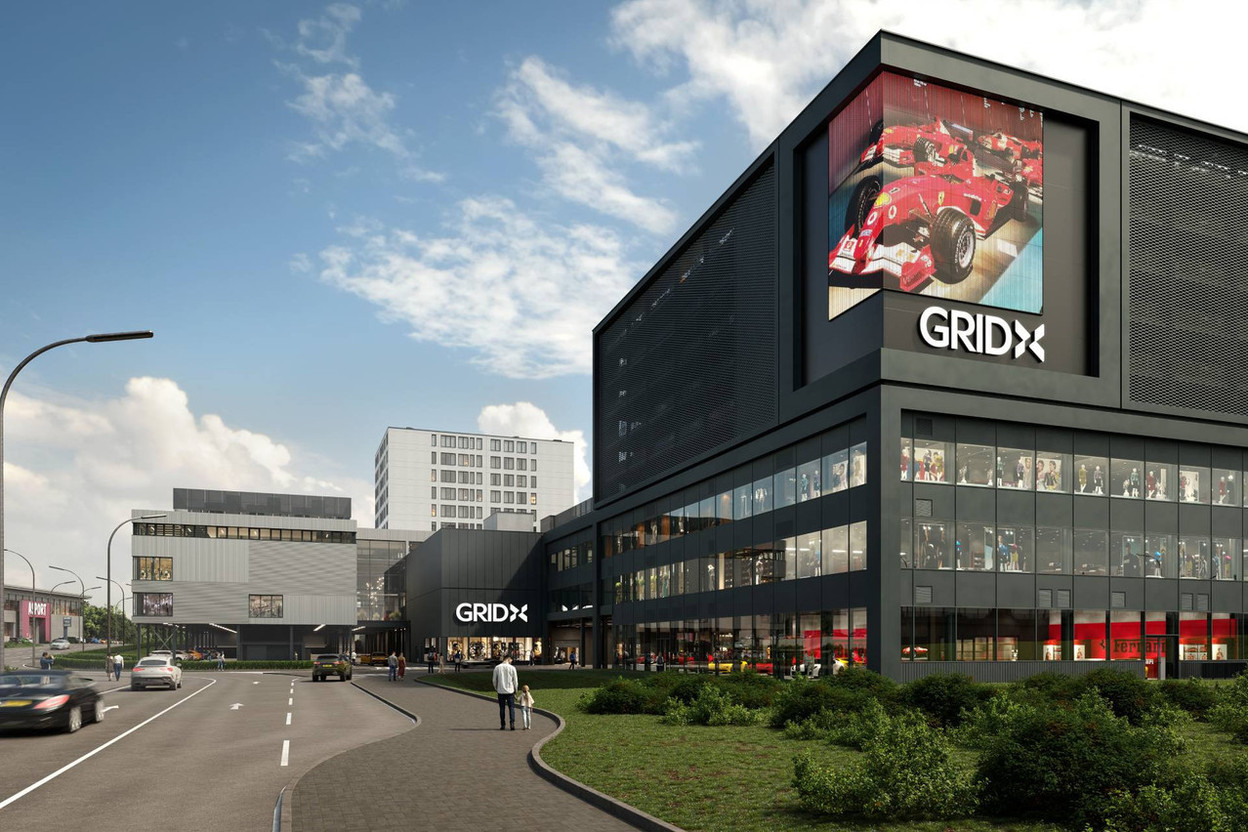
“Quite honestly, I can’t explain exactly why the Giorgetti family chose this site over another. On the other hand, its advantages are obvious. Firstly, accessibility: Gridx is located right next to the motorway and is easy to reach from Luxembourg, France and Belgium. Then there’s the setting. Unlike a more business district like Kirchberg, the environment here is more open, more landscaped, almost designed as a place for experiences and events.
Gridx is regularly featured in the press, which feeds curiosity and creates a form of expectation.

Doesn’t the fact that Gridx is not yet fully finalised worry you?
“No, it doesn’t worry me. When we open, a large part of the space will already have been finalised. And above all, certain key stages will play a decisive role in the site’s development. The opening of Delhaize, for example, will play an important role in naturally generating traffic. And the food hall, combined with our arrival, will be a real boost to footfall for the whole centre. I’m convinced that the momentum will build gradually: first there will be the discovery effect, then word-of-mouth. What’s more, Gridx is regularly featured in the press, which feeds curiosity and creates a kind of expectation. For all these reasons, I’m confident that people will come, and above all, they’ll come back.
How have you planned the organisation of the shop?
“We have opted for a different organisation to that of traditional department stores. There will be no single-brand corners, and customers will not move from a Hugo Boss area to a Marc O’Polo area. The shop will be structured around eight distinct universes, which we call ‘planets’. In concrete terms, customers will be led through these coherent stylistic worlds, where brands interact with each other, both in terms of style and price positioning. For example, there will be a men’s luxury world, a more casual area for women and a sports-oriented segment.
Our approach is to reinforce what only a physical shop can offer: advice, experience, contact and pleasure.
Will you be offering e-commerce?
“No, there will be no e-commerce. We have chosen to concentrate on the shop, because our offer can only be fully appreciated on site. Of course, digital is part of our times and will not disappear, but we are not trying to fight against it. Instead, our approach is to reinforce what only a physical shop can offer: advice, experience, contact and pleasure. And if these elements are present, customers will come. Because it’s more fun, quite simply.
And to offer this differentiating experience, what have you actually put in place?
“We thought of the experience as a whole. At the heart of the shop, Café Gaia accompanies the different moments of the day, from breakfast to the aperitif, with a simple and quick offer, designed for short breaks. The aim is not to compete with the restaurants in the centre, but to extend the time spent in the shop. Areas such as a champagne bar and a whisky bar are also part of this approach.
What role does sustainability play in your strategy?
“Many brands are now developing more responsible lines—reduced water consumption, lower CO2 emissions, better control of materials—and we work with those that make a concrete commitment to this approach. That said, not all clothing has the same ecological constraints: producing a t-shirt does not involve the same requirements in terms of materials and manufacturing as a waterproof jacket, for example [often made from polyester, editor’s note].
Many consumers want more responsible clothing, but without always agreeing to pay the price.
In this context, how do you position yourself against the fast fashion players?
“Many consumers want more responsible clothing, but without always agreeing to pay the price. But sustainable production has a cost. For our part, we are focused on premium and luxury, with the idea that a well-designed, quality garment will last much longer than a fast-fashion product. On a personal level, I admit to finding this model hard to understand: when you simply compare the cost of transport from Asia to Europe with the final selling price in shops, the economic logic begs to be questioned.
What do you see as the major trends at work in retail today?
“The last major turning point came after the Covid crisis. Formal dressing, particularly for men, has declined sharply and the relationship between clothing and work has undergone a lasting transformation. Another key factor was social networking, which greatly accelerated the pace of trends. What has disappeared, on the other hand, is the great single trend of 20 years ago. Back then, for example, a single skirt length dominated and deviating from it was almost tantamount to being out of fashion. That logic no longer exists. Today, almost anything goes. From my point of view, I try above all to see the opportunities: never has the fashion sector generated as many ideas, proposals and creativity as it does today.”
Did you know?
Engelhorn has already been present at Gridx since last September with a shop dedicated to running, training and fitness. The brand will maintain this outlet despite the opening of the new department stores. The future fashion space will not compete with this specialist offering. It will complement it, with a more lifestyle positioning and a sportswear-oriented selection, particularly around brands such as New Balance.
A three-way alliance
This joint venture brings together Marc Georgetti (Gridx), Peter Eberle and Fabien Engelhorn. A former manager at Konen—owner of Bram at City Concorde—Peter Eberle knows the Luxembourg market well. A member of the Engelhorn board since 2015 and close to the family, he put the developer in touch with the German group. Convinced by the site and by a model centred on the in-store experience, Fabian Engelhorn took a stake in the capital and authorised the use of his name. Peter Eberle heads up the Luxembourg entity.
This article was written for the March 2026 Paperjam magazine, published on 26 February. The content is produced exclusively for the magazine. It is published on the site to contribute to Paperjam’s comprehensive archive. Click on this link to subscribe to the magazine.
Is your company a member of Club Paperjam? You can request a subscription in your name. Let us know via club@paperjam.lu.