“What have you done to ensure the creation of skilled jobs in your commune?” Or: “What will you do in concrete terms to ensure that your municipality or inter-municipality, the Département or the Region, creates jobs with high added value during your term of office?” What if, instead of letting the candidates for mayor, on the other side of the border, go off in all directions, the voters challenged them with this precise question? What if they revisited this question in the light of what has happened over the last 20 years—since statistics don’t provide a better view beyond that?
While debates about frontier workers often focus on taxation, teleworking or unemployment payments, labour market data tells a different story: that of a long-standing structural imbalance between the capacity for job creation in the French Grand Est and the dynamism of the Luxembourg labour market.
The massive presence of cross-border workers in Luxembourg can be explained first and foremost by a structural employment differential between the Grand Est and the Grand Duchy. Official data from Insee and Dreets Grand Est show that, despite a large pool of working population, the French border departments are not creating enough jobs to absorb their workforce locally, particularly in high value-added sectors.
+0.3% jobs per year over 40 years, much less over 20 years
The Grand Est region has a population of around 5.54 million. There are almost 2 million salaried jobs in the region, while the regional unemployment rate is 7.1%, with comparable levels in Moselle (7.0%) and Meurthe-et-Moselle (6.7%). These indicators do not have the same scope: unemployment is calculated on the basis of the resident active population, while salaried employment measures the number of people working in the region, regardless of their place of residence. They nevertheless converge on the same observation: the Grand Est is not in a situation of full employment, even though it concentrates a significant proportion of the active border population.
Insee’s long series make it possible to place this situation in a long-term perspective. Between 1989 and 2024, total employment in the Grand Est increased from 2.03 to 2.22 million jobs, i.e. almost 200,000 additional jobs over more than three decades (+0.3% per year on average), with the 2024 figure being provisional. However, this overall trend masks a much weaker dynamic in salaried employment since the early 2000s. Over the period 2000–2024, total salaried employment fell slightly, from 2.02 million to 2.00 million jobs, with no significant net creation over almost a quarter of a century. The dynamic is even more unfavourable in the border departments: over the same period, salaried employment falls by around 4.2% in Moselle and 1.6% in Meurthe-et-Moselle.
These figures relate to jobs located in the Grand Est and do not include residents of the region who work abroad, particularly in Luxembourg. They therefore describe the region’s capacity to offer jobs locally, independently of outbound cross-border worker flows.
Relatively stable commuting times since 2003
Demographic trends reinforce this diagnosis. According to Insee data, the population of the Grand Est has remained stable overall since the end of the 1980s, reaching around 5.56 million in the early 2020s. However, this stability masks major regional disparities. Areas close to Luxembourg, particularly in Moselle and the north of Meurthe-et-Moselle, are experiencing population growth, driven by the arrival of active households attracted by job opportunities on the other side of the border. Local population growth is therefore not correlated with an equivalent creation of salaried jobs in the area.
The work of Liser (formerly CEPS) provides a perspective on changes in commuting patterns for cross-border commuters over almost 20 years. As early as the early 2000s, surveys were already highlighting high journey times and distances, of the order of 40 to 45 minutes per single journey, with a heavy reliance on the car. Twenty years on, these orders of magnitude remain, but they are part of a profoundly different context, marked by a doubling in the number of cross-border workers, an increased concentration of jobs in Luxembourg and a structural saturation of transport infrastructures. While the data do not allow us to measure a linear increase in journey times over the long term, they clearly indicate an increase in the economic and organisational cost of commuting.
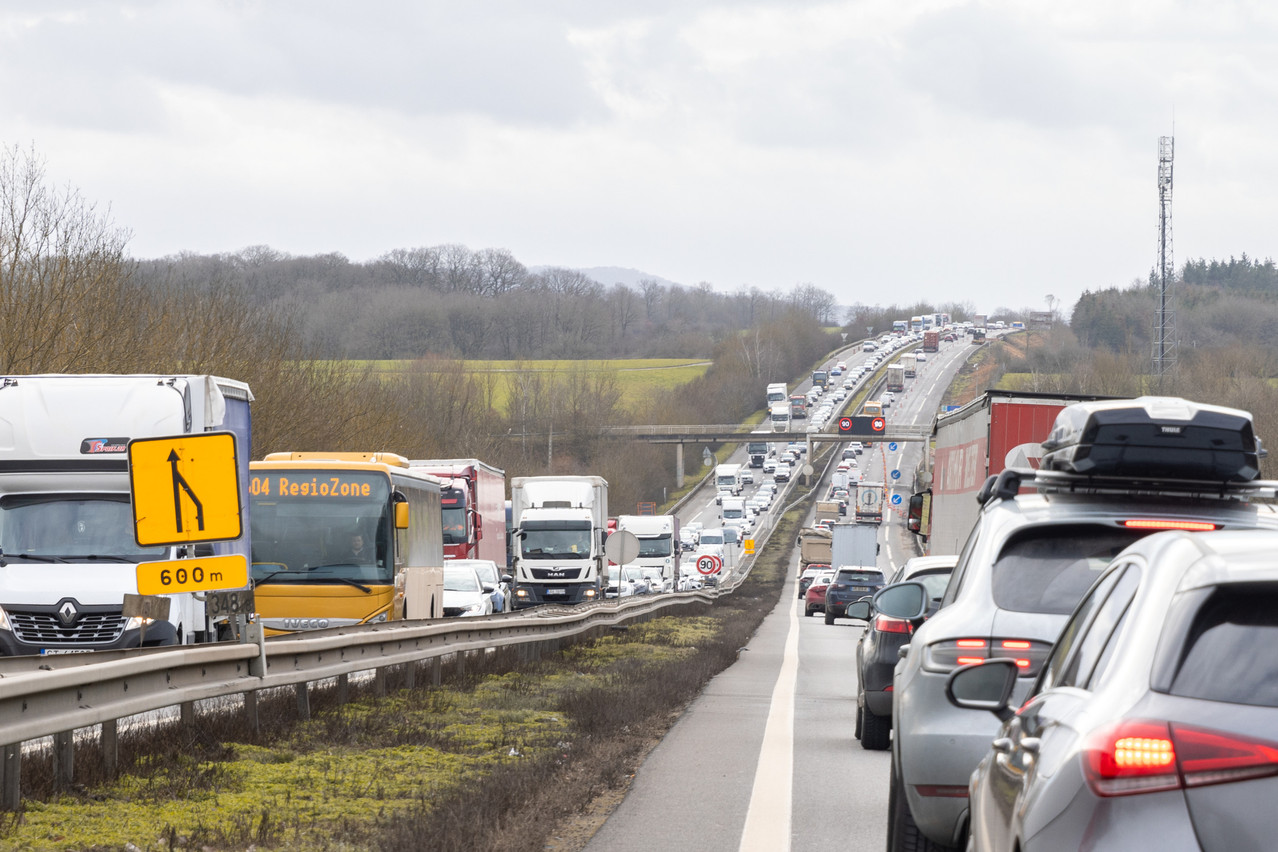
Another, more recent factor is thus helping to reconfigure the choices made by cross-border workers: the lengthening and worsening of travel conditions. Increasing road congestion and the unreliability of cross-border rail links are increasing unpaid commuting time, reducing the effective hourly income from jobs in Luxembourg. As this constraint increases, the differential in attractiveness between border jobs and jobs located in the Grand Est narrows at the margin, making some local jobs relatively more attractive due to shorter commuting times, despite lower nominal pay levels.
Structural differences depending on the sector
No statistical indicator, however, allows, at this stage to quantify any massive return of cross-border workers to jobs in the Grand Est region for transport-related reasons. The available data do not provide any information on individual motivations for changing jobs, or on the direct impact of commuting times on career decisions. On the other hand, longer journeys and infrastructure saturation are objectively justifiable economic constraints, likely to gradually alter the choices made by some workers, without calling into question the overall dynamics of cross-border working.
The sectoral structure largely explains the persistence of these flows. In the departments bordering Luxembourg, industry has fallen sharply in recent years, with a 12.5% drop in industrial jobs in Moselle. The growth observed mainly concerns accommodation and catering, logistics and administrative services, sectors where pay levels remain lower than in Luxembourg. Conversely, the Grand Duchy concentrates financial, legal, technological and business services activities that generate a sustained demand for skilled labour.
Commuting patterns confirm this economic logic. The Dreets territorial indicators show a high intensity of cross-border commuting in the intermunicipalities close to Luxembourg, reflecting a persistent mismatch between the place of residence of working people and the location of jobs. This mobility is not marginal: it is a structural response to the organisation of the regional labour market, not a cyclical phenomenon.
The issue of taxation, secondary
In this context, taxation appears to be a secondary factor. As the analysis published by Improof on the new Franco-Luxembourg tax treaty points out, the text is not the reason why Luxembourg is attractive to French workers. It provides a framework for a flow that already exists, by adjusting the distribution of the tax base between countries, without calling into question the fundamental determinants of mobility. Differences in salaries, job opportunities and career prospects are still more than sufficient to explain the choices made by cross-border commuters.
The figures show that cross-border commuting is not based on opportunistic optimisation, but on a long-term economic rationale. As long as the Grand Est does not have a comparable capacity to create skilled, well-paid salaried jobs, Luxembourg will continue to exert a lasting attraction on the workforce of neighbouring territories, regardless of tax or regulatory adjustments.
And instead of picking on Luxembourg, the mayors on the other side of the border should be calling to account the intermunicipalities—which always reflect local political balances—and the now Grand Est Region—whose centre of gravity moved from Metz to Strasbourg in 2016, without which Alsace would have wanted to stand apart. Do they? To ask the question is to answer it. Between the State-Lorraine plan (1984–1988) in billions of French francs, the Resider plan—community initiatives for the conversion of steel areas—in billions of ECU, the new Lorraine Pact (2014–2016) in hundreds of millions of euros (and billions of subsequent investments) and European funding (2014–2020) in billions of euros, what has become of these pharaonic sums in this context?