1. The European Commission has set unrealistic targets for hydrogen production and imports, and the EU is not on track to meet them.
2. The legal framework is almost fully defined, but its overall impact on the market is still uncertain.
3. There are multiple European sources of funding for hydrogen projects, but there is no guarantee that they will be suitable for the development of an EU-wide market.
4. Insufficient coordination efforts on the part of the commission, both internally and with the member states, as well as with industry.
In four chapters over 124 pages, the European Court of Auditors has blasted the European Commission over its ‘green’ hydrogen strategy, obviously in a much more diplomatic style.
The ECA, the EU’s public spending watchdog, criticised the lack of rigorous analysis before setting production and import targets, the fact that these targets have not been broken down into targets for each member state, and the fact that the targets set by the member states are not all aligned with those of the European Commission. “The EU targets turned out to be overly ambitious: based on the available information from member states and industry, the EU is unlikely to meet them by 2030. The commission did not set any EU targets for low-carbon hydrogen,” the report stated.
Funding in the fog
“Investment needs are huge, but the commission does not have a complete overview of these needs or the public funding available,” the ECA said on Wednesday. “There is still no guarantee that the EU’s hydrogen production potential can be fully harnessed. So far, those member states with a high share of hard-to-decarbonise industry are more advanced in terms of planned projects (either at an advanced or in the feasibility study stage).” The cost of the necessary investments for the entire production chain was not spelled out in the 2020 strategy, but the figures roughly tally up to €458bn, although the Court of Auditors preferred not to consolidate them. The RepowerEU plan for 2022 is in a range of €335bn to €471bn, but it is off by €45bn-€49bn, according to the ECA. According to the auditor’ estimates, €18.8bn is available for all hydrogen-related projects (including non-green projects).
In the objectives, it is difficult to know whether the capacity indicated is linked to the supply of green electricity or to hydrogen production capacity--the difference between the two being the efficiency of the electrolysers. Worse still, as the European Court of Auditors pointed out, “The estimates relating to renewable hydrogen production (in million tonnes, Mt) that can be achieved with electrolysers with a total capacity of 40 GW varied in different commission documents,” from 4.4Mt to 6.6Mt, “as did the electrolyser capacity required to produce 10 Mt.”
On the subject of imports, the RepowerEU plan mentions 10 Mt of imported hydrogen, while another commission document states that imports will involve 6 Mt of renewable hydrogen and 4 Mt of ammonia, although it is not clear whether the figure refers to the 4 Mt of hydrogen that is supposed to be imported (i.e. 25 Mt of ammonia) or to 4 Mt of ammonia (i.e. 0.6 Mt of hydrogen).
Not enough production capacity
As far as consumption is concerned, the ECA’s calculations show that stimulated demand will not even reach 10 Mt by 2030, and certainly not by the 20 Mt target set by the commission in 2023. Even imports would remain below 10 Mt until 2040. Here again, demand scenarios range from 3.8 Mt according to the International Energy Agency to 10.5 Mt according to Standards and Poor. And then some. If we take the installed electrolysis capacity in Europe, between 46 GW and 50 GW, we're still a long way off the mark. Two studies say that 192 GW of capacity would be needed to reach 10 Mt, and 60 to 120 GW in the second.
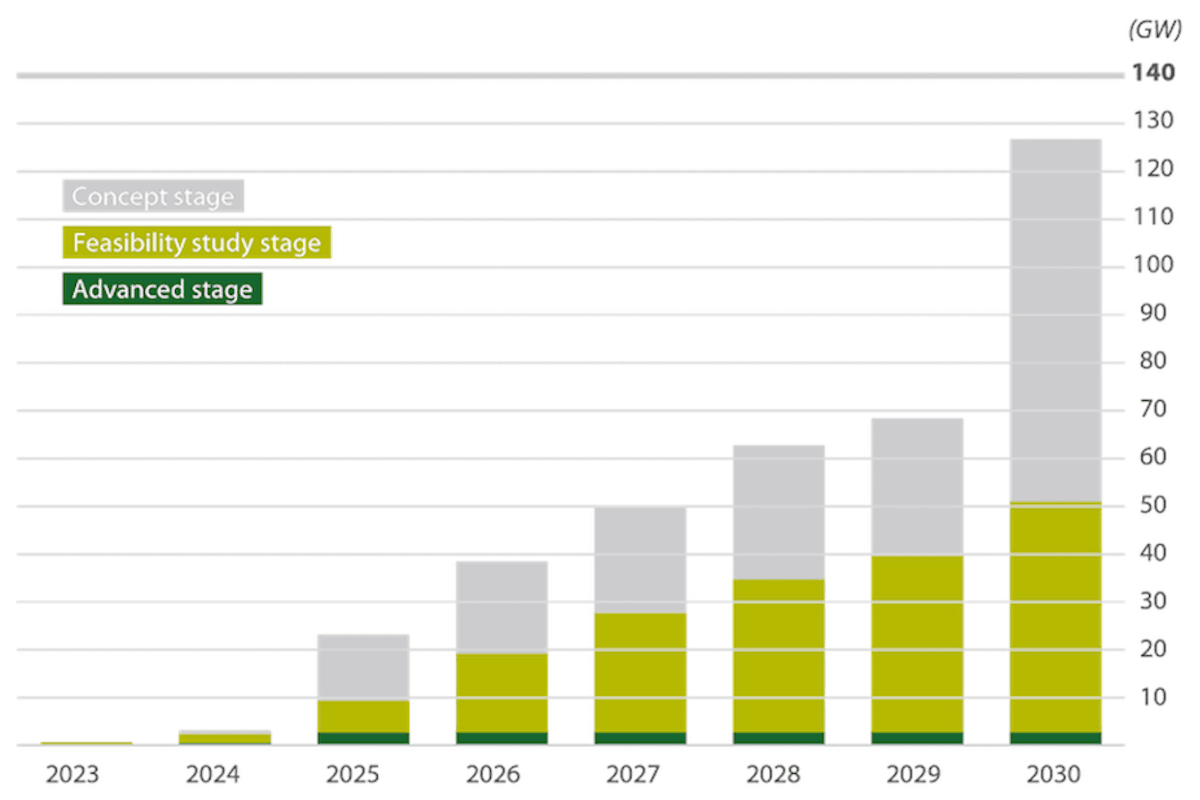
Electrolyser capacity of projects announced (cumulative, in GW) by stage and projected year of entry into operation (as of October 2023). Note: Advanced stage includes projects that are operational, or where the stage is “under construction”, or for which a final investment decision has been taken. Source: ECA, based on data from the International Energy Agency
And the dismantling continued with the member states’ targets, National Energy and Climate Plans (PNEC), that are in the process of being updated. Luxembourg’s government presented its new PNEC on Wednesday. It was Wednesday in Luxembourg, more positive than the European Court of Auditors. The seven measures planned by the Luxembourg government to develop a renewable hydrogen market are "cooperation on infrastructure and certification, the implementation of flagship or pilot projects, the identification of supply, import and demand potential, the development of financial instruments to stimulate supply and demand, for example, through operating or investment aid as for other renewable energies, and the deployment of hydrogen filling stations, the first of which is under construction and will be commissioned in 2023."
The national objective can be summed up in one sentence: to replace 100% of the fossil hydrogen used by industry with renewable hydrogen by 2030 at the latest. "A decarbonisation study of industry and a decarbonisation study of the road transport (logistics) sector show that demand for hydrogen could already be substantial before the end of the decade", said the Luxembourg document. "Close collaboration with the Luxembourg natural gas transmission system operator and with natural gas transmission system operators in neighbouring countries has been initiated. Luxembourg is working to ensure a connection to a European hydrogen infrastructure that will enable large quantities of hydrogen to be transported in order to meet emerging demand to decarbonise sectors and processes that are difficult to electrify. It is estimated that the first hydrogen pipeline could be commissioned around 2035.”
2024, a decisive year
In 2021, when presenting Luxembourg's first hydrogen strategy, then environment minister Claude Turmes (déi Greng), said that "aiming for climate neutrality by 2050, and after discussions with the sector, it can be projected that the sensitive and targeted use of renewable hydrogen and its renewable derivatives will eventually require a volume in excess of 125,000 tonnes (H2) per year and up to 300,000 tonnes (H2) per year, i.e., between 4 and 10 TWh (H2) per year in Luxembourg". From 1 to 4 TWh for industry, from 2 to 4 TWh for transport and from 1 to 2 TWh through the emergence of an integrated energy system. Producing such quantities of hydrogen would require 6 to 15 TWh of renewable electricity per year between now and 2050. Let's be pragmatic, replied Luxembourg industry trade group Fedil, inviting manufacturers to commit to moving towards hydrogen without getting stuck on green hydrogen.
And time is running out, said ECA. While some announcements have been made, it will take three to five years for the decision to invest in renewable hydrogen production projects to be made, and a further three to five years for construction and commissioning. In other words, for 2030 targets, 2024 will be a decisive year.
This timetable is one of the problems, explained the representatives of ministries and industry, in moving faster, higher and stronger. Like the lack of standards and certification systems, the difficulty of guaranteeing demand (because of the lack of visibility on the quantity available and on the price), inflation, which increases the cost of projects and the price of electricity, the difficulty of obtaining supplies of renewable energy, the length of the procedures for obtaining a permit, the lack of sources of finance and the absence of transmission and distribution networks.
And electrolyser manufacturers have other problems that will eventually become strategic: not enough electrolysers being produced in Europe, problems of access to raw materials, lack of skilled labour... and this text in preparation of these chemical substances grouped together under the acronym PFAS: there is no alternative either for electrolyser membranes or for fuel cells.
Read also
Priority for Ursula Von der Leyen
The European Court of Auditors called on the European Commission to update its strategy by 2025 (incentives, limited allocation of funds, industries to be prioritised), to draw up a roadmap and monitor progress by mid-2026, to obtain detailed data on national funding by the end of the year, to monitor licensing procedures, and to decide on support measures, in all three cases by mid-2025.
The candidate for president of the European Commission--and now president for the next five years--von der Leyen, barely had time to hear the message. After an EU court ruled against her for withholding information on vaccine orders on Wednesday, she only mentioned hydrogen four times in her general policy speech to the European Parliament at midday on Thursday. "We must use the power and size of our market to secure supplies. That is why I will propose activating and extending our aggregate demand mechanism to go beyond gas and include hydrogen and critical raw materials", she said. Then she assured us that "the European Competitiveness Fund will support Important Projects of Common Interest (iPCI) so that Europe can use its collective strength to invest together in ambitious joint projects - as has already been done on a smaller scale with batteries, hydrogen and microelectronics."
"We need a new impetus in our mutual partnership with Africa before the next EU-African Union summit in 2025. Through Global Gateway, we will stimulate investment in transport corridors, ports, renewable energy production, green hydrogen production and commodity value chains", the commission president also announced.
"Luxembourg has a moral obligation towards the countries from which it intends to import raw materials, energy or, in this case, hydrogen", warned the platform for climate action and energy transition--called on by the government as part of the PNEC--"as part of the feasibility study for hydrogen production in Cape Verde, with a view to its export to Luxembourg, the climate platform recommends ensuring that any investment in energy transition benefits the local population first."
That's what it says too. But Cape Verde is not the only 'friendly' country on the authorities' radar. In addition to the Greater Region's MosaHYc project, Luxembourg has signed import agreements with Denmark via the Netherlands and the port of Mertert, then with Portugal and its facility at the port of Sines.
It will be up to the new European Commission to sort all this out as soon as possible, given the difficulties of anticipating a nascent market surrounded by so many technical, financial and regulatory constraints.
Read the original French version of this report here