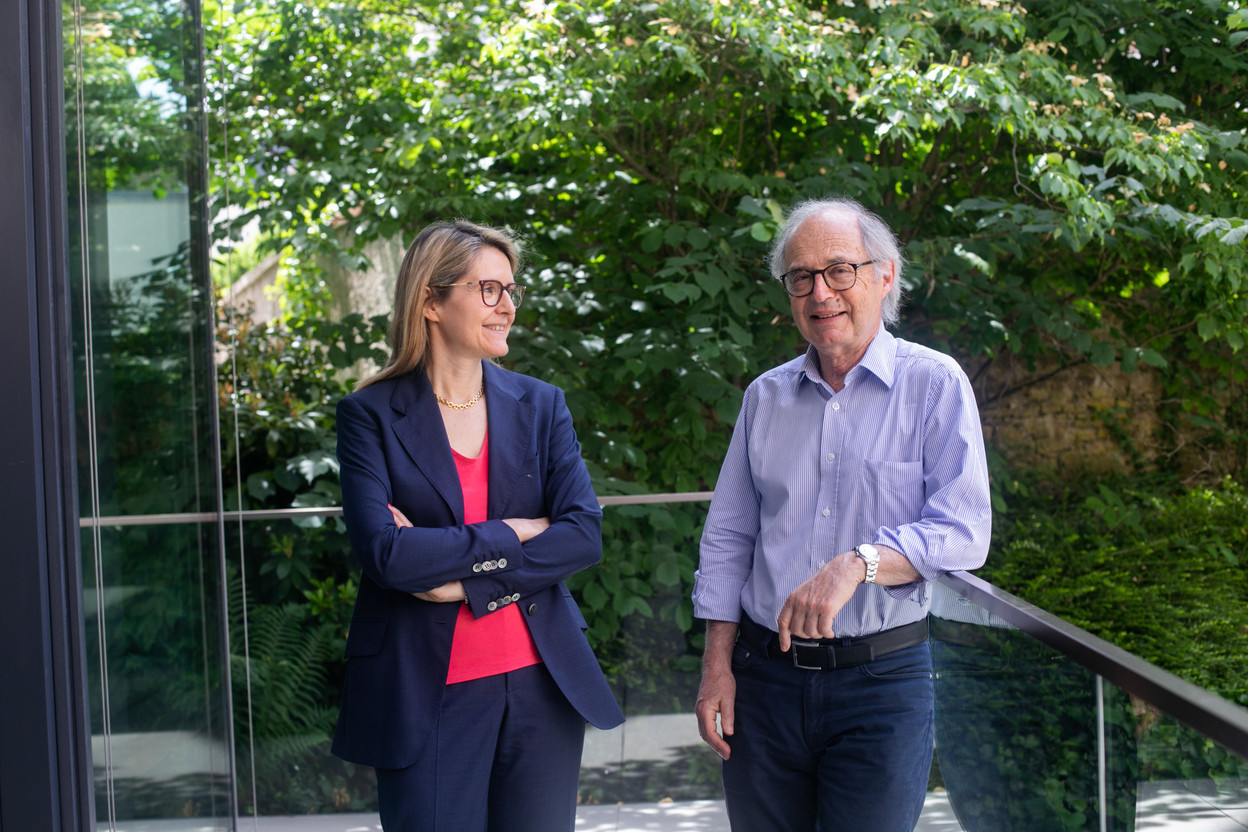
After leaving the bank Degroof Petercam, where he was CEO and then head of private banking, Bruno Colmant returned to his roots at the consulting firm Roland Berger, where he was appointed partner last May. He had held the same position between September 2011 and October 2015, before joining Bank Degroof. He is also a professor at several Belgian universities. He spoke to Paperjam and Delano about the risks of the current economic situation.
Marc Fassone: For a long time, debt was presented as something bad, dangerous, even taboo. In recent years, this topic has disappeared from the headlines. Can the current economic conditions bring it back to the fore?
Bruno Colmant: The theme of debt has disappeared because we have lived for 40 years in a period of structural disinflation and for the last 10 years in a period of debt monetisation. In other words, since inflation has disappeared, interest rates have fallen and at the same time, banks have appeared as the new creditors of states.
This gave an illusion of ‘perpetual’ borrowing after all.
The debt on the balance sheet of central banks, or at least the public debt, is, I think, a debt that will be refinanced ad infinitum. The real problem that will arise will be the new debt that will have a higher interest rate.
But I’m not too worried at the moment, because the central banks are keeping their rates very low for the moment. This results in a negative real interest rate. Today, the real interest rate is lower than it was a year ago. So we are still borrowing after inflation at extremely favourable conditions. And this is often forgotten...
When we say that a state has a debt to GDP ratio of, say, 110%, in the end we have to deduct 30% of this amount which is in the balance sheet of the central bank. So the ‘operational’ debt to GDP ratio becomes 80%. So of course the refinancing will be at a higher interest rate. But as the central bank earns money from its debt operations, the ‘dividend’ it pays to the states will compensate for this.
Some analysts believe that the European Central Bank cannot raise rates as it would like precisely because of the stock of government debt. Do you share this view?
Yes, but the risk does not come from the stock of debt.
The ECB is caught between a reality and an illusion.
The reality is that an increase in interest rates that is too high would be harmful for states. The European Central Bank cannot afford this because of its debt buy-back operations. This is an unbelievable situation that is the exact opposite of the famous independence of central banks that has been promoted.
The illusion is believing that raising interest rates will fight inflation. This is not true. For two reasons.
First of all, we have imported inflation, which is scarcity inflation. And the central bank can’t do anything about that. It is not because it raises rates that Russian gas will become cheaper.
And secondly, raising interest rates only fights inflation if two conditions are met: full employment and maximum capacity utilisation. This is the case in the US, but not in Europe. Raising interest rates serves no purpose, except to risk a contraction of the economy and to embarrass governments. The risk is that of the fragmentation that we experienced 10 years ago and which is linked to the fact that there is too great a rate differential between certain countries. But we understand that the ECB will more or less modulate its asset refinancing to refinance Italy a little more and Germany a little less.
In my view, it will hover between all these constraints and do everything it can to prevent a significant rise in rates.
If the situation is under control for governments, what about for companies?
Most companies--at least the more lucid and visionary ones--don’t really have a debt problem, because they have secured their long-term debt at low interest rates.
The current concern for companies is energy and social costs. It is clear that their margins will suffer.
And what about the situation of households?
Their situation is more worrying.
The inflationary shock translates into a loss of purchasing power. What worries me is that we are seeing an increase in the demand for personal loans. This is the case in France. This means that initially, people who are affected by the drop in their purchasing power are looking to debt to supplement their income. We know that this is not a solution. This is a risk factor.
The situation is also tense for mortgages. There is a double negative effect for first-time homeowners: a higher purchase price and higher financing costs. This is an unfair situation.
But for me, it is currently the social risk that is the most important. Society is in the process of dividing and if we don’t stop this movement it will be dangerous and it is its foundation--living together peacefully with a common shared project--that will be threatened. The purchasing power of the middle class is not extraordinary and we can expect the situation to get worse. In September there will be a second round of inflation in the food sector, that is very clear to me.
Watch out.
This article was published for the Paperjam + Delano Finance newsletter, the weekly source for financial news in Luxembourg. Subscribe using this link. Read the original version of the interview in French on the Paperjam website.