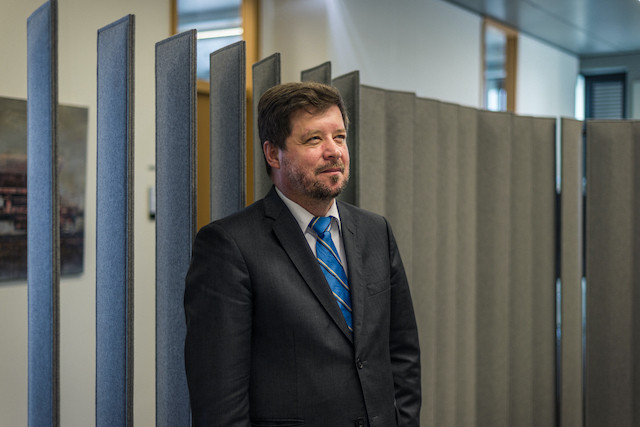
As the pandemic arrived in Luxembourg at the start of 2020, the grand duchy’s public research institutions and the FNR quickly created the Research Luxembourg covid-19 task force. “Research had to step up,” says Schiltz. “We had to give back.”
The FNR freed up €7.5m in funding for pandemic-related research projects, including the weekly analysis of wastewater for traces of virus particles, studies on the long-term effects of the coronavirus and developing the large-scale testing programme.
“This wasn’t about self-promotion,” Schiltz says about the collaboration. “It was all of us together. Everyone has their strengths.” The task force was a boost for the Research Luxembourg brand, founded well before the pandemic with middling success in an effort to present a more united front.
While there has always been some cross-pollination between the grand duchy’s public research hubs, there is also competition, for funding, attention and recognition. “I hope we can continue carrying this forward and learn that lesson for the future,” says Schiltz about the pandemic’s spirit of scientific siblinghood.
Schiltz has been at the helm of the FNR for ten years in 2021. “Ten years ago, we were much more in a pioneer phrase, we were building things from the ground up, testing things,” he says. “The research system has become more professional, consolidated, is much stronger, in terms of quantity but also quality.”
The pandemic response back then would have been much more limited, Schiltz surmises. “Everybody would have tried to do their best,” he says, but the research landscape wouldn’t have been prepared to help deliver answers to the extent it is today.
Still, there was a learning process. “The interaction between research and the political sphere was something new for both sides,” Schiltz says, “The dialogue and exchange were very close.”
Politicians, and the public, had to understand that science doesn’t always deliver clear answers and that the state of knowledge changes. A prime example is the use of masks, which at the beginning of the pandemic was deemed necessary only for at-risk individuals but has now become ubiquitous.
Researchers, on the other hand, had to understand that politicians must weigh up scientific evidence against other factors, such as societal wellbeing or the economy. “Everyone has to stick to their role,” Schiltz says. “It worked well in the end.”
A case for spending
Luxembourg’s government invests around 0.7% of GDP in research and development, below an EU average of just over 0.8% and far from an EU target of public spending worth 1.25% of GDP on R&D by 2030.
“During the pandemic, research has been able to show that there is a direct benefit for society and the country, and that’s important,” says Schiltz. “The expenditure is justified.”
The FNR will soon begin talks on its next four-year budget, the current one expiring in 2021. “There’s clearly a willingness to keep investing,” Schiltz says, adding that as the research landscape grows in size and substance, government funds will need to account for this.
In 2020, the FNR committed €97.06m on public research, up from €54.23m the year before, a big jump even when not taking into account the extra pandemic funding. “Many more projects were submitted. Demand increased substantially and a majority of projects was evaluated favourably. When there are good projects, we want to finance them to the best of our abilities,” says Schiltz.
Projects submitted for funding to the FNR are evaluated by scientific committees including international experts. “The message from them is clear that the quality of research is increasing.”
At the end of 2019, the government for the first time passed a national research strategy, which outlines four priorities: Industrial and service transformation, personalised healthcare, 21st century education, and sustainable and responsible development. “These are all important projects where research can and should play its part,” says Schiltz.
The FNR secretary general doesn’t believe that social and human sciences are being sidelined, even though they receive only between a fifth and a quarter of the annual funds attributed.
“Looking at the UN’s 17 sustainable development goals, they’re societal changes rather than technical ones,” Schiltz says, citing digitalisation as an example. “The technical aspect is a small part. The bigger challenge is how does it change society? How does it change the healthcare sector, education? These societal questions are much more difficult to answer.”
Fighting fake news
The public is responding well to the progress research and science in Luxembourg are making. Nearly two thirds of respondents (64%) in a survey conducted by the FNR this year said they are interested in science and research. In 2013, this number was at only 43%.
Trust in science has also grown, from 67% in 2019 to 70% in this year’s edition of the study, which is carried out every two years.
“We’re really happy about it,” says Schiltz. But the researcher adds: “The fight against fake news and conspiracy theories will unfortunately be one of the big challenges in the next years.”
The FNR has boosted its presence on social media through its science.lu platform and cooperation with local media. “There is an enormous need for information,” Schiltz says. With trust and interest in place, the organisation plans to further build its public outreach in coming years.
But misinformation isn’t the only challenge ahead. “We must continue consolidating our research system,” says Schiltz. This includes quality projects, attracting talents, funds, the right infrastructure and international recognition.
Schiltz also sees room to involve external stakeholders more closely, for example, the healthcare or education sectors, which are among the national research priorities. “If we want our research to have an impact, we must involve people, respond to the expectations of external stakeholders.”
And Luxembourg must continue moving with the times. “The manner in which we do science and work together changes,” says Schiltz, citing open access research, data sharing and more collaboration as replacing the lone star researcher.
In a first step, the funding body will award a mentorship prize for the first time at this year’s FNR Awards. It’s part of a process to move away from corporate-style performance indicators, such as the number of publications or citations. “Funding agencies are in the process to try and rethink the evaluation system, what we value in science,” Schiltz says. “We have to make sure we’re a frontrunner and not running behind these trends.”