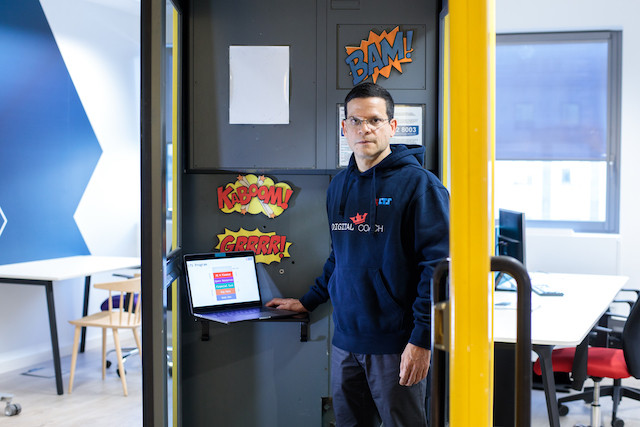
A 2017 Eurostat report showed that in Luxembourg, 6 in 10 ICT jobs were hard to fill. “Instead of complaining, myself and three other people decided to do something about it,” says Sergio Coronado, founder of the Luxembourg Tech School.
He says he noticed there was a gap in the education system and so began developing a virtual school with a targeted programme, where teenagers in their last three years of high school, aged 15-19, can train to become future digital leaders. Coronado says he quickly received support from the education ministry and Digital Luxembourg.
“The programmes are built on a business component,” he says. “We’re not a coding school. We give them a context, a business need or problem, and then the technology to solve the problem. It’s very powerful.”
What initially started off as a one-year programme in 2016 with 32 graduates has since developed rapidly, in part due to the motivation of the students themselves. Today, LTS has around 110 students, split nearly 50-50 between females and males, with possibility for students to “level up”. Level one focuses on game development, big data and financial tech. Each module lasts about three months, culminating in a competition, tech showcase and fintech hackathon, respectively. Level two gets into space resources and AI for finance, with more to come in 2020.
To maintain quality, Coronado says he wants to target a maximum of 150 students in a single year. “A big challenge for us is to revise the content every year because it changes, and we make sure the younger generations get the latest, because by the time we go to the market, it would already be obsolete… we need to keep the content alive.”
LTS promotes not only tech and an open, dynamic environment--built on teams, with minimal help from the coaches so students help each other with problem-solving--, it also shows industry that youngsters are ready for such challenges. Coronado is actively trying to address the “chicken and egg” situation, where employers may be reluctant to hire those lacking experience, but youngsters will never be able to prove their worth if not given opportunities. And so LTS also developed “Learn to Work” so that students get support from industry. Coronado says the target in January was to offer 1,000 hours of paid work in total--10 students at 100 hours each--but by summer, they’d already doubled that goal.