The challenge of financing a massive rearmament drive while navigating the highest debt levels since the Second World War is now playing out in real time among the institutions shaping the EU’s fiscal and political direction.
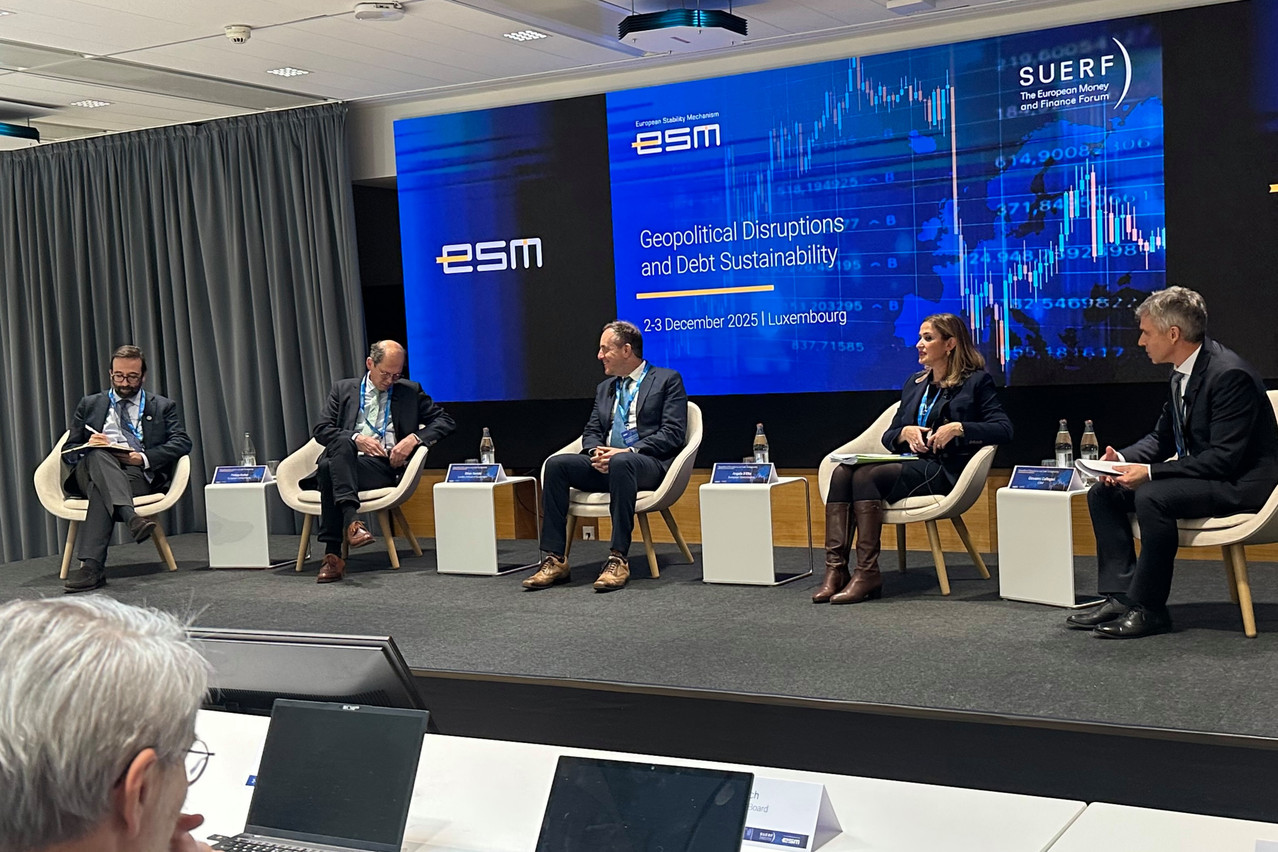
This was evident at a high-level ESM/SUERF conference on “Geopolitical Disruptions and Debt Sustainability”. In a panel on geopolitical risks and public debt, a consensus emerged: while Europe’s strategic environment has changed for good, the economic strategy to deal with it remains trapped between political ambition and market reality.
Leading the technical charge, Angela d’Elia, head of unit for the sustainability of public finances at the European Commission, confirmed that Brussels has urged member states to trigger the “national escape clause” in the reformed fiscal rules. The clause allows governments to deviate from expenditure paths by up to 1.5% to finance defence needs until 2028. Luxembourg has notably abstained to signal its cautious stance.
No free lunch
But d’Elia warned this flexibility is “not a free lunch”. The additional debt will require steeper adjustments once the clause expires in 2029. And defence spending comes on top of two structural pressures already straining the framework: ageing populations and mounting climate-adaptation costs.
Ethan Ilzetzki, associate professor at the London School of Economics, offered a pragmatic, if contrarian, roadmap. “I found myself having to persuade European policymakers that a defence expansion is not going to destroy the European economy,” he said. Defence buildups, he argued, typically have a five-year “half-life”, meaning frontloaded, durable goods should be debt-financed. Historically, governments seldom cut social spending to pay for war preparations.
No growth miracle
Ilzetzki dismissed expectations of a growth miracle. While the US during World War II effectively “added another US economy to itself”, he noted this was military output displacing civilian activity, leaving the fiscal multiplier at roughly one.
Yet he offered a sociological silver lining from new research on “hard hat jobs”. Modern defence production, he said, creates “the type of jobs that Donald Trump likes to take pictures of himself with”—manufacturing rather than service-sector roles. Defence spending could therefore act as a training ground for low-skilled workers, “internalising the externality” of human-capital development.
Prisoners of debt
Speaking after the panel, ESM managing director Pierre Gramegna invoked an allegory from Amélie Nothomb’s Péplum—in which captors claim to have “abolished the south”—to warn that geopolitical shocks can upend international cooperation. His prescription was political boldness: treating shared fiscal discipline as a competitive asset to “bake a bigger pie”. Citing Airbus as the blueprint for autonomous defence, he argued that the solution is “not less Europe, but more Europe”.
In a keynote address, the IMF’s Era Dabla-Norris countered this with an empirical warning. Quoting economist Alan Auerbach, she reminded the room that “hoping for a better future does not constitute an appropriate policy response to uncertainty.” She dismantled the “optimism bias” embedded in current forecasts, noting that political manifestos advocating higher spending have surged markedly since the 1960s, even as “many countries are still pressing the fiscal accelerator”. This collides, she said, with “geoeconomic fragmentation”, a force she estimated could add 2.5 percentage points to debt levels.
Ilzetzki challenged the gloom during the Q&A, pointing to France, where yields remain historically low despite political upheaval—“the dog that refuses to bark”.
Monetary straitjacket
Earlier, Philipp Rother of the European Central Bank injected monetary realism, emphasising the fragility of the euro area’s architecture: “one monetary policy and many fiscal policies”. He showed that gross financing needs for several member states are breaching the 20% of GDP threshold—a “green line” that triggers heightened scrutiny of sustainability risks.
Rother cautioned that markets may view long-term debt as sustainable today, but expected values rarely hold. “There will be some disasters of whatever political kind,” he warned, “and that will kick you out of this projected path.”
Asked whether a fiscal union might help, Rother conceded it would make the ECB’s job “easier” and more textbook-like. But he pointed to a potential market-liquidity trap: shifting issuance to EU-level bonds could drain liquidity from national markets, destabilising the very sovereigns the system aims to protect.
Efficiency deficit
The panel ended with a sharp exchange on coordination. One audience member contrasted Europe’s fragmented system with the US, where project assignment is centralised. Ilzetzki agreed, while cautioning against “over-romanticising” the American model: “The Navy has an Air Force,” he quipped, pointing to the huge duplication within the Pentagon itself.
A factual dispute underscored the opacity of Europe’s defence supply chain. Ilzetzki estimated around 70% of defence material is imported, largely from the US. An audience member disputed this, citing reports—likely Draghi or Kiel—that put domestic production far higher, at 80–90%. Estimates vary widely depending on methodology. Yet regardless of where the money is ultimately spent, the consensus remained that without the sense of urgency seen in Ukraine—one participant pointed to the rapid scaling of drone production—the fiscal space for Europe’s rearmament is shrinking fast.