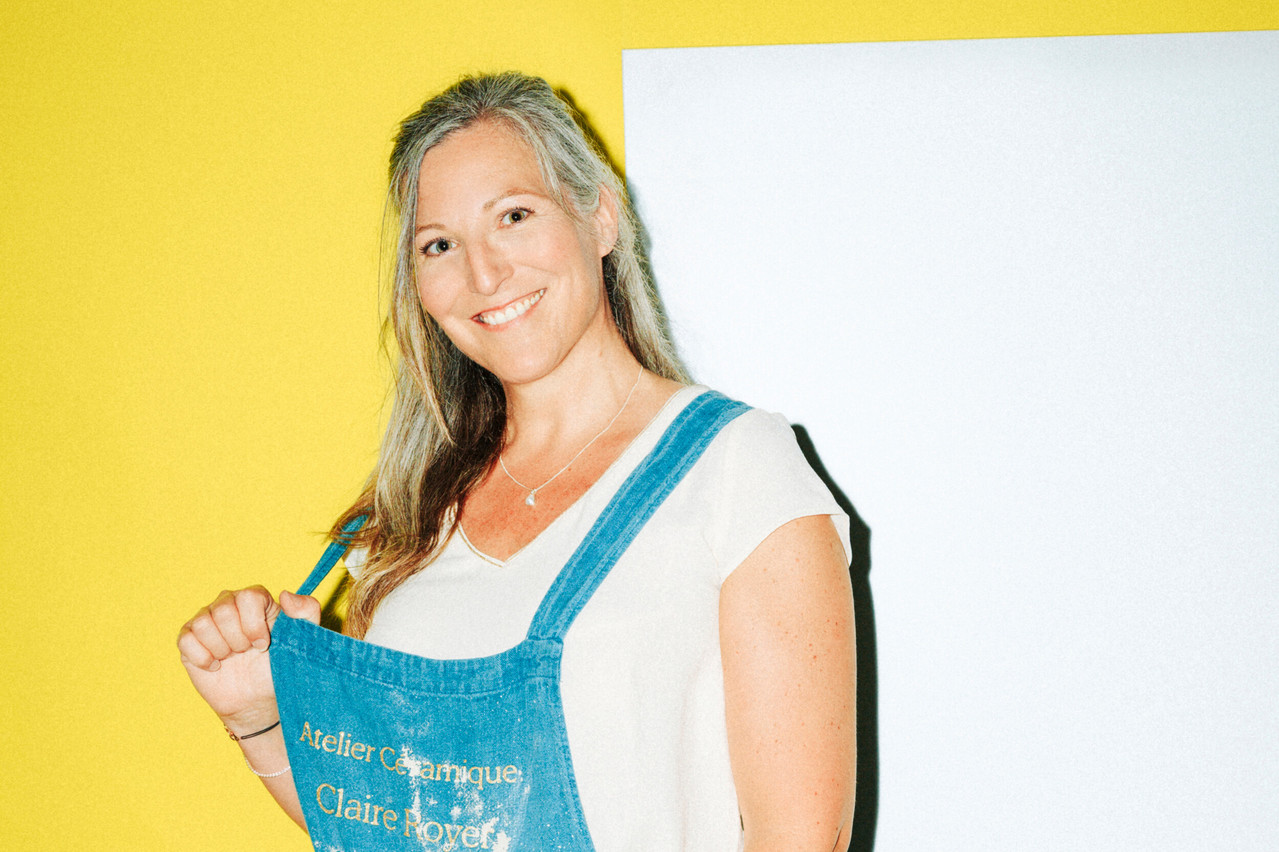
After 15 years in finance in Luxembourg, Claire Royer decided to change careers as she approached her forties. Having been passionate about pottery since childhood, she undertook a six-month training course in Paris before opening her studio in September 2019. Today, she divides her time between creating ceramic pieces, fulfilling commissions for private clients and restaurants, and teaching pottery classes. She now hopes to set up a pottery school to expand her range of courses.
Why did you leave the world of finance to take up ceramics?
Claire Royer. – “When I arrived in Luxembourg, I was 25 and finishing my studies. I saw all these beautiful villas and examples of professional success. In my mind, I had a career goal and a life goal: to get married, have two children, own a beautiful villa and hold a senior position. When I achieved that situation, which for me was the key to happiness and success, I felt empty and not at all fulfilled. I thought to myself: ‘On paper, I’ve got it all, so why don’t I feel fulfilled?’
I went on a meditative journey, a period of self-reflection, to try to find my bearings again and work out who I was. I think I had a slightly more creative side, and there were other things I wanted to express that I couldn’t in my job. And that frustrated me.
I thought to myself that perhaps it was that little spark that would keep me going. I decided to take the plunge.

Was pottery already a passion of yours?
“During this period of self-reflection, I had a flashback to when I was little, working the soil. It was something that brought me immense pleasure and a great deal of pride. I told myself that perhaps it was this little spark that would sustain me. I decided to take the plunge.
How did you prepare for your career change?
“In 2018, as I was approaching my forties, I decided to change careers. I had the support of my ex-husband, who helped me through this transition. I undertook a six-month training course in Paris, then set up my own workshop in September 2019.
I didn’t want to be an artist. I have two children to support and I’m on my own. For me, it was important to support myself and be independent. Being an artist seemed riskier and more uncertain to me, whereas being a craftsperson, with my own workshop and a small business, seemed a bit more sustainable in terms of income.
What are the different activities carried out at your workshop?
“I design my own collections. I work with stoneware and porcelain. I create tableware collections for private customers, as well as for restaurants. In particular, I have worked with the Clairefontaine and a Parisian restaurant run by Jean-François Piège.
I also run workshops. I specialise in pottery-throwing classes. What’s great about our profession is this dual role: teaching classes and interacting with students, and then the more solitary side of creation. That’s when you need to be on your own, in a quieter environment, to experiment, create collections and produce them.
What are the defining features of your designs?
“I really love anything that’s very soft. I like pieces that gently accompany us, both in the colours I use and in the way they feel to the touch. I like playing with different materials, the glazed parts and the raw, rougher parts of the clay. I like shapes that are quite feminine, quite rounded and yet quite slender at the same time.
Developing the courses alongside other ceramists will enable me to reach a wider audience and meet demand.
I find everything Japanese very inspiring, and nature, of course. For the Folia collection, these are very organic porcelain pieces that evoke coral, foliage and other plant-like forms. They are functional, but also decorative. You can leave them on the table as a centrepiece, like a sculpture.
Why do you want to set up a ceramics academy?
“I get a lot of enquiries about my classes and, at the moment, I’m running them all on my own. I only have five places on each course. What I really love is this close connection with people. My teaching approach really supports them, guiding their movements, always with kindness. Students come back term after term. Developing the courses with other potters will allow me to reach more people and meet the demand.
Anouk, who went to the same school as me in Paris, is leading a workshop. Another ceramist, Anaïs, is also due to run some classes. We’re going to expand our range of courses with professional potters who have the expertise and technical skills. These are leisure classes, not courses leading to a qualification.
What are the challenges of running your own business on your own?
“When you’re on your own, you’re as much a community manager as you are a potter, an accountant and a communications officer. You have to organise events and photo shoots, manage registrations and check payments. There’s a lot to do.
When you’re self-employed, your business is part of who you are. It’s part of who we are.
It’s great being on my own, but on the other hand, I have less time to devote to new collections, producing my pieces and developing my brand. I’d really like to take on a workshop manager who would take care of all the day-to-day running of the workshop.
How do you view your journey since the workshop opened?
“I find myself thinking that it’s all gone by so quickly, that I haven’t even noticed the years passing. When I look at my daughters, I realise how much time has gone by. They were little when I set up the workshop; now they’re teenagers. I also wanted to make this change for them, to show them that when you really have a dream, a plan or a desire, you have to believe in yourself and take the plunge. You then have to give yourself the means to succeed, and that’s not easy. I work much harder than I did when I was an employee.
When you’re self-employed, your business is part of who you are. It’s part of who we are. We work hard, but on the other hand, it doesn’t really feel like work. When I started out, I never imagined I’d have such wonderful projects and such great opportunities.
For me, success is when you feel alive and when you find fulfilment in your work.
How would you define success today?
“I’ve re-examined this notion through my career change. Before, I had a completely different idea of success. For me, success is when you feel alive and when you find fulfilment in your work. It’s also when you manage to strike a good balance between your professional and personal life, and both are fulfilling and enriching.
How do you envisage the future of your workshop?
“In five years’ time, I’d like to see the academy grow, with more ceramicists joining the team so that we can open the workshop to even more students and share our passion with them. I’d also like to work on projects creating pieces in collaboration with other shops or restaurants.
But I don’t want to end up just managing staff, doing admin and running a business. In the craft sector, the balance is very delicate. I want to keep my hands in the clay. I want to strike the right balance between growing the business and continuing to create pieces.”
This article was written for the October 2026 issue of Paperjam magazine, published on 16 September. The content is produced exclusively for the magazine. It is published on the site to contribute to Paperjam’s comprehensive archive. Click on this link to subscribe to the magazine.
Is your company a member of the Paperjam Club? You can request a subscription in your name. Please let us know via club@paperjam.lu.