
Europe’s sustainable fund market remained above water in the second quarter of 2026, but the headline inflow conceals a sharp change in investor behaviour, said Morningstar’s Global Sustainable Fund Flows: Q2 2026, published in August 2026.
Bond funds and passive products attracted substantial sums, while active managers, equity strategies and new fund launches struggled. The result is a market that is still growing, yet increasingly concentrated around cheaper vehicles, defensive assets and a small group of dominant providers.
Bonds keep flows positive
European-domiciled sustainable funds attracted $3.5bn during the quarter, down from a restated $8.2bn in the first three months of the year (see Chart 1). The positive total was entirely dependent on passive strategies, which collected $11.4bn. Active funds, by contrast, suffered $7.8bn of withdrawals.
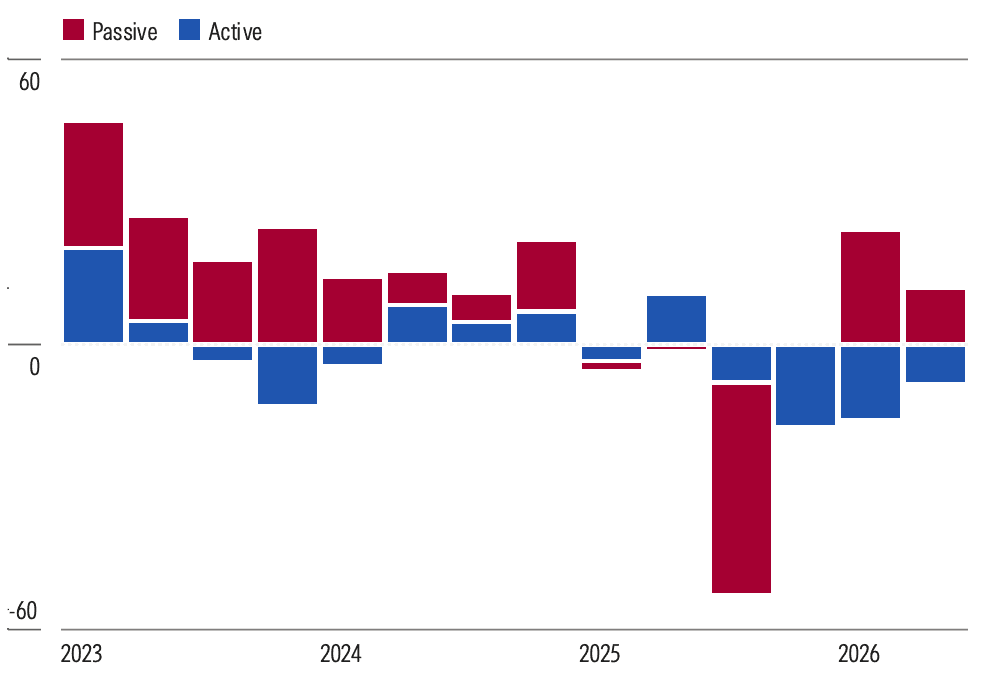
Chart 1: European sustainable fund flows by investment style USD billion Source: Morningstar Direct. Data as of June 30, 2026. Flows exclude funds of funds.
The divide was equally stark across asset classes. Sustainable fixed-income funds drew $14.4bn as geopolitical uncertainty encouraged investors to seek the relative security of bonds (see Chart 2). Sustainable equity funds lost $9.3bn, even as equity funds in the broader European market continued to receive money. Those conventional-market inflows were heavily directed towards passive strategies offering broad exposure to US, global and technology stocks.
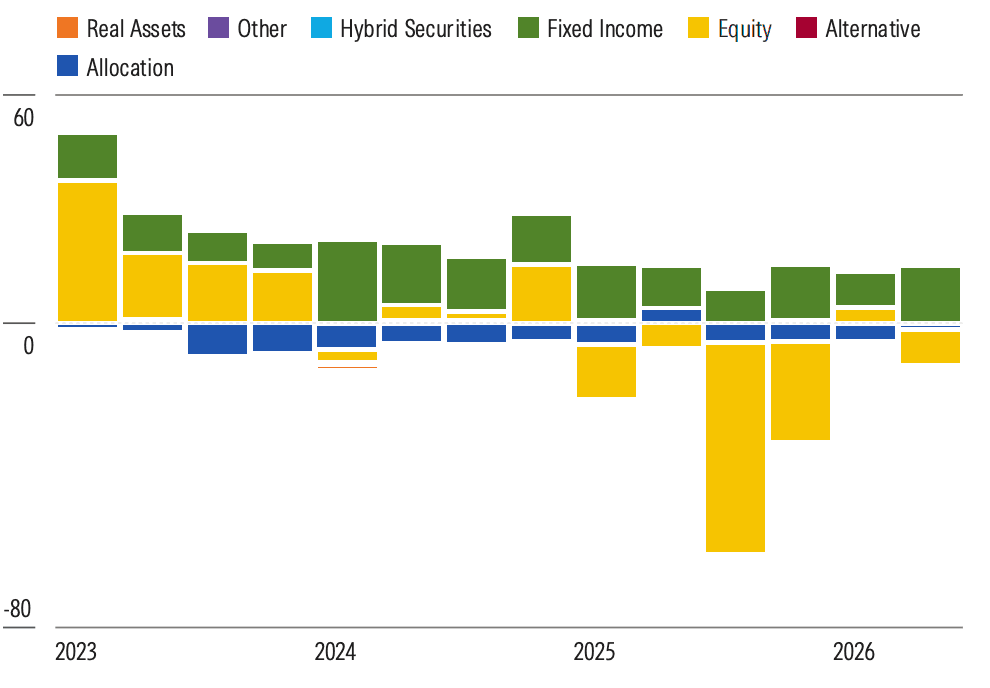
Chart 2: European sustainable fund flows by asset class USD billion Source: Morningstar Direct. Data as of June 30, 2026. Flows exclude funds of funds.
AI and space capture attention
Some equity products nevertheless found enthusiastic buyers. The newly launched ABN AMRO FGR Portfolio Classic EuroTilt ESG Equities led the rankings with inflows of just over $4bn. The iShares MSCI ACWI Screened ETF followed with almost $2.5bn.
Investor excitement surrounding artificial intelligence also lifted the iShares MSCI Global Semiconductors ETF, which attracted nearly $1.7bn. VanEck’s Space Innovators ETF gathered just over $1bn, suggesting that narrowly defined technological themes can still succeed within an otherwise difficult market for sustainable equities.
At the other end of the table, the Amundi S&P 500 Climate Paris Aligned ETF lost $2.7bn. The largest individual outflow, however, came from TM Brunel Global Sustainable Equity, which shed almost $5.7bn as part of a politically driven restructuring rather than an ordinary loss of investor confidence.
Brunel closure distorts the picture
The Brunel withdrawals followed the UK government’s “Fit for the Future” reforms. Brunel Pension Partnership was one of two Local Government Pension Scheme pools ordered to disband, prompting its client funds to select new pooling partners.
Morningstar described the subsequent movement of assets as a one-off, policy-mandated migration concentrated within a single sponsor relationship. The outflow should therefore not be interpreted as evidence of poor performance or a wider flight from sustainable investing.
This event pushed Thesis, also known as Tutman, to the bottom of the provider rankings with redemptions of almost $5.7bn. Eurizon recorded the next-largest outflow, losing $1.7bn across its sustainable range (see Chart 3).
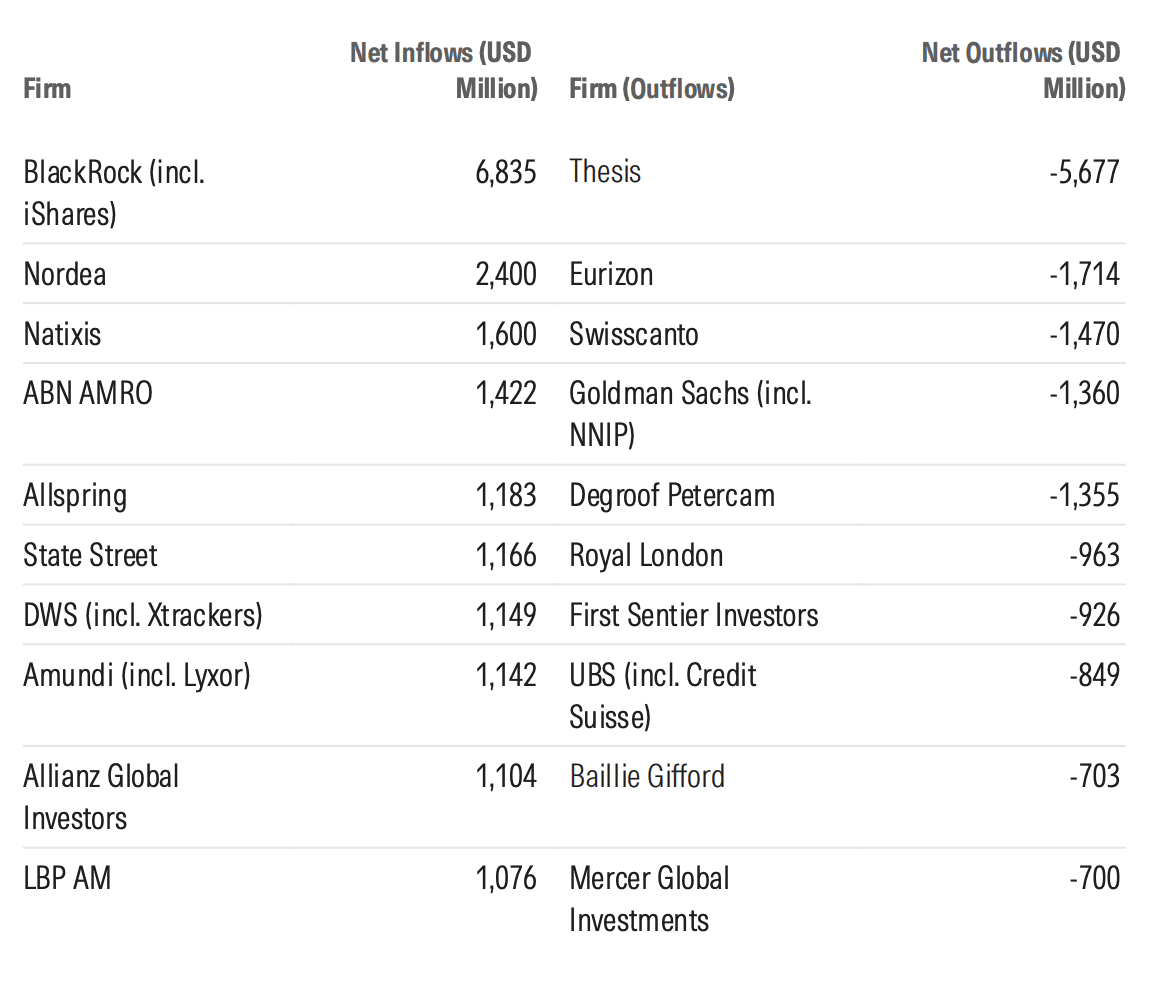
Chart 3: Top and Bottom 10 European Sustainable Fund Providers by Flows in Q2 2026 Source: Morningstar Direct. Data as of June 30, 2026. Flows exclude funds of funds.
BlackRock tightens its grip
The ten bestselling providers collectively attracted about $19bn. BlackRock led for a second consecutive quarter, taking in $6.8bn, followed by Nordea with $2.4bn and Natixis with $1.6bn.
BlackRock’s dominance extends well beyond quarterly sales. At the end of June, it managed $391bn in European sustainable open-end funds and exchange-traded funds. Amundi ranked second with $243bn, while UBS held third place with $215bn.
Overall sustainable fund assets rebounded to near-record levels after equity-market weakness linked to the Middle East conflict had depressed valuations in the first quarter. Equities still represented 65% of assets and bonds 22%. Passive funds increased their share of the market to 33%, up from 28% in early 2023.
Product development hits a low
Despite recovering assets, providers appear reluctant to expand their ranges. Only 13 sustainable funds were launched in Europe during the quarter, the lowest number in the series and well below the restated 38 launches recorded in the final quarter of 2025 (see Chart 4). Meanwhile, 64 funds closed, up from 56 in the preceding quarter.
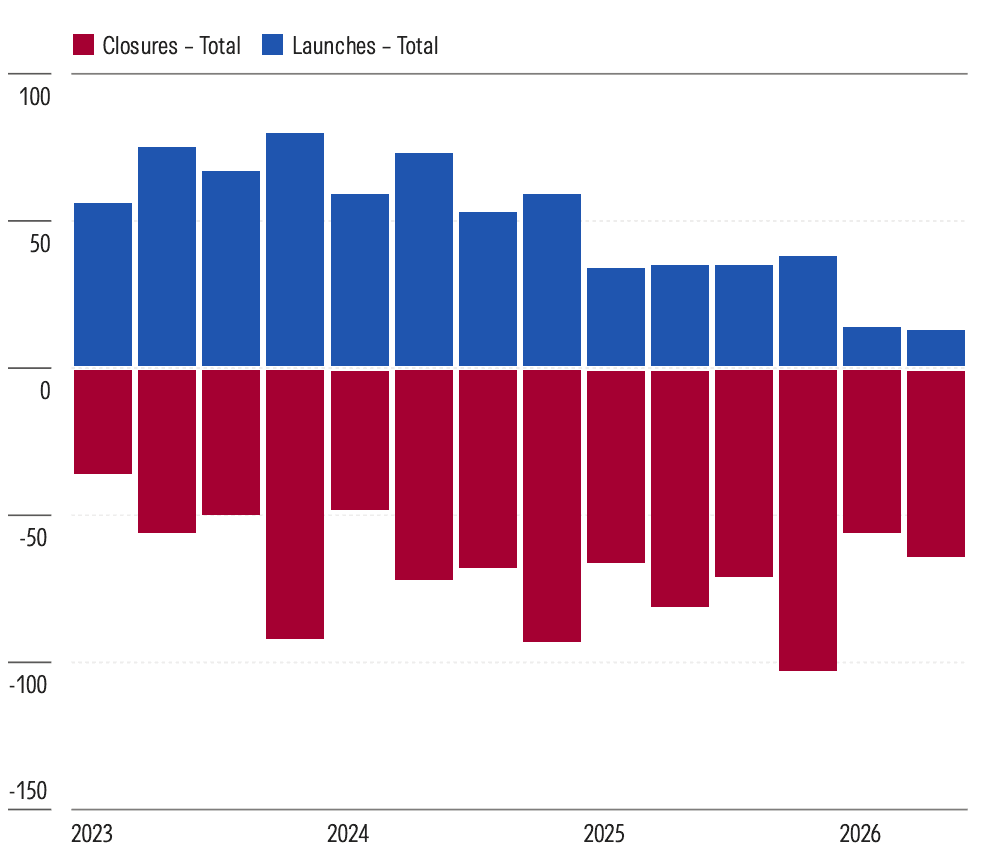
Chart 4: European sustainable fund launches and closures Source: Morningstar Direct. Data as of June 30, 2026.
The slowdown partly reflects normalisation after the launch boom of 2020–22. It also reveals greater caution among asset managers facing greenwashing accusations and regulatory uncertainty. Consolidating and rationalising existing ranges has replaced product proliferation as the industry’s priority.
Regulation enters a decisive phase
In the EU, negotiations over a revised Sustainable Finance Disclosure Regulation are moving forward. The Council has backed three categories — transition, ESG basics and sustainable — each carrying a 70% investment threshold. It also supports removing entity-level Principal Adverse Impact disclosures while demanding stronger product-level information from transition and sustainable funds.
Trilogue negotiations must still settle differences over sovereign debt, disclosure requirements and implementation. The Council favours a 24-month application period, rather than the European Commission’s proposed 18 months.
The UK is also reconsidering its approach. The Financial Conduct Authority has proposed replacing existing TCFD product reports with more targeted, outcome-based disclosures focused on financially material climate risks and opportunities. Together, these reforms could make sustainable labels more exacting just as Europe’s fund industry becomes more selective about where it places its bets.