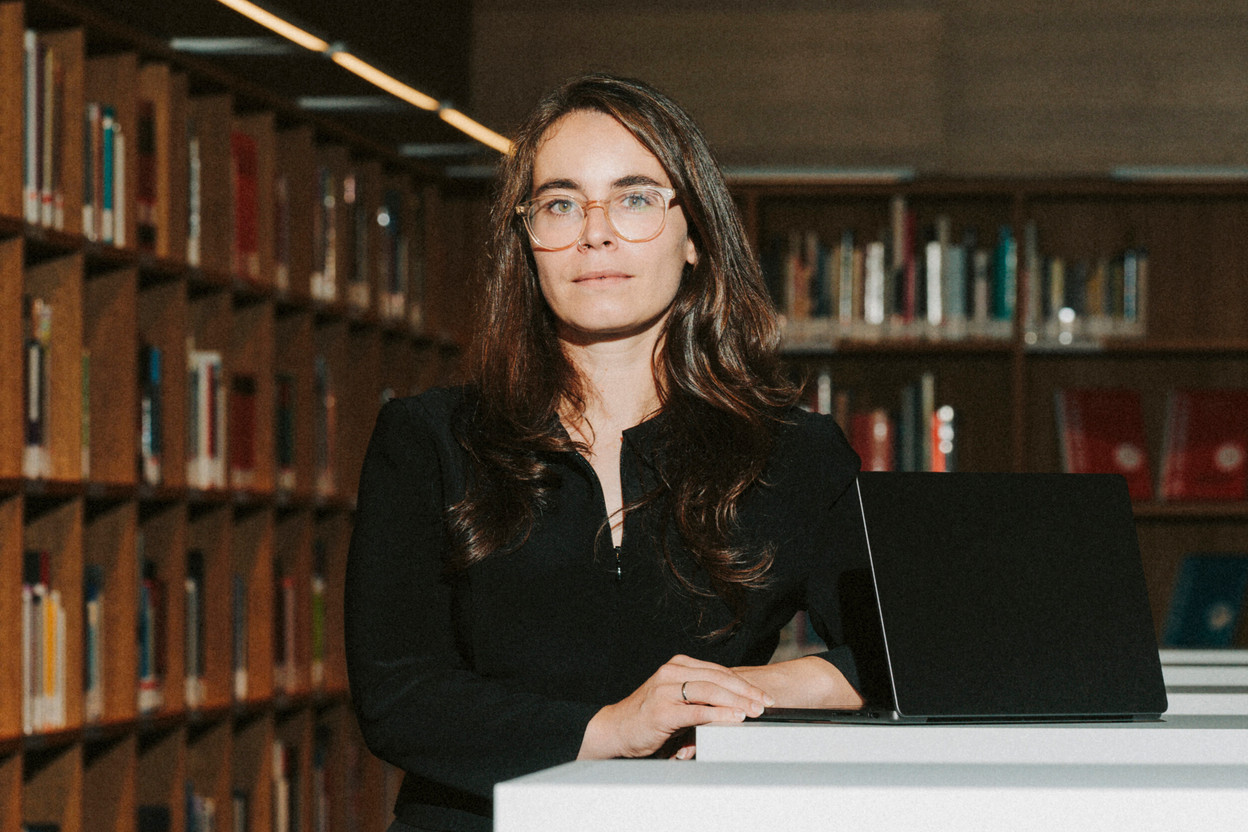
Your project with Paul-Antoine Lucas and Bùi Quý Sơn has been selected to represent Luxembourg at the Venice Architecture Biennale in 2027. What was the starting point for your thinking?

What can we already learn from the Vietnamese model?
“At first, I was mainly thinking about how to use less floor space. But there is also something very interesting about the use of semi-public spaces. In Vietnam, certain spaces are shared much more readily. In Luxembourg, there’s a greater tendency to view a space adjoining one’s home as something that should remain private, rather than imagining that it could be shared. What I find interesting is that sharing works very well when it comes from the residents themselves, but much less so when it’s imposed from above and they’re told what to do.
How much living space per person do we actually need to live well?
“It obviously depends on the composition of the household. A single person needs more floor space per person than a family. But I know of many projects that work very well with around 30 to 35m² per person. It is therefore entirely possible to live very comfortably with less space than we currently have in Luxembourg.
In my view, a national programme dedicated to the conversion of large detached houses should be set up.

But what should we do about the large houses that already exist?
“In my view, we need to set up a national programme dedicated to the conversion of large detached houses. They are becoming increasingly out of step with changes in our demographics and lifestyles. Family structures are changing, and there is also the issue of costs: heating a very large house when you live there alone is set to become increasingly unaffordable. There is already a great deal of research into how to adapt these homes to allow several households to live in them.
In practical terms, how can we transform these houses?
“In Munich, for example, architects have been working on different types of houses and ways of adapting them. In some cases, it is possible to add an external staircase; in others, to rethink the interior layout. But we need to focus on both the architecture and how the buildings are used, as acceptance of these changes is essential. It is then also up to politicians to create the conditions to make them attractive.
When it comes down to it, does Luxembourg really lack living space?
“For me, the problem isn’t so much that we lack living space. The real problem is the prices, both for renting and for buying. There is also a high concentration of property ownership amongst a relatively small number of players, which gives them a great deal of power. Housing has become an extremely effective way of generating returns. That, too, is part of the problem.
This critique of speculation is also evident in the work of Less Yellow, the architecture practice you co-founded in 2024. In your work, you advocate for the idea that housing is a form of infrastructure. What does that mean?
“The right to housing is a human right. That doesn’t mean housing has to be free, nor that it shouldn’t be possible to make money from building it: companies must, of course, be able to make a profit. What I find contradictory is that, as a society, we consider it normal to speculate on housing. I have no problem with someone earning a lot of money through their work. But housing meets a fundamental human need. With a luxury item, you can choose not to buy it. With housing, you cannot choose to do without it.
Is that precisely why you advocate the housing cooperative model?
“Yes. In a cooperative, the future residents set up a company together and are involved in designing the project. Once the building is completed, it belongs to the cooperative and not to its individual members. Residents pay rent to cover costs, but never become owners of their homes. When a member leaves the cooperative, they get their initial contribution back in accordance with the laid-down rules, without benefiting from any increase in the property’s value. Speculation is thus eliminated from the system.
What is the long-term benefit?
“We can create a mechanism for expansion. In the cooperative project run with Agora in Belval Sud, for example, the land is made available on very affordable terms, with the rules set out in the articles of association. Once the loans have been repaid, any surplus can be reinvested in new projects. The system can thus develop gradually. In Zurich, some cooperatives have been in existence for over a century and now manage several thousand homes.
If, by 2050, [cooperatives] were to account for 5% of the housing stock, that would already be a significant and very ambitious figure.
But isn’t this collective way of living rather restrictive for the residents?
“No one is obliged to live in a cooperative. But yes, the trade-off is that it requires a great deal of commitment. You have to organise yourselves, make decisions together, set up working groups, a board of directors and a general meeting. At the same time, this organisation also fosters social bonds. The group we’re supporting through Agora comprises 14 households who didn’t know each other before and who have gradually learnt to function as a genuine collective.
To what extent could cooperatives grow in Luxembourg?
“If, by 2050, they accounted for 5% of the housing stock, that would already be a significant and very ambitious figure. In an ideal world, I would like new builds to be based on a three-part model: one third from the private sector, one third affordable housing provided by public bodies, and one third from the third sector, particularly cooperatives. The private sector obviously remains essential. The idea is not to replace it, but to create a supply that is still lacking today.
If you had the power to introduce just one rule for the Luxembourg housing market tomorrow, which one would you choose?
“I would introduce a progressive tax on the concentration of property ownership. It could, for example, apply from around twenty properties held. The idea is certainly not to target someone who owns two or five properties, nor someone who has bought a house to pass on to their children. I am talking about much higher levels of concentration. We would also need to define very clearly who is affected, why these owners should contribute more, and what the revenue generated in this way is to be used for.”
This article was written for the supplement Living & Workspace from the October 2026 issue of Paperjam magazine, published on 16 September. The content is produced exclusively for the magazine. It is published on the website to contribute to Paperjam’s comprehensive archive. Click on this link to subscribe to the magazine.
Is your company a member of the Paperjam Club? You can apply for a subscription in your name. Please let us know via club@paperjam.lu.