
Ecologists had been hoping for this: the European Commission is set to put pressure on companies that operate data centres. Brussels is preparing to introduce a groundbreaking EU-wide rating system for data centres. The idea is simple: to apply a familiar concept—such as energy labels or the Nutriscore system—to digital infrastructure, using a visual classification ranging from A to G.
In practical terms, each facility will be assessed against two key indicators. The first, “power usage effectiveness” (PUE)—a criterion already well established in the data centre sector—measures the data centre’s overall energy efficiency. The closer the figure is to 1, the more efficient the infrastructure. Brussels has set precise thresholds: a Class A rating would correspond to a PUE of 1.15 or less, whilst a Class G rating would apply to facilities with a PUE exceeding 1.9. In between, the scale progresses in intermediate steps, from B (up to 1.25) to F (up to 1.9).
The second indicator, “water usage effectiveness” (WUE), measures water consumption associated with cooling. Here too, a scale from A to G is used: the most efficient data centres have a WUE of 0.1 or less, whilst the least efficient exceed 1.0.
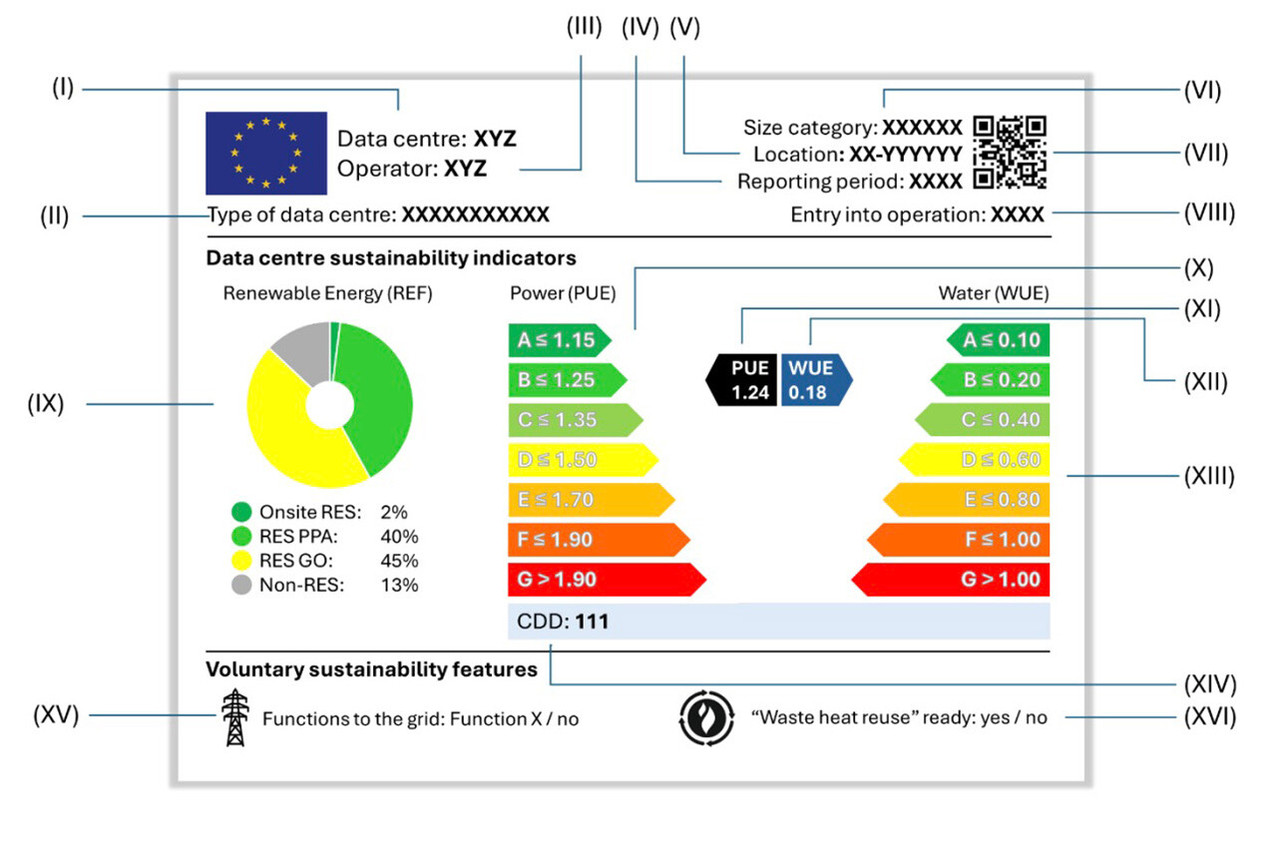
A first glimpse of what the label—which will vary from site to site—for a data centre will look like, according to the draft regulation that the European Commission has submitted for consultation. (Photo: screenshot of the annex to the draft regulation)
The hyperscalers are ranked quite highly
These two ratings provide a framework for understanding the label, but they do not summarise the scheme in its entirety. The scheme also incorporates a series of additional indicators, which play a decisive role in the overall assessment of the infrastructure. The proportion of renewable energy used by the data centre is thus displayed in detail. The label also indicates whether the facility contributes to the stability of the electricity grid, for example by modulating its consumption, as well as its capacity to recover and reuse the heat produced.
Other factors help to put the performance figures into context. Local climate conditions—measured, for example, in terms of cooling requirements—as well as the size and age of the facility, have a direct impact on the results obtained. The aim is to avoid overly simplistic comparisons between data centres located in very different environments.
At this stage, the major cloud providers should generally rank highly, at least in terms of energy efficiency. Amazon Web Services (AWS) thus has an average PUE of around 1.15, which is on the borderline of Class A, whilst Google Cloud claims an even lower figure, close to 1.09, clearly placing it in the top category. Microsoft Azure sits slightly above this, at around 1.16, which would correspond more to Class B in the future European system.
The differences are more pronounced when it comes to water consumption, an indicator that has so far been less standardised. Amazon reports a figure of around 0.15 litres per kilowatt-hour, corresponding to a B rating, whilst Microsoft is closer to 0.30, or a C rating. Google, for its part, does not publish a directly comparable overall indicator, which precisely illustrates one of the challenges of the future European framework: ensuring consistent transparency across all players.
Several limitations
Unlike traditional energy labels, however, this system does not rely on a single rating. A data centre could therefore be rated A for energy efficiency but only C or D for water consumption, whilst still demonstrating a high proportion of renewable energy or advanced heat recovery capabilities. The Commission has chosen not to aggregate these criteria, in order to highlight the technical trade-offs inherent to the sector.
However, the text is not yet final. The European Commission has launched a public consultation on this draft delegated regulation, allowing industry representatives and stakeholders to submit their comments between 26 March and 26 April.
However, this approach has several limitations. The absence of an overall score, whilst reflecting the technical complexity of the sector, may make the system less accessible to non-specialist users. Furthermore, comparability between sites remains partially skewed by geographical factors, particularly climatic conditions, which directly influence energy performance. The water consumption indicator, which is still not widely standardised at international level, could also give rise to debate regarding its interpretation, particularly in regions experiencing water stress.
Above all, the system currently operates on the principle of transparency without any direct enforcement. No minimum threshold is imposed, and the least efficient operators face no penalties. The actual impact of the scheme will therefore depend largely on how it is utilised in future public policy, public procurement or investment decisions.
A manager to oversee public procurement
At first glance, the initiative may come as a surprise. The major market players have already invested heavily in improving their energy performance and reducing their carbon footprint. In most cases, their newer facilities are likely to be in the highest categories. But the scheme also aims to highlight disparities within the market. Older or less optimised facilities could appear in the middle or lower categories, providing a direct comparison at European level for the first time.
Beyond transparency, the Commission is developing a more structured regulatory framework. The rating system is set to become a benchmark for public policy, public procurement and, potentially, access to certain forms of funding. Ultimately, it could serve as the basis for the introduction of minimum performance thresholds.
Against a backdrop of strong growth in the sector, driven in particular by the rise of artificial intelligence, Brussels is seeking to integrate data centres into its energy strategy. The aim is no longer simply to improve their efficiency, but to make their environmental impacts measurable, comparable and, ultimately, manageable.