
“The biotechnology sector represents the technological frontier of medicine,” said Lydia Haueter, senior investment manager at Pictet Asset Management, during an online presentation on 18 February 2026. She said the shift is fuelled by rapid advances in the biological toolbox and by AI — a “supercharger” that improves pattern recognition and extracts meaning from the growing volume of data in the space.
Essential elements for new drugs to emerge
According to Haueter, innovation occurs at the intersection of three critical pillars: unmet medical need, biological insight into disease pathology, and a technological toolbox capable of modifying specific proteins or genes.
Over a 30-year arc (see chart 1), the industry has transitioned from accidental discoveries to highly engineered therapies, transforming conditions like HIV into manageable chronic diseases and developing targeted cancer treatments that act like “targeted missiles.”
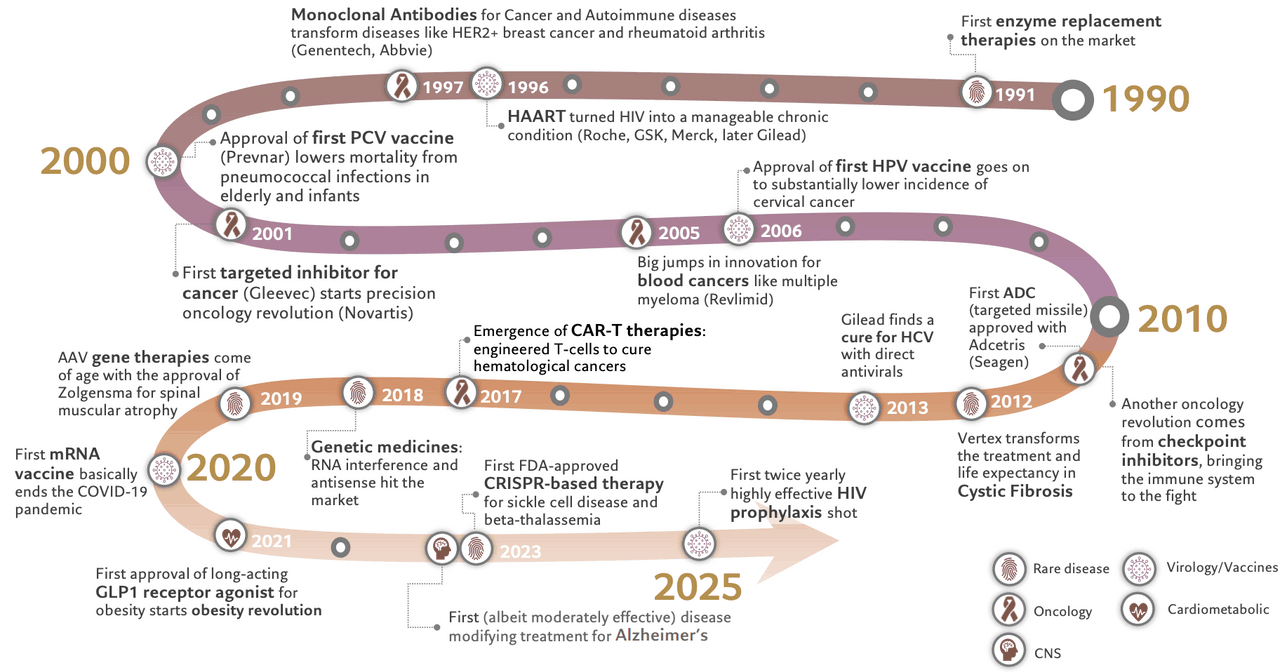
Chart 1: Three decades of biopharma innovation Sources: Pictet Asset Management, FDA, Nature, NEJM, CDC, WHO, Biopharma Dive, Reuters, JAMA, Science, The Lancet, New York Times, Stat News, Pharmaceutical Journal, Gilead, Alnylam, Novartis, Pfizer, BMS, Merck, Vertex, Roche, Eisai. FDA, Nature, NEJM, CDC, WHO, Biopharma Dive, Reuters, JAMA, Science, The Lancet, New York Times, Stat News, Pharmaceutical Journal, Gilead, Alnylam, Novartis, Pfizer, BMS, Merck, Vertex, Roche, Eisai; all accessed 2025
Biotech becomes pharma’s lifeline
A fundamental shift has occurred in drug development. While large-cap pharmaceutical firms once dominated approvals, small-cap biotech now accounts for the vast majority of novel drug approvals (see chart 2).
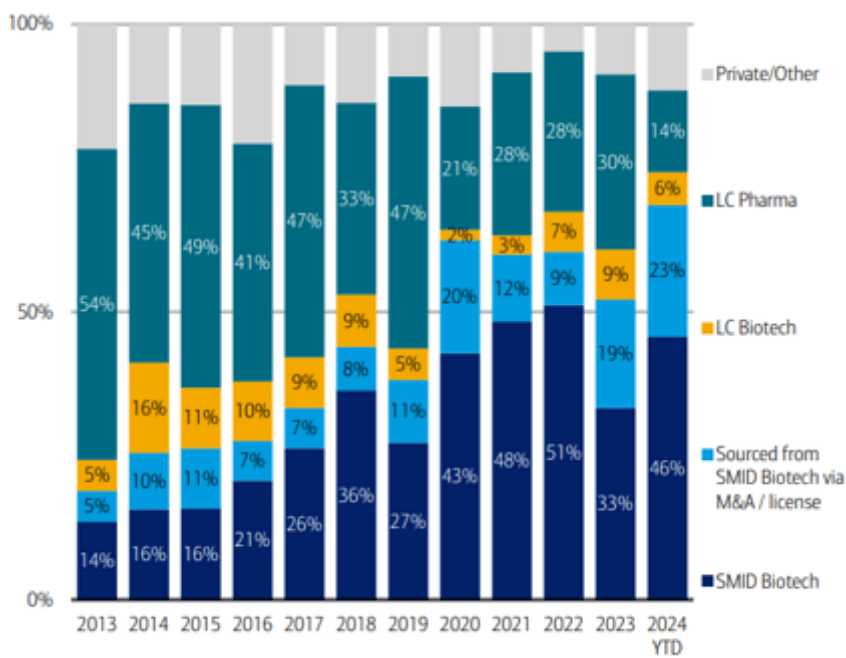
Chart 2: Around 70% of FDA novel drug approvals originate from biotech companies Source: Pictet Asset Management, FDA gov (novel NDA/BLA approvals), company reports, BofA global research, 2024
This has resulted in a structural “outsourcing” of research and development (R&D), where pharma companies replenish their pipelines through mergers and acquisitions (M&A) or licensing. Haueter noted that large pharma is currently facing a significant patent cliff, with over $400bn in sales expected to be lost to generic competition over the next decade.
This dynamic reinforces biotech’s strategic leverage in negotiations and could support elevated deal premiums over the coming cycle. These pharma companies retain substantial financial firepower. “They have enough cash to buy the whole biotech sector” to offset these revenue gaps.
If the whispers of a market bubble get louder, biotech historically has fared better in a market crash
AI powers the lean biotech revolution
AI is democratising drug discovery by improving operational efficiency rather than promising instant breakthroughs. Biotech firms can now remain “lean,” sometimes with as few as 20 employees, by renting cloud-based automated labs, using AI models for preclinical toxicity screens, and outsourcing clinical trial operations. “What you want is to own the data, the intellectual property (IP), and the decision on pricing, to name a few,” stated Haueter.
Biotech breaks free from macrogravity
Haueter stressed that biotech companies are very volatile individually, but when assembled in a portfolio, they offer low correlation to the broader market because the sector is highly idiosyncratic, driven by clinical trial results and regulatory interactions rather than just macro trends. “If the whispers of a market bubble get louder, biotech historically has fared better in a market crash,” she said.
The sector is emerging from a prolonged bear market that began in 2021, which “flushed out” lower-quality IPOs and left valuations at attractive levels when looking at enterprise value (EV)-to-cash ratios.
Currently, the focus remains on “smid” caps (small and mid-cap) below $10bn, particularly in oncology, orphan diseases, and the Central Nervous System (CNS), where the largest value increases occur during the de-risking of clinical products. It is also an attractive size for M&A activities.
In the investment process, AI functions as a “cyborg” assistant, helping humans synthesise scientific literature, simulate clinical trials through Monte Carlo methods, and analyse physician interview transcripts. Pictet also purchases prescription data from a third-party provider to assess how a drug is launching, including the number of prescriptions being written.
Axsome, Abivax and Mineralys may be the next movers
Haueter cited Axsome Therapeutics as one of the successes in their portfolio. By pairing the compound with bupropion, a generic, Axsome developed an antidepressant, Auvelity, that targets the same receptors as ketamine but without the dissociative side effects or the need for a doctor-supervised “drug trip.”
Not unique in the biotech space but a challenge compared to large pharmas, Axsome displays some commercial success, having sold $500m worth of the drug in 2025. The company is now expanding into Alzheimer’s-related agitation, addressing a substantial unmet need. Axsome awaits an FDA decision expected this spring.
Abivax produced transformative Phase 3 data for an oral therapy for ulcerative colitis, providing the efficacy of injectables in a safer, more convenient format.
Haueter considers it risky to rely on M&A as the only exit strategy for an investor, yet she believes that the company, with its potential blockbuster (more than $1bn in sales), makes strategic sense for many pharma players.
Questioned on an undervalued and underreported play, Mineralys was cited by Haueter as an attractive asset in hypertension, “a large market that could fit very well in the cardiovascular portfolio of a strategic buyer.” She noted ongoing M&A rumours involving companies such as Eli Lilly and AstraZeneca.
Second lives for acquired drugs
Asked which are the most successful pharma companies in commercialising medicines/treatments following an acquisition, Haueter argued that all major pharma companies boast powerful commercial platforms — but their strength varies by therapeutic area. Roche dominates in oncology, while GSK is a key player in respiratory. Success ultimately comes down to the indication and strategic fit.
M&A has been a major growth lever. Merck’s acquisition of Acceleron added Winrevair, which is off to a very strong launch. Johnson & Johnson’s takeover of Intra-Cellular Therapies brought Caplyta into its portfolio — a blockbuster already generating over $1bn in sales and now expanding into another large indication. These deals highlight how big pharma continues to buy growth and diversify revenue streams.
Policy fears fade
While innovation and M&A dominate the upside narrative, policy risks remain a recurring concern for investors. For instance, the Most Favoured Nations (MFN) drug pricing discourse — i.e., matching US prices to European prices — and potential FDA staff cuts have proved to be less impactful than feared.
Trump’s previous MFN deals were largely “optical wins” that did not significantly damage company economics. Meanwhile, the FDA’s approval rates remain in line with historical precedents despite noise at the top of the agency.
Asked about the commercial challenges facing Vertex’s Casgevy — a one-time gene-editing treatment for sickle cell disease and transfusion-dependent beta thalassaemia with a U.S. list price of $2.2m — Haueter argued that orphan drugs command high prices to justify R&D costs, given the relatively small patient populations.
Instead of the regulator dictating the price of a drug, an approach that will likely disincentivise investors, Haueter expects that the “democratisation” of R&D through more intense competition is the best mechanism to naturally drive down these costs over time.
The outlook for the sector is supported by several structural tailwinds. Historically, biotech outperforms in falling interest rate environments as a long-duration asset class. Furthermore, she argued that the industry is currently "underowned", meaning even a small rotation of capital from the “Magnificent 7” could lift the entire space. Continued M&A activity is expected as big pharma seeks to deploy its cash-rich balance sheets to secure the next cycle of blockbuster launches.