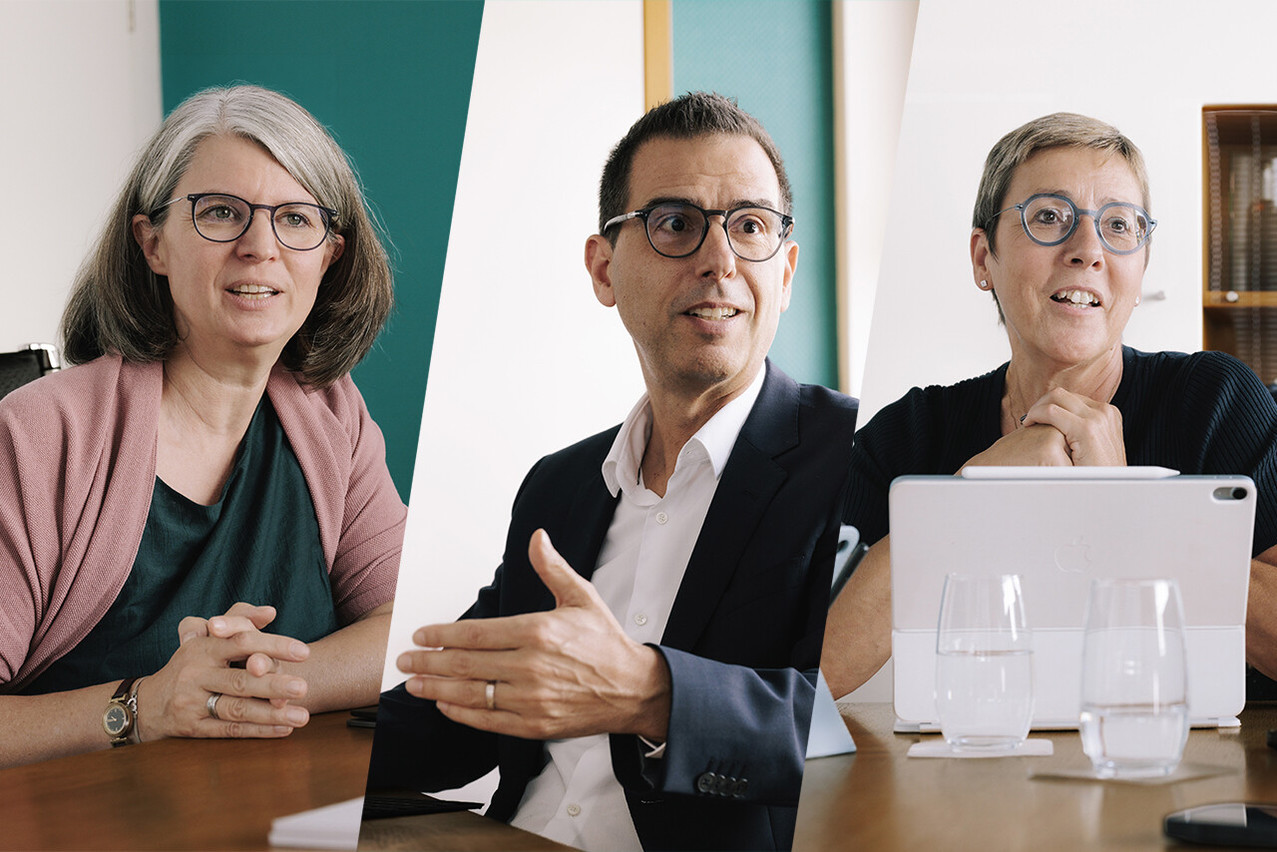
There are three of you running Office Freylinger. How are the responsibilities divided up?

Innovation can be technological or industrial, but it can also relate to products, processes, services, etc. As for brands, they can distinguish both products and services across sectors as varied as manufacturing, banking, retail, the craft sector and consultancy. Ideally, we get involved right from the start of a project.
How do we define innovation?
P.O. – “For a business, innovation means introducing a new product or service into its range. Innovation is, therefore, not limited to major technological breakthroughs. Drawing on our expertise as industrial property consultants, we focus, above all, on identifying what aspects of this innovation can be protected and by what means.
With regard to patents, we examine, amongst other things, whether the technical solutions developed are novel and inventive in relation to the prior art, beyond the company itself, in particular by carrying out patent prior art searches prior to filing.
What types of businesses do you support?

We protect everything from everyday consumer products to cutting-edge innovations.

These clients may have requirements relating to both patents and trade marks. We therefore offer a comprehensive strategy: protecting the technical aspects of the product or process with a patent, its appearance with a design, and its name with a trade mark. We protect everything from everyday consumer products to highly specialised innovations, for example in the cosmetics, automotive and semiconductor sectors, such as OLEDs.
Which form of protection is best suited to which innovation?
P.O. – “The choice depends as much on innovation as on the company’s business model. For a technical invention, a key question is whether a competitor will be able to understand how it works by examining the product on the market. If so, a patent will be particularly relevant. Conversely, know-how that is difficult to uncover, such as certain manufacturing parameters, can sometimes be kept secret, provided that proper confidentiality measures are put in place.
It is also important to consider the product’s lifespan, the target markets and the available budget. The aim is not to register everything, but to protect what gives the company a competitive advantage.
You are, in a way, a barometer of innovation. Is there a lot of innovation in Luxembourg?
M.-C.S. – “Above all, our work gives us an insight into the projects being undertaken by businesses and the growth sectors in Luxembourg. However, it does not, on its own, allow us to gauge the country’s overall level of innovation. Nevertheless, we are seeing certain trends, particularly in the software and space sectors.
The clear trends at the moment are AI and the energy transition.

The enquiries we receive also reflect the direction of economic policy: support measures for certain sectors and the establishment of new businesses are reflected in our business, albeit sometimes with a time lag.
What other trends or developments do you see?
P.O. – “The clear trends at the moment are AI and the energy transition. In the steel industry, for example, the challenge is to replace carbon with hydrogen in steel production. The sector is working on CO₂ capture technologies, something that wasn’t being done quite so actively 15 years ago. In the automotive sector, one client is developing hydrogen engines for commercial vehicles.
But the real question is one of the market: will these technologies be adopted? Between the rise of AI, the pace of technological change and environmental challenges, businesses are operating in a rapidly changing environment. We must adapt our practices and anticipate these developments.
Why can a good idea fail?
M.-C.S. – “When it comes to patents, the first hurdle is a lack of novelty. If the inventor has already spoken about their idea, published it or described it on the internet – even in a simple post – this disclosure may compromise the novelty of the invention. The inventor may, therefore, themselves jeopardise their chances of patenting their invention…
Another challenge stems from a lack of understanding of the issues surrounding intellectual property (IP), sometimes combined with limited financial resources. Yet IP can be one of a start-up’s key assets. Failing to protect it can have far more serious financial consequences in the long term.
In the field of patents, we are now seeing inventions that utilise AI. Ten years ago, we had none.
Is AI bringing about any changes to your business at this stage?
Pascale Vandorpe. – “We are seeing clients submit AI-generated analyses or advice to us for us to check and validate. Whilst this tool may be useful, it is no substitute for the experience and judgement of a professional who has been supporting their clients for many years.
P.O. – “In the field of patents, we are now receiving applications for inventions that utilise AI. Ten years ago, we had none. These are innovations in which AI is applied in industrial contexts, and this may be patentable. AI is a mathematical tool, and mathematical methods are not patentable in their own right. However, when this tool is used in a technology to solve a technical problem, it may be patentable according to the same criteria as other inventions: novelty and inventive step.
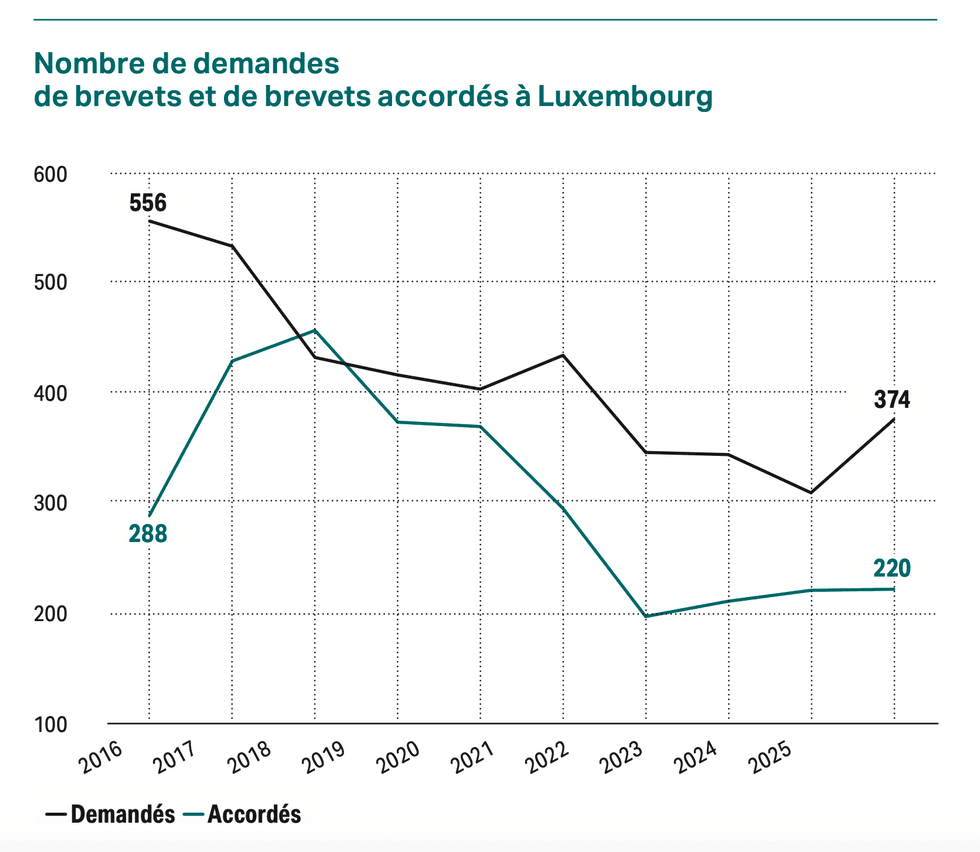
Number of patent applications and patents granted in Luxembourg. (Infographic: Paperjam)
How does intellectual property create value?
P.O. – “Intellectual property forms part of a company’s intangible assets. Protecting these assets makes it easier to identify them and ensures they can be exploited safely. Industrial property is also a factor in competitiveness.
Patents remain a traditional indicator of innovation: for a start-up seeking funding, holding a patent demonstrates that it has legal control over its technology, which reassures investors. A study by Euipo has also shown that SMEs which register trade marks and patents generate, on average, higher revenues.
P.V. – “Industrial property rights (patents, trade marks or designs) may also be licensed or assigned. Industrial property rights therefore have a dual purpose: to protect the business against copying by granting it exclusive rights over its innovation, but also to capitalise on these rights, notably by licensing or assigning them. A licence thus allows a third party to exploit an industrial property right, usually in return for the payment of royalties.
M.-C.S. – “When a business is sold, intellectual property is also taken into account in its valuation. We value the premises or factory, but also the intellectual property. Specific analyses are carried out to estimate the value of the patent or trade mark and the proportion of the sale price that corresponds to these intangible assets.
Incorporate intellectual property right from the start of the [start-up] project.
Any advice for an entrepreneur?
P.O. – “Incorporate intellectual property right from the start of the project. Ask yourself what sets you apart from your competitors, which markets you want to expand into, and how to maintain that advantage. This will help you choose the appropriate forms of protection and anticipate their cost.
A brief glossary of intellectual property
Intellectual property. The body of laws protecting intellectual creations. It encompasses industrial property rights and copyright.
Industrial property. A branch of intellectual property law that protects inventions, trade marks and the appearance of products.
Patent. It grants an exclusive right to a technical invention that is new, involves an inventive step and is capable of industrial application.
Brand. A sign used to distinguish a company’s goods or services: a name, logo, slogan, sound or shape.
Copyright. Automatic protection is granted to an original work upon its creation. It protects the work’s form, but not the idea itself.
Design. A title protecting the appearance of a product: shape, lines, colours, texture or decorative features.
Submission. An official application submitted to an office with a view to obtaining the registration of a trade mark, a patent or a design.
Priority. Creation, publication or an earlier right that may prevent or limit further protection.
New. A condition whereby an invention must not have been made public prior to the filing of the patent application.
Inventive step. The inventive step of an invention, which does not follow obviously from existing knowledge.
Opposition. A procedure enabling a third party to challenge the registration or continued validity of a patent or trade mark.
Counterfeiting. Unauthorised use or reproduction of an invention, a trade mark, a work or a protected design.
License. A contract authorising a third party to exploit an intellectual property right, often in return for payment.
Key figures
60
Office Freylinger was founded in 1966, when Ernest T. Freylinger, an engineer and former examiner at the International Patent Institute, decided to set up his own firm. He began with a client from the steel industry who remains one of the firm’s clients to this day. Sixty years on, the Strassen-based firm has 35 employees and is celebrating its anniversary this month.
44%
The study “Intellectual property rights and firm performance in the European Union” (2025) by Euipo and the European Patent Office shows that SMEs holding at least one registered intellectual property right have, on average, 44% higher revenue per employee than those holding none. It covers nearly 119,000 European companies, analysed between 2013 and 2022. The study does, however, point out that it establishes a correlation, not a causal link.
This article was written for the November 2026 issue of Paperjam magazine, published on 14 October. The content is produced exclusively for the magazine. It is published on the website to contribute to Paperjam’s comprehensive archive. Click on this link to subscribe to the magazine.
Is your company a member of the Paperjam Club? You can apply for a subscription in your name. Please let us know via club@paperjam.lu.