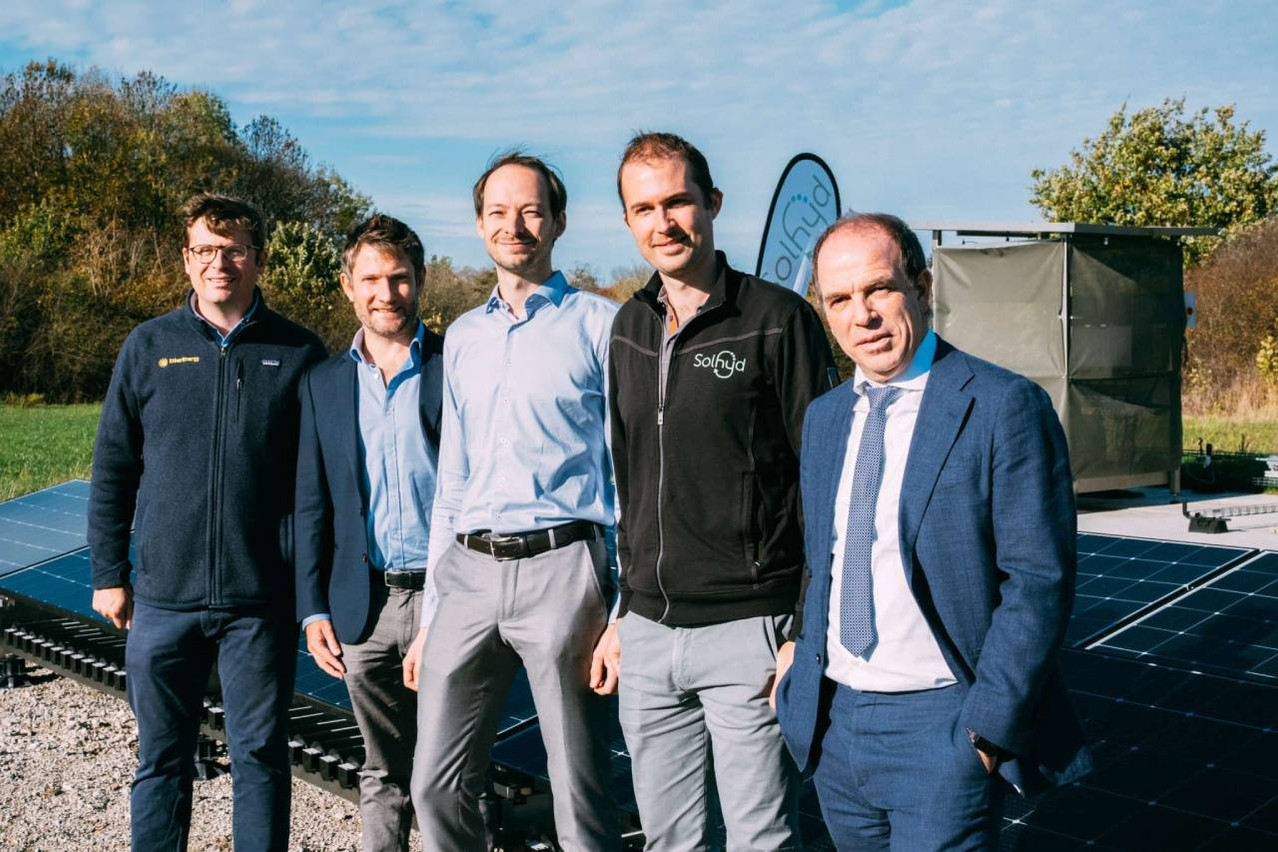
Four companies are launching an unprecedented project following the signing of an agreement on Tuesday 4 November: the construction, in 2026, of the world’s first hydrogen solar park on a site in Wallonia, near Namur. Ether Energy, SunBuild, Solhyd and Nippon Gases are forming a consortium to create a continuous chain “from the sun to the industrial application of green hydrogen”. The site will include a solar farm of around 2 megawatts peak, a battery system and Solhyd 50-kilowatt modules capable of simultaneously producing electricity and hydrogen. The partners then set a target of ramping up to 2 megawatts for future installations.
The fruit of more than a decade of research
The Solhyd technology stems from research carried out at KU Leuven more than ten years ago. The company now designs modules that run on light and air, without liquid water, without heavy connections to the grid and without rare metals. The company’s co-founder and CEO, Jan Rongé, says that “this project is the first demonstration on a commercially relevant scale and serves as a benchmark for further deployment”. He explains: “We are proving that green hydrogen can be approached in a pragmatic and scalable way. By harnessing the sun directly, we are lowering costs and radically simplifying the system. Together with our partners, we are demonstrating that it can be done.”
Direct integration into the industrial chain
Nippon Gases will provide hydrogen post-processing, storage and distribution. Director of strategic growth at Nippon Gases, Johan Desmet, describes an evolving market: “Hydrogen is still part of our product portfolio. For years, we have been supplying hydrogen in high-pressure containers to sectors such as food, chemicals and pharmaceuticals. Today, we see hydrogen emerging as a growth market, particularly in combustion processes and in the manufacture of next-generation chips. This project represents a major step forward and demonstrates that we can now also offer green hydrogen.”
Four players and complementary expertise
Ether Energy owns and operates the project, SunBuild is designing and building the solar and battery system, Solhyd is supplying the hydrogen modules and Nippon Gases is integrating them into its existing chain. The CEO of Ether Energy, Pierre de Liedekerke, said: “This project demonstrates that sunlight can be used in a different way, thanks to green hydrogen. It opens up new prospects for investors and plays a crucial role in the energy transition.” SunBuild CEO Gilles Charlier added: “By combining innovation and industrial know-how, we are demonstrating that it is now possible. We are creating a new generation of hybrid farms that produce both renewable electricity and green hydrogen, thanks to Solhyd technology. This is an essential step towards sustainable energy autonomy for Europe.”
Towards a model to be rolled out across Europe
The site will operate for at least five years and will serve as the foundation for a 2-megawatt project in 2028, before being rolled out across Europe and then in sun-rich regions. The consortium aims to offer solar parks a model capable of creating new sources of revenue, reducing grid congestion and increasing the value of solar during periods of low or negative electricity demand.