Thirty-seven centimes more per litre. To fill a 50-litre tank, the difference amounts to €18.70. All within the space of a month, without having changed cars or driven a single extra kilometre.
The maximum price of diesel stands at €1.966 per litre in Luxembourg on 31 July, compared with €1.592 on the first day of the month. The exact increase amounts to 37.4 cents, or 23.5%. This is significantly higher than the rise in the price of 95-octane petrol, which rose from €1.629 to €1.761: an additional 13.2 cents, or 8.1%.
This difference is the key. If the price of crude oil were the only factor, diesel and petrol would follow more similar trends. An analysis published on Friday by the European Central Bank shows that the current shock is also occurring downstream, in the refineries responsible for processing crude oil into usable products.
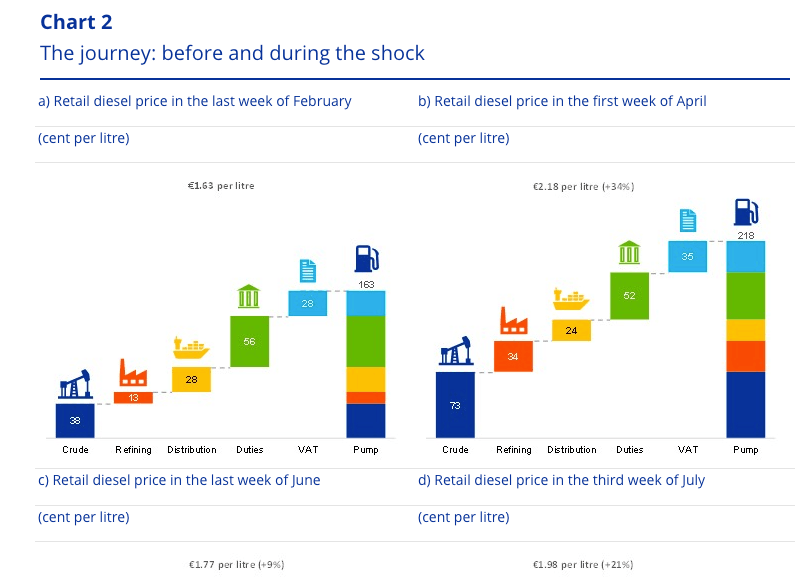
How the price changes. (Visuel: screenshot de l’étude de la BCE)
The price paid at the petrol station is made up of several components. It includes crude oil, refining costs and margins, transport and distribution, excise duty and VAT. Not all of these components react in the same way. Some remain relatively stable. Others can skyrocket within a matter of weeks.
Since the start of the crisis in the Middle East, crude oil prices have risen sharply. Brent crude peaked at $138 a barrel in early April, almost double the price at the end of February. But the price of diesel leaving the refineries rose even further, reaching $197 per barrel. Consumers have therefore not only paid more for the raw material; they have also paid more for its processing.
The closure of the Strait of Hormuz affected a significant proportion of global refining capacity and reduced exports of refined products by around 4.5 million barrels per day in the second quarter, according to data cited by the ECB. This was compounded by reduced activity at Middle Eastern refineries, attacks on Russian facilities and the scaled-back operations of several Asian sites.
The ECB estimates that, in the eurozone, refining costs and margins accounted for 35 centimes of the price of a litre of diesel during the first three weeks of July. Their contribution was only around 10 centimes in February. For petrol, this figure stood at 23 cents in July. This difference helps to explain why diesel prices have risen much more sharply.
These figures represent an average for the eurozone. They do not allow each of the 37.4 Luxembourg centimes to be attributed precisely to crude oil, refining or distribution. However, the local timeline corresponds to the mechanism described by the ECB. Diesel was still priced at €1.642 on 10 July. It then rose by 32.4 centimes over three weeks, as the renewed escalation of the conflict drove up the prices of crude oil and refined products.
A continued rapid rise
The pass-through is rapid. According to the ECB, it generally takes one or two months. A 10-cent increase in the cost of crude oil contained in a litre of fuel usually results in an equivalent 10-cent increase in the pre-tax price at the pump. The impact is therefore not, as a general rule, absorbed by a reduction in margins further down the supply chain.
This does not mean that a 10% rise in the price of oil automatically leads to a 10% increase at the petrol station. Excise duties are levied as a fixed amount per litre. Distribution costs do not automatically follow the price of Brent crude. VAT increases in line with the pre-tax price, but these factors mitigate the percentage change in the final price.
This mechanism explains an apparent paradox. Between late February and early April, the price of crude oil and refined diesel rose by more than 90%, according to the ECB. The price of diesel sold to consumers in the eurozone rose by around 34%. The increase is much smaller in relative terms, but it remains clearly visible in terms of cents per litre.
In Luxembourg, the advertised price is also a ceiling set under the national maximum price scheme. Petrol stations may sell at a lower price, but not at a higher one. Historical records published on the basis of the Ministry of the Economy’s tariffs show that a series of adjustments took place in July: €1.610 on the 4th, €1.642 on the 10th, €1.698 on the 11th, €1.743 on the 15th, €1.804 on the 17th, €1.853 on the 21st, and then €1.966 on the 31st.
Diesel prices did not, therefore, rise by 37 centimes in a single go. The impact of international developments reached the petrol pumps in rapid succession. The speed of these adjustments shows just how much a market located several thousand kilometres away can, in the space of a few days, affect the maximum regulated price in the Grand Duchy.
The rocket and the feathers
That leaves the reverse trend. Motorists often suspect that fuel prices shoot up like a rocket and come back down like a feather. The ECB points out that earlier studies focusing on the eurozone did not conclusively establish this asymmetry. More recent research suggests, however, that the fall could be slower, particularly due to the replenishment of stocks, uncertainty over how long the decline in crude oil prices will last, and weaker competitive pressure when costs fall.
Prices had indeed fallen during the temporary reopening of the Strait of Hormuz, from 18 June to 11 July. They began to rise again following the latest escalation. The futures markets analysed by the ECB were forecasting, as at 20 July, that the contribution from refining would peak in August, followed by a gradual decline to around 16 centimes per litre of diesel by the end of 2027.
This forecast is not a promise made to Luxembourg’s motorists. It does, however, reveal where part of the price is determined. The price per barrel remains the most visible barometer of the oil crisis. But between the well and the pump, the lack of refining capacity can further drive up prices.