The Ilres study on purchasing habits, commissioned by the ministry of the economy and the Luxembourg Confederation, makes it possible for the first time to analyse in detail the behaviour of residents compared with non-residents. And on several segments, the differences are striking.
Residents continue to make purchases mainly in their commune of residence, ahead of shopping centres and town centres. They prefer to shop in Luxembourg for food, but are more inclined to go abroad for fashion, household appliances and personal care products. Price, availability and familiarity play a central role in this geographical choice.
Sixty percent of them say they only buy their food in Luxembourg, compared with just 23% of cross-border commuters. The gap widens further for beauty and hygiene products: 55% of residents buy abroad, while 74% of cross-border commuters turn to their own markets.
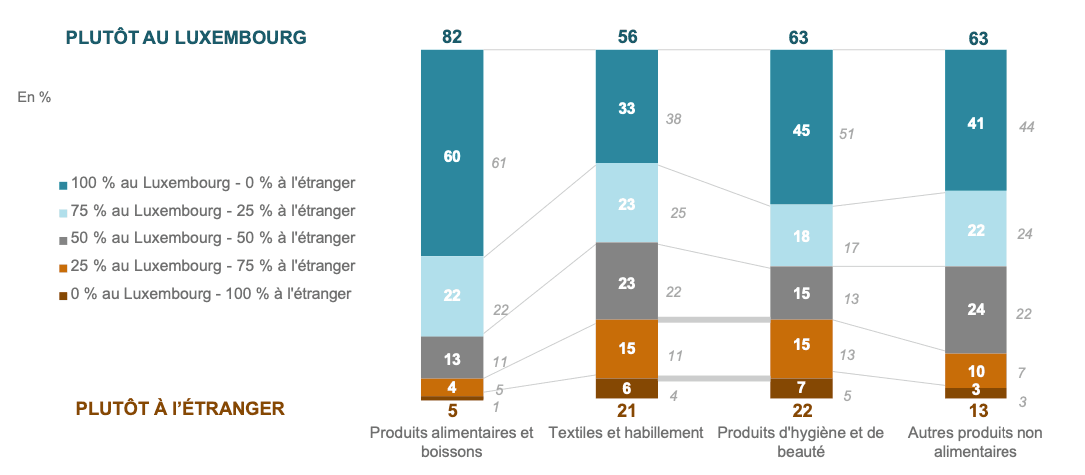
The share of purchases abroad among Luxembourg residents. Graph: Ilres
As far as cross-border commuters are concerned, the logic is reversed: they come to Luxembourg above all to fill up on fuel, but also to take advantage of shopping perceived as accessible, well-stocked and efficient. On the other hand, they return to their country of residence for the majority of their other purchases--a strategy that combines purchasing power, national habits and an offer that is perceived to be more competitive.
The reasons given are clear. Residents emphasise proximity, knowledge of what’s on offer and quality of service. Cross-border commuters, on the other hand, cite the more competitive prices in their home countries. And the same is true of residents themselves: one in four believes that value for money has deteriorated in Luxembourg restaurants. It’s a sensitive indicator, at a time when 49% of survey respondents say they have cut back on spending in restaurants over the past two years.
Satisfaction is high, but weakened by prices and flexibility
Overall, customers--both residents and cross-border commuters--say they are largely satisfied with the retail experience in Luxembourg. Over 75% of respondents appreciate the waiting time in shop and the availability of products. These figures are confirmed by cross-border commuters, who also give high marks to opening hours and the general atmosphere of sales outlets.
But this satisfaction is far from uniform. When we zoom in on the criteria of flexibility, return policy or language skills, the approval rates fall sharply. Cross-border commuters--who systematically compare their experience with that in their home country--are even more critical on these points. In the survey, after-sales service, commercial flexibility and exchange opportunities came bottom of the league in terms of satisfaction.
Another major sticking point: value for money. A quarter of residents consider it unsatisfactory when it comes to restaurants, but the perception is similar in the retail trade. The quality of the products is recognised, but the prices displayed struggle to convince, especially in an inflationary context.
These criticisms take on their full meaning when we look at the purchasing behaviour of residents and cross-border commuters. For example, residents remain loyal to Luxembourg for food products (60% never buy food abroad), but go abroad for fashion, hygiene and household electrical goods. Conversely, cross-border commuters come to Luxembourg for petrol, branded products, availability and a wide range of opening hours, but make the rest of their purchases in their country of residence, which is often considered to be cheaper.
Whether it’s product quality, in-store service or the overall experience, consumers are now raising the bar. The trade-offs are constant: buy less, compare more, and look for the best balance between proximity, quality and price. This is a dynamic that Luxembourg’s retail sector must continue to follow closely if it is to maintain its appeal at the heart of an increasingly mobile and demanding region.
Finally, customer expectations are changing. The ability to buy or book online, and the link between physical presence and digital channels are becoming crucial elements in the evaluation of a business. This is a transformation that Luxembourg retailers must continue to embrace if they want to retain their local roots, while limiting leakage to international platforms.
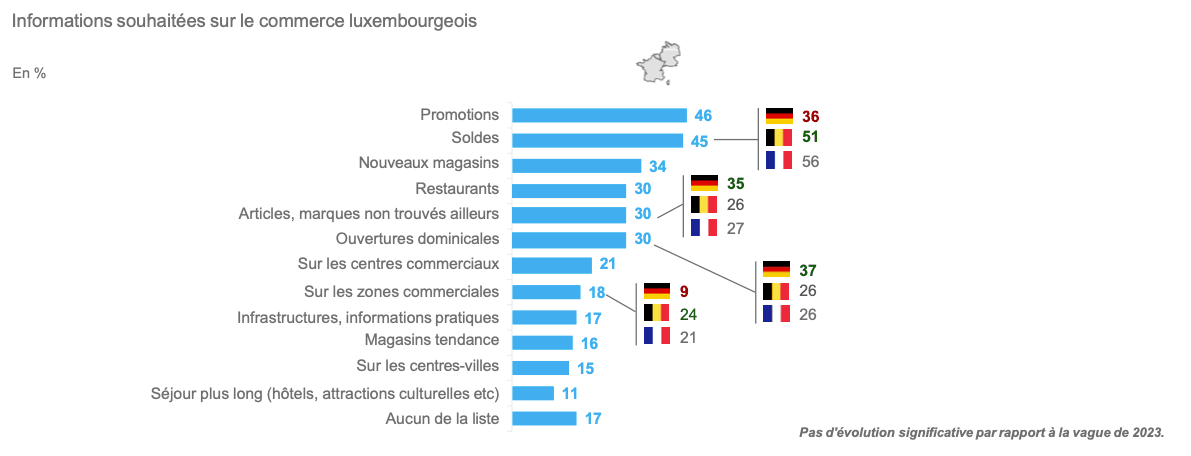
Residents of the Greater Region would like more information about promotions and sales in the grand duchy. Graph: Ilres
Online commerce
E-commerce is establishing itself as an essential part of consumer habits in Luxembourg, but the intensity and channels vary greatly according to age and residential status. While 76% of respondents say they buy online, the details of usage show a more nuanced landscape.
On the one hand, the younger generations are the most active, particularly for non-food purchases: fashion, high-tech, culture. More agile with interfaces and more exposed to targeted advertising, they do not hesitate to use international platforms or to order via social networks. This practice, still marginal among the over-45s, is now commonplace among shoppers aged 16 to 34. The study reveals that almost one in two respondents has already made at least one purchase directly from an ad on Instagram or Facebook, a proportion that rises sharply among the youngest shoppers.
On the other hand, cross-border commuters of all generations are slightly more inclined to buy online than residents. Their online consumption is not limited to traditional products: it extends to specific segments that they cannot easily find in their own country or in Luxembourg, or that they consider to be more competitive elsewhere. Price remains a key factor here.
Digital advertising plays an ambivalent role. It acts as a purchase accelerator for young people, but has little influence on the general behaviour of older people. Less than 15% of consumers say they rely on online reviews or social networks to choose a restaurant, for example, while word of mouth and traditional criteria (quality, price, service) largely dominate in this area.
Finally, the transition to online retailing is taking place in a complementary rather than substitutive way. Consumers are juggling between physical shops and platforms, in an omnichannel logic. Letzshop.lu, the digital shop window supported by the state, is a good illustration of this trend: known to the majority of residents, it is still little used, but retains a positive image, particularly among young people who see it as a credible local alternative to e-commerce giants.
This article was originally published in French.