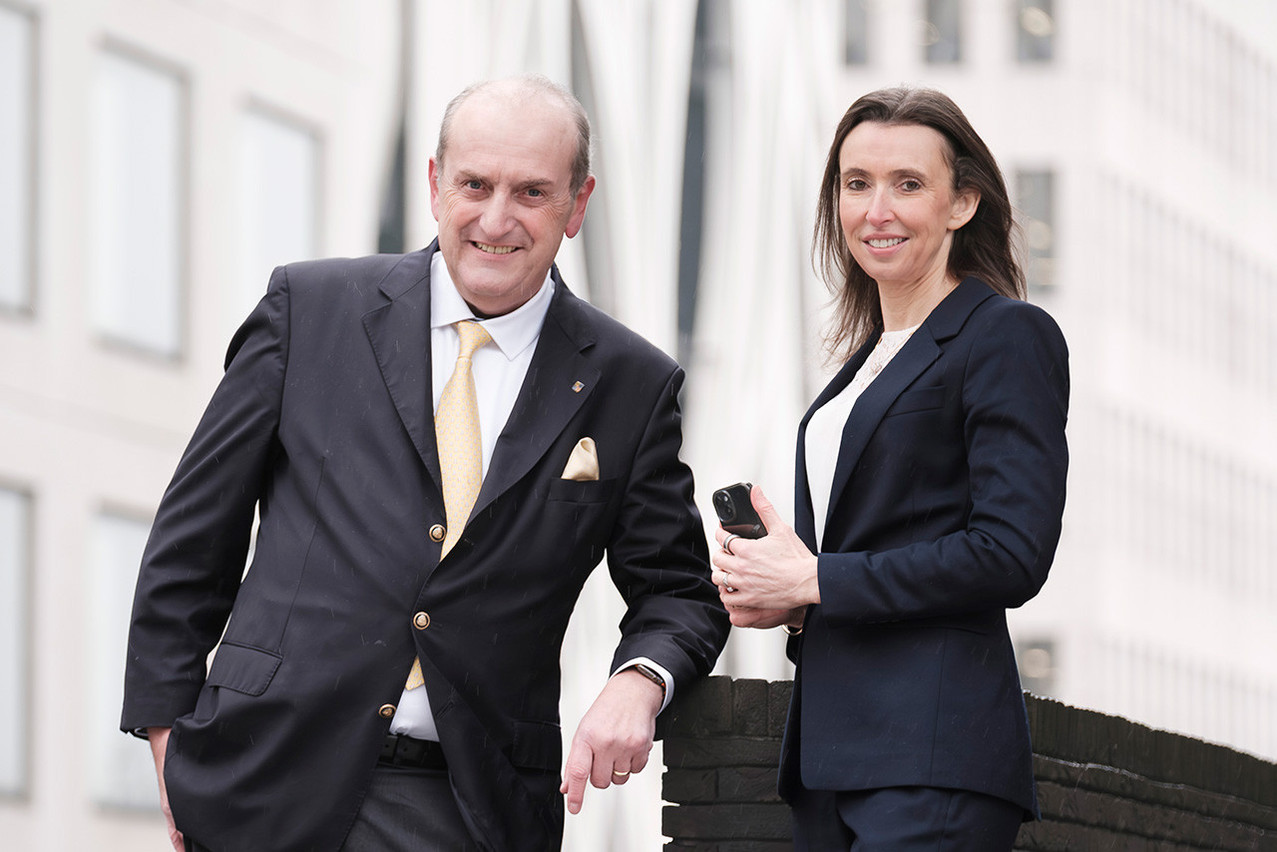


Equity markets are looking expensive. How do you assess the risk of a correction in 2026?
Yves Stein (Y.S). – “We’re not in a ‘run for cover’ mindset. Corporate fundamentals and earnings are not that stretched. The main risk lies in market emotion. More often than not, a correction is triggered by something nobody saw coming. In the current macroeconomic environment, a ‘crisis’ driven purely by sentiment would, in our view, represent a buying opportunity.
That said, there are very significant points of attention around the valuation of certain pockets – artificial intelligence being the obvious one – which have grown to an extraordinary scale. The question is whether companies will be able to deliver results that sustain investor confidence at such lofty valuations. More than ever, you need a team advising you in this environment: it is complex.
From a European economic perspective, the key question remains whether nations will manage to bring the war in Ukraine to an end. If they do, it would be a genuine windfall for Europe economically. We saw periods in 2025 when European markets outperformed US markets. Over the long cycle, that is not the usual reality. So far, so good… but vigilance remains essential.
Sandrine De Vuyst (S. D. V.). – “On the fixed income side, we believe the decline in European rates is now well under way. We do not expect major surprises in 2026, with the yield curve likely to remain steep and short-term rates broadly around current levels.
How did assets under management (AUM) at Luxembourg private banks evolve in 2025?
Y. S. – “2024 was an excellent year, with double-digit market performance and +4% in net new money (NNM). The latter is traditionally what private banks aim to achieve, because it implies growth rates above the underlying economic growth of our economies.
For 2025, markets evolved rather favourably. Above all, we expect the gradual compression of net interest margins to be offset by higher fee income. Markets were supportive of active management: there were many decisions to be made, so we anticipate stronger transactional revenues. We will need to see where the ‘interest’ component ultimately lands, but technically, in terms of AUM, performance should once again be very positive. As for net new money, the constructive environment, the international visibility of the financial centre and the arrival of new players make us optimistic for 2025.
S. D. V. – “Adding to that is the sometimes uncertain political situation in certain neighbouring countries, which also allows us to attract capital thanks to Luxembourg’s political stability.
Do you have a sense of what proportion of that NNM is coming from neighbouring countries?
S. D. V. – “The bulk of NNM does indeed come from European countries. While we do not yet have statistically precise figures for 2025, our sentiment surveys within the PBGL suggest that the objective achieved in 2024 will be maintained – and may even be slightly exceeded – in 2025.
There is currently a very specific Latin American wave.

What is the typical profile of the private client who came to Luxembourg in 2024-2025?
Y. S. – “In 90% of cases, the typical client is European. Their wealth has generally been built through international business activity, and they are either looking for wealth planning and structuring solutions, or they are drawn by the country’s triple-A rating and its political stability.
We also see many Latin American fortunes – particularly Brazilian – taking a renewed interest in their roots and, more broadly, in Europe. They often choose Portugal or Spain as a first step. Once there, they think: ‘I also need a hub for my financial activities, for my investments in Europe, and to set up my base in Portugal.’ Very often, they either come across a Luxembourg bank branch locally, or they conclude that Luxembourg is Europe’s most international country – and, by the way, with Portuguese residents making up more than 30% of the population, they can even find cultural familiarity. For us, this is a priority. There is currently a very specific wave, largely Latin American and especially Brazilian, that we are following with great interest.
In the face of competition from Singapore or Hong Kong, what is Luxembourg’s distinguishing strength for wealthy non-European clients?
Y. S. – “Let’s remain humble: 90% of our clients are European. I can imagine the heads of banking associations in the UK and Switzerland wake up at night thinking about these questions more often than we do – we have so much to do in Europe. We remain present and visible in Asia, particularly in Singapore, to learn and take inspiration, but it remains a distant market for us.
The Middle East is another dynamic region, torn between East and West. For now, many still choose Singapore as their financial partner. We are monitoring this closely to seize opportunities where we can. For us, international markets are a source of inspiration – and also of partnerships: for instance, the ABBL had a strong presence at the fintech forum in Singapore.
We’ve spoken about the inflow of new clients. Is there a reverse movement – people leaving Luxembourg? And what would their profile be?
S. D. V. – “Naturally, there are always inflows and outflows. We also know Luxembourg attracts people who come here sometimes for a limited period. But, generally speaking, around 70% of people who move to Luxembourg end up staying. Now, ultra-wealthy individuals also tend to diversify globally, so capital can clearly move from one location to another. But this is not something we monitor with particular precision.
Y. S. – “I can confirm that we do not observe any relevant outflow of private banking clients leaving Luxembourg, other than isolated cases linked to relocation or transfer to the next generation. It does happen that money leaves the bank balance sheet for direct investments, particularly in property, but this is not a cause for concern.
What we do need to watch is that banks themselves do not leave. One or two banks have exited Luxembourg in recent years, but the declining number of private banks is almost entirely a consolidation phenomenon. That is why the number of banks is falling while AUM continue to rise.
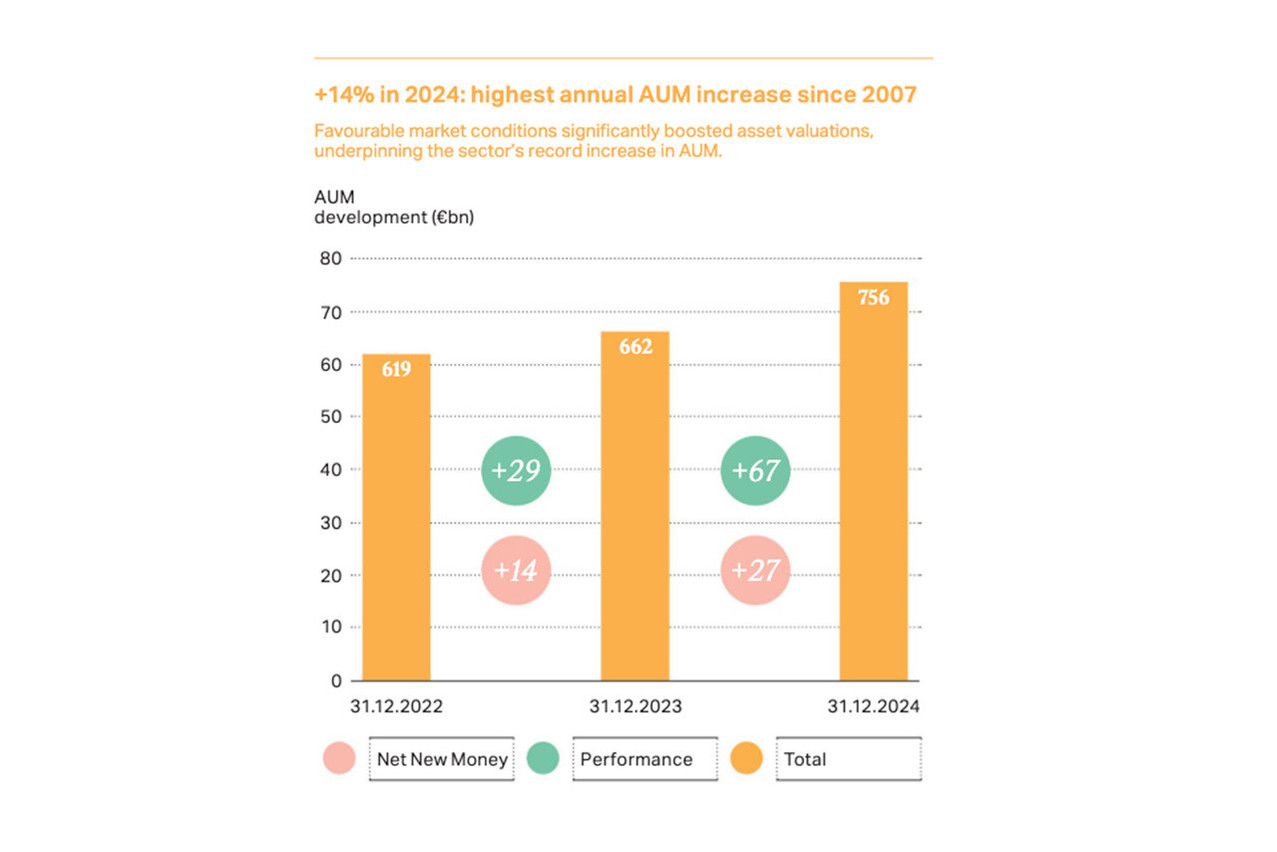
+14% in 2024: highest annual AUM increase since 2007 Source: ABBL-KPMG-CSSF, “Private Banking Report 2025”
Is the consolidation under way in private banking beneficial for Luxembourg in terms of substance?
S. D. V. – “In any case, at ABBL level we don’t see any particular threat on that front. Some groups are streamlining their footprint, but we don’t think this is necessarily for or against Luxembourg. What is clear is that Luxembourg must continue to position itself as a centre with its full ecosystem and stay competitive. We very often talk about property constraints – it is difficult for people arriving here, and for those already here – but on the other hand we remain an extremely multicultural, multilingual country, with many advantages that should not be overlooked. These are also factors that can tip the balance when it comes to maintaining the attractiveness of Luxembourg for banks.
In other words, you don’t see Luxembourg becoming a mere branch office…
Y. S. – “Each group is a bit like a multi-geography family, and has to choose its organisational model. The drivers are not always the same. You can identify a dozen drivers that justify a given setup, then develop the top three for your group and assess how financial centres stack up against those drivers. Fortunately, Luxembourg’s stability, predictability and robustness means that we’re bound to have at least one driver among the top three.
Players will continue to position themselves. We will see new entrants coming to Luxembourg – thankfully – and we will also see activities or institutions remain and even grow in Luxembourg without necessarily having their headquarters here, because their key drivers may favour another financial centre.
How is the new political landscape in the US influencing the strategy of US banks present in Luxembourg? Are you sensing any shift?
Y. S. – “We do not observe any fundamental shifts. Banks are economic actors: they follow their clients’ needs and the markets. North American players are extremely important for the Luxembourg financial centre. If you look at our business clusters, Americans represent an exceptionally large share of, for instance, the depositary business in Luxembourg. In European UHNWI private banking, US players are very present. These institutions are also deeply involved in real assets. So if Luxembourg is today Europe’s leading hub for private equity you can expect many American firms to be active here, because they are the key players in that field.
As for movements, the only one we can reasonably point to – and which has in fact been rather favourable for Luxembourg – was Brexit. Since Brexit, we saw many non-European players strengthen their presence, because access to the European continent could no longer be channelled through London. Economically, that was very beneficial.
Yves Stein, you recently appeared smiling on social media alongside the US ambassador. In 2026, can one publicly highlight links with Trump’s US without risking offending Beijing – or even Brussels, in the midst of tensions between Luxembourg and the EU over the possible centralisation of asset manager supervision by the European Securities and Markets Authority (Esma)?
Y. S. – “Our approach has been consistent and long-standing – we defend the interests of the banking sector. Topics, issues or challenges faced by banks are linked to the nature of their activity, not where the institution comes from.
In Luxembourg, banks from different regions operate in a shared environment. They collaborate on practical, sector-wide initiatives through professional structures, such as our working groups, particularly on regulatory, operational and market-related topics. This collective approach supports stability and Luxembourg’s philosophy of openness.
International finance has always operated across borders and Luxembourg’s financial centre has long played a central role in facilitating this.
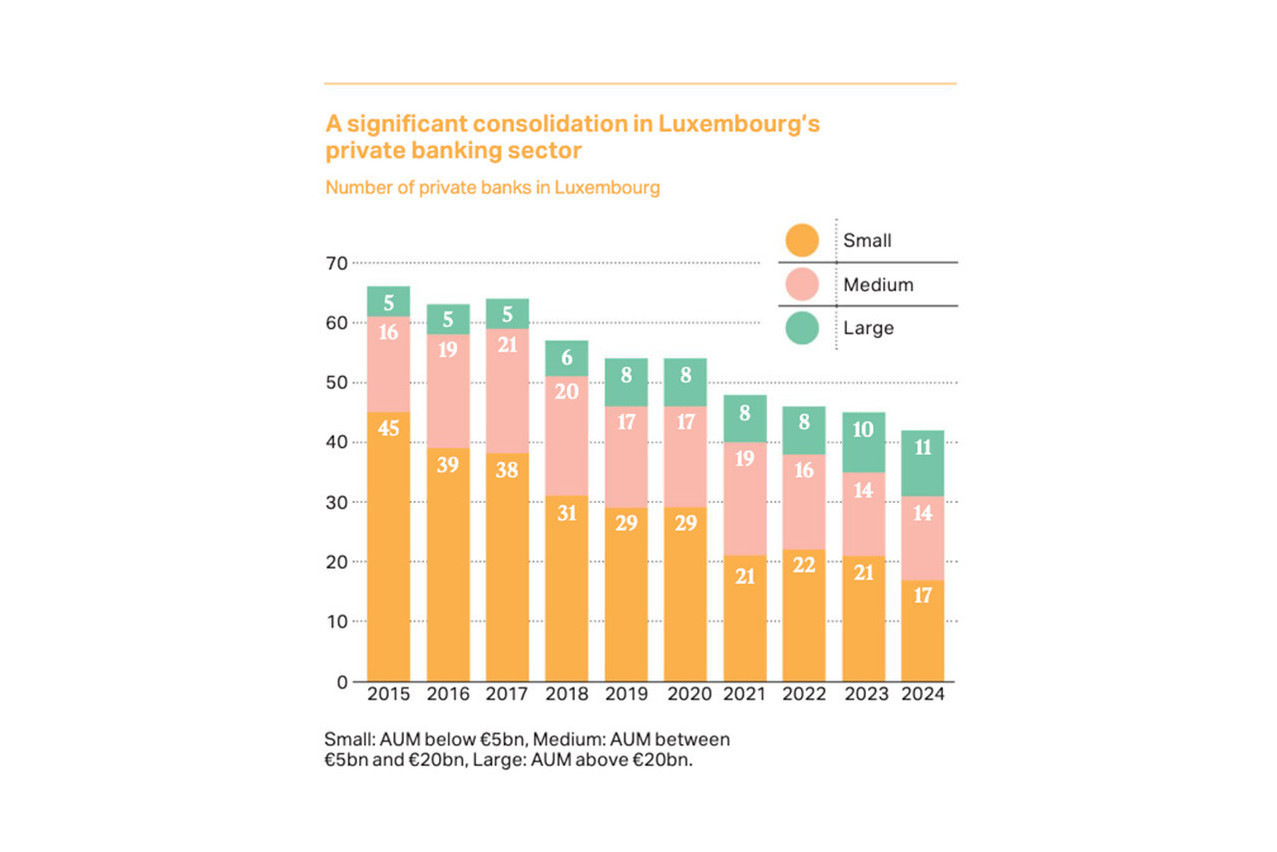
A significant consolidation in Luxembourg’s private banking sector Source: ABBL-KPMG-CSSF, “Private Banking Report 2025”
Is Luxembourg’s ecosystem sheltered from major tectonic and geopolitical shifts across the world?
Y. S. – “Luxembourg is not sheltered from global geopolitical shifts, and no international financial centre can be. The question is how the systems in place can operate in these periods of uncertainty.
In this case, dialogue and cooperation with all stakeholders remain essential. Having the right people around the table at the right time is where Luxembourg excels. This is in the interest of the financial centre, the country and, ultimately, its people.
How do private banks integrate geopolitics into client management today? Do you ever end up having to choose between Chinese and American clients?
S. D. V. – “In Luxembourg, the question of choosing between American and Chinese private banking clients simply does not arise. The private banks operating here do not serve these types of clients. Providing investment advice to US private clients requires a licence from the Securities and Exchange Commission (SEC). As for Chinese banks, their activities in Luxembourg are more focused on corporate and institutional clients rather than private banking.
While the EU has heavily regulated the financial sector, the US has embarked on deregulation. Is this asymmetry undermining our competitiveness?
S. D. V. – “The regulatory framework is still a pillar of the EU’s financial system. This being said, some measures have been introduced with the right intentions, like the interests of clients – Mifid, for instance – but have become increasingly complex and onerous and, on top, result in growing frustration for clients. If regulation ends up discouraging clients from investing rather than encouraging them, then there is clearly an issue. We need to restore a fair balance between regulation that is necessary and over-regulation that benefits no one.
In addition, at present there is a lack of proportionality, which disproportionately affects the smaller players within the PBGL.”
Y. S. – “We advocate for a proportionate, principle-based approach, rather than rigid rule-setting.”
Raiffeisen’s private banking push
Raiffeisen is best known as a local, independent universal bank—and not instinctively associated with private banking—yet its wealth business “has seen strong growth in recent years.” Sandrine De Vuyst says the ambition is to build private banking from the domestic base: deepen corporate relationships, upscale retail clients and acquire new clients through “a truly human approach.”
This article was written for the Wealth management & Private banking supplement of Paperjam magazine’s March 2026 issue, published on 25 February. It is published on the site to contribute to the full Paperjam archive. Click this link to subscribe to the magazine.