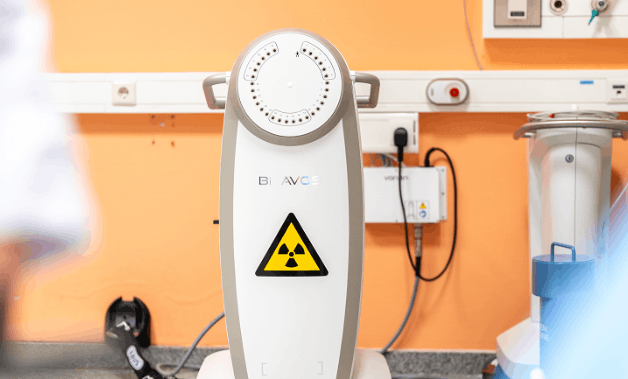
Brachytherapy: treating cancer at the heart of the tumour
Brachytherapy is an irradiation technique involving the introduction of radioactive sources (iridium) in contact with or inside the tumour itself. This treatment is therefore ideal for targeting the area affected by the cancer directly and precisely, with greater protection for nearby organs.
Brachytherapy has been used at the Centre François Baclesse (CFB) for many years in prostate cancer treatments, as well as in combination with external radiotherapy in the context of vaginal fundus treatment.
Since 2024, the CFB has been developing a new application of this treatment: uterovaginal brachytherapy, a first in Luxembourg. This technique is used to complement external radiotherapy treatment for tumours affecting the cervix and body of the uterus. It requires two short hospital stays lasting two days at one-week intervals.
“By developing this technique in the grand duchy, we are offering our patients more centralised care within Luxembourg and aim to improve their comfort in their therapeutic pathway; previously, they had to carry out this "additional dose" in neighbouring countries,” explains Dr Johanne Hermesse, radiotherapist oncologist at the Centre François Baclesse.
A collective effort opening up new prospects for patients
The introduction of this practice in Luxembourg is the result of close collaboration between the Centre Hospitalier Emile Mayrisch (CHEM) and the CFB.
“We are making our operating theatre, patient transport and one of our inpatient departments available. Many of our staff were able to receive training in the particularities of this treatment: the anaesthesia team, our medical technical assistants (ATMs) and several CHEM nurses, as well as the CFB brachytherapy specialists,” explains Dr René Metz, CHEM’s director general.
Building on this success, the CFB and CHEM are planning to jointly develop new indications--particularly for certain cancerous or benign skin lesions (keloids).
For more information, write to contact@baclesse.lu or visit www.baclesse.lu.
This article was originally published in French.