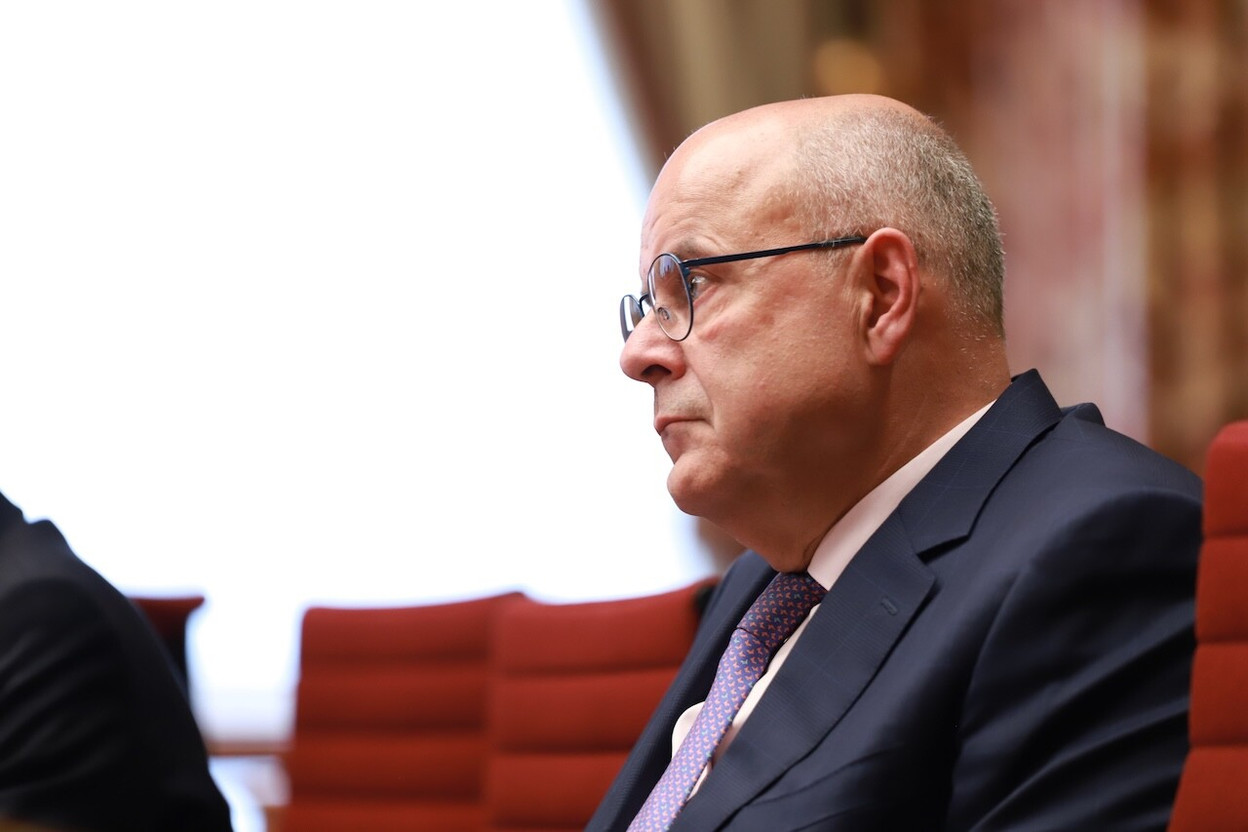
Following the provisional agreement reached last April between the Council of the European Union and the European Parliament on the issue of unemployment benefits for cross-border workers, the visit by the French minister for Labour, Jean-Pierre Farandou, to Moselle on Thursday 21 May was highly symbolic.
He first visited the Lidl site in Ogy-Montoy-Flanville to meet with staff and tour the premises, before visiting the France Travail office in Manom, where discussions focused on unemployment benefits for cross-border workers. As a reminder, a political agreement was reached on 23 April between the European Council and the European Parliament regarding the revision of the rules on the coordination of national social security systems under European Regulation 883/2004. The aim is to modernise these rules “to make them clearer, fairer and simpler to apply”, according to the Cypriot presidency, for whom this revision is “essential to strengthen the fair mobility of workers”.
In short, the agreement stipulates that the last country in which an employee worked shall be responsible for paying unemployment benefits. This responsibility currently lies with the worker’s country of residence. This applies for a maximum period of six months, provided that the beneficiary can demonstrate that they have made contributions for 22 weeks. Whilst France is currently responsible for paying unemployment benefits to cross-border workers, the reform would change the situation and Luxembourg would become responsible. A budget cost of €200m, according to the Luxembourg Minister for Labour, 
A Franco-Luxembourgish agency
During his visit to Moselle, Jean-Pierre Farandou stated that “today, France is paying out nearly €860m in unemployment benefits to cross-border workers, even though contributions are paid in neighbouring countries. This is an imbalance that we must correct. France is leading crucial negotiations at the European level to build a fairer system. The progress made in recent weeks already constitutes a real victory for our country.” The €860m in question relates to all cross-border workers who live in France and work mainly in Switzerland (236,000 workers in 2025, according to Urssaf), Luxembourg (126,600), Belgium (40,000) and Germany (50,000).
And let us not forget that, on the Swiss side, a tax rebate scheme is in place. “As compensation, France pays Switzerland a rebate amounting to 4.5% of the income of French cross-border workers. In return, the canton of Geneva also pays a rebate to France equivalent to 3.5% of the total payroll of French workers subject to withholding tax in that canton,” states the Frontaliers Grand Est website.
As reported by our colleagues at Radio Ici, “the minimum transition period [before the new unemployment benefit system comes into force, ed.] to be included is two years. The Luxembourgers, whose negotiating skills are well known, have already secured an additional three years. I am convinced that, in five years, with goodwill on both sides […], our Luxembourgish friends will be able to establish a Luxembourgish employment service,” the French minister also explained, having notably asked France Travail to engage with Luxembourg to set up a Franco-Luxembourgish employment agency to facilitate the sharing of information on job vacancies.