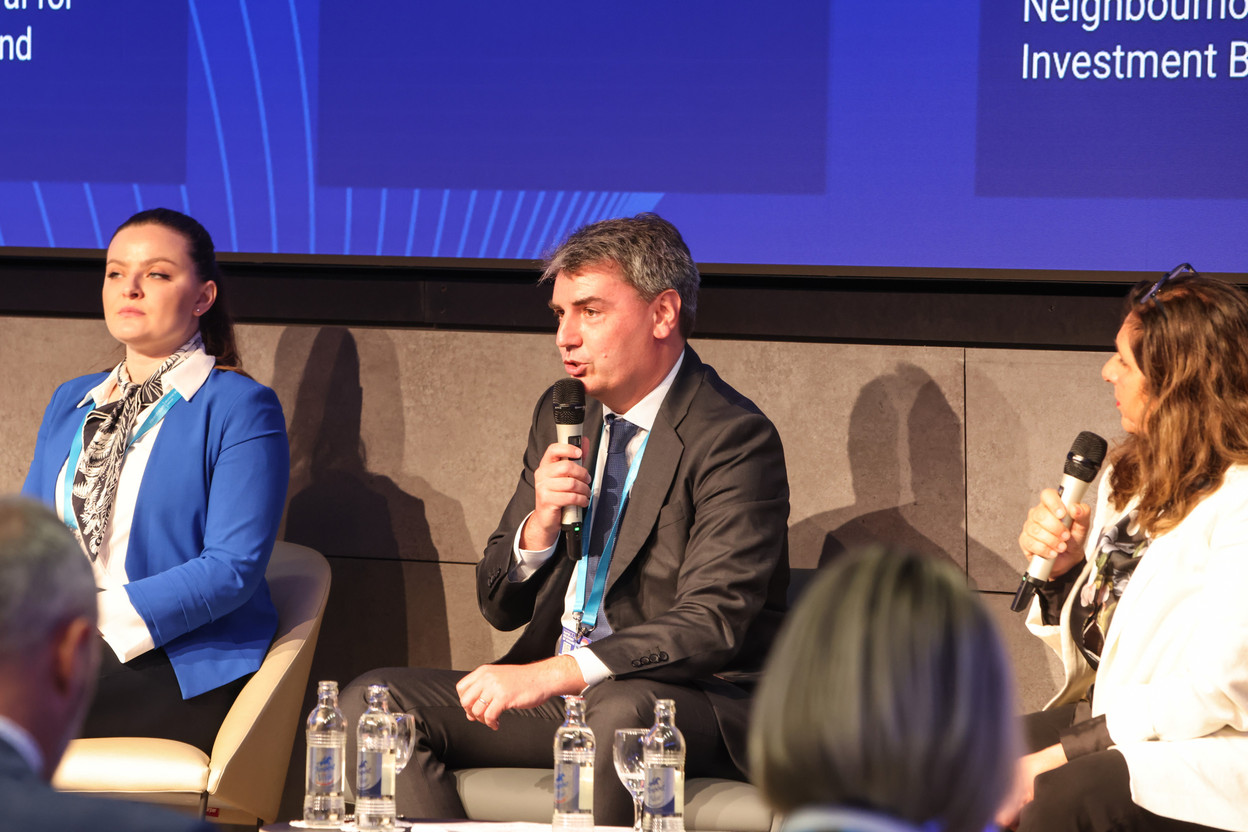
“The technological battlefield is the only one on which we can achieve total victory,” summed up Inna Perepelytsya, senior advisor at Luxinnovation, as she launched a presentation on the technological aspect of the war being waged by Ukraine in response to Russia’s full-scale invasion. The presentation was led by Oleksandr Dmitriyev, a specialist in automated military systems and coordinator of the EYES project for the Ukrainian armed forces, and Volodymyr Ben, director of the Ukrainian Space Agency.
A paradigm shift in defence
“We have to fight and innovate at the same time,” explains Oleksandr Dmitriyev. “We experienced an unprecedented interruption to the energy infrastructure that was shelled by the Russians at the start of the war. As a result, communications systems and the cloud went offline. This posed a real challenge for us. It was as if we had suddenly gone weightless.” This, according to Dmitriyev, led to a paradigm shift in defence and a focus on data and its exploitation by artificial intelligence in real time.
It is this paradigm shift that has led the Ukrainian Space Agency to learn how best to use data against the Russians. “A big change for the Ukrainian space industry,” Volodymyr Ben sums up. Under the coordination of the Ukrainian Defence Committee, the agency first learnt how to exploit space observation data to update Russian missile attack patterns. Then, by exploiting GPS data supplied by public and private partners--which it will not name for reasons of military security--the Ukrainians were able to penetrate the navigation systems of Russian missiles so that they no longer hit their targets. “Data and public-private partnerships with industry players are essential for us.”
Seeing far to react fast
Data is Dmitriyev’s speciality. For him, the challenge is to coordinate all the information collected here and there “to see beyond the front line and follow operations in real time.” Monitoring operations and reacting immediately. “With modern weapons systems, we have less and less time to react,” he insists. That’s why the EYES project was conceived. “The idea is to combine space technologies, IT technologies and artificial intelligence so that only one second elapses between the moment when information is received and analysed and the moment when the appropriate response is triggered.”
Dmitriyev is convinced that the weapons systems of tomorrow are being developed in the Ukrainian theatre of operations today. “Weapons systems that will guarantee peace. But for these systems to see the light of day, Ukraine needs the help of its Western partners.” This is the message he intends to get across over the two days of Nexus2050, at which Ukraine is the invited country.
This article was first published in French on Paperjam. It has been translated and edited for Delano.