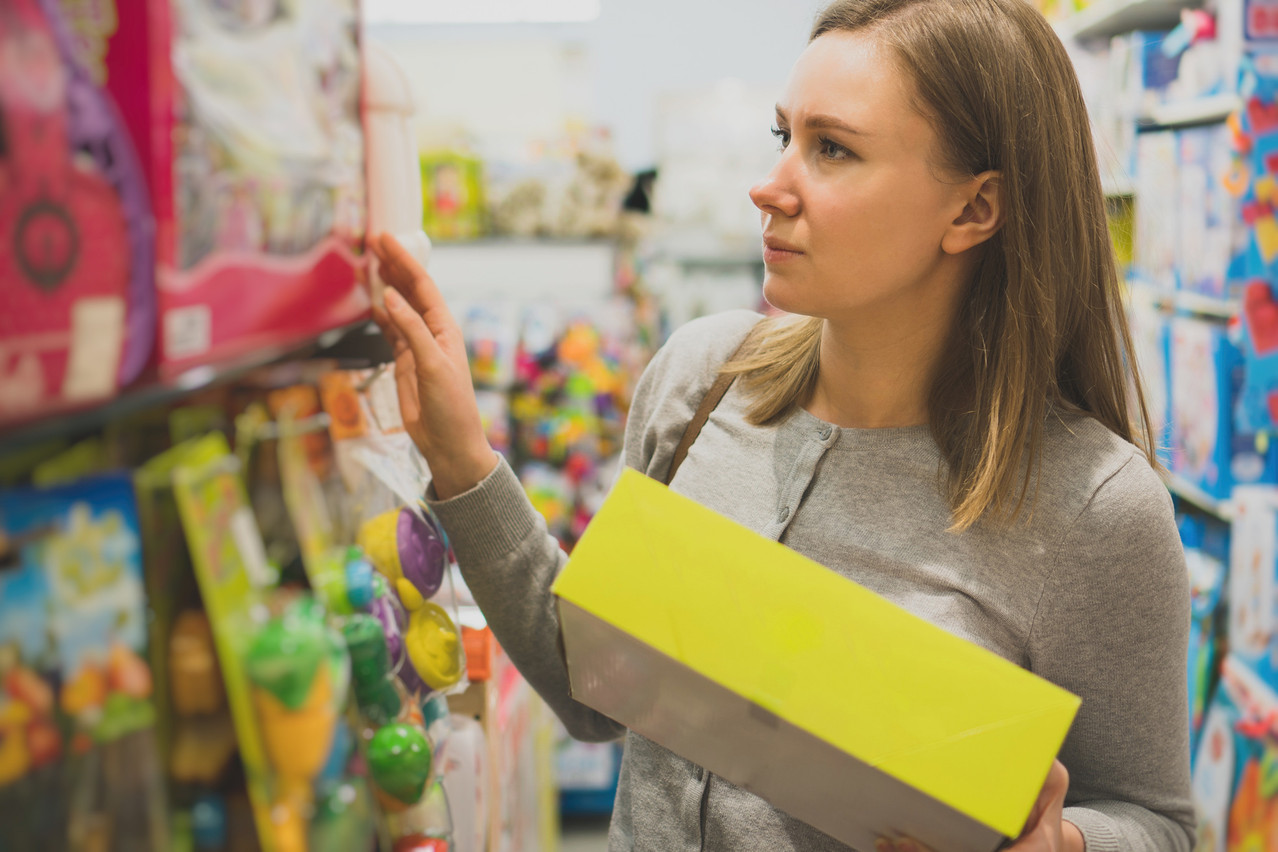
Under the tree, carefully wrapped, Christmas toys are a delight for children, but they can also be dangerous: because of their quality or the small parts they contain. Worse still, when they are connected, they can represent a breach into which ill-intentioned people can swoop. Every year, the Luxembourg Institute of Standardisation, Accreditation, Safety and Quality of Products and Services (Ilnas, part of the economy ministry) publishes a guide for parents on how to choose safe and suitable toys. It also gives advice on how to check toys regularly after purchase, and on which toys are best suited to a child’s age.
Some information to check
Consumers are well advised to look out for certain markings that must appear on the product. The most important of these is the CE marking, which means that the manufacturer has complied with conformity assessment procedures. If it is not affixed to the toy itself, it must at least be on the packaging. In principle, a product without this mark could not be legally sold in Europe. Exceptions exist for certain products such as clothing or certain items of furniture. On the other hand, on the internet, on sites based outside the EU, you may find yourself faced with these products. The risk of such a product is that it may not be compliant and may present serious risks. In the event of a problem, it may be more difficult to seek redress.
Another thing to check is the brand name and--if possible--the contact details of the manufacturer or importer. Any European manufacturer or importer must “indicate its name, company name or registered trademark on the product, as well as an address at which it can be contacted,” says Ilnas. If this is not the case, the toy may not comply with certain safety criteria.
Common sense, above all
A piece of advice that seems more like common sense, Ilnas recommends “choosing toys according to the child’s age and abilities.” Many toy boxes contain an age recommendation. But this must obviously be assessed according to each child’s abilities.
“It is also recommended that priority be given to toys that stimulate children's physical, mental and social development, as well as their creativity,” adds Ilnas. It is therefore recommended to pay attention to the potential presence of a pictogram warning of a potential danger for a young child. Similarly, adults should “check that toys intended for children under three years of age do not contain small detachable parts.” And this doesn’t just apply to games with separate pieces: Ilnas also cites the example of a soft toy, for which it is more prudent to check “the solidity of the seams by pulling on the eyes, nose and all the glued or sewn parts to check that they are solidly anchored.”
Connected toys, a window of opportunity for criminals
Just as adults are increasingly interested in technological products, electronic toys are becoming more and more appealing to children. But they are not without risk. Ilnas recommends checking the noise levels of musical toys. “We recommend giving preference to toys with an on/off button and possibly a volume control.” For electric or electronic toys, Ilnas also recommends paying attention to the batteries, and making sure that they are located in a compartment that the child cannot open by him or herself. “Be particularly careful when buying toys containing button-type batteries,” adds Ilnas. Their small size represents a danger of suffocation as well as burns.
You also need to be vigilant when it comes to connected toys, because “they can pose a real safety risk for your little ones,” says Ilnas. Some toys can be used as a means of accessing a home network and can open the door to data piracy. If passwords have to be created, it’s best to use complex combinations and only allow access to functions that are strictly necessary. As a general rule, to guard against possible hacking, it’s also advisable to avoid connecting the toy to a public wifi network and to enter only essential information. It is also advisable to disconnect the toy from the internet when it is not in use.
This article was originally published in French.