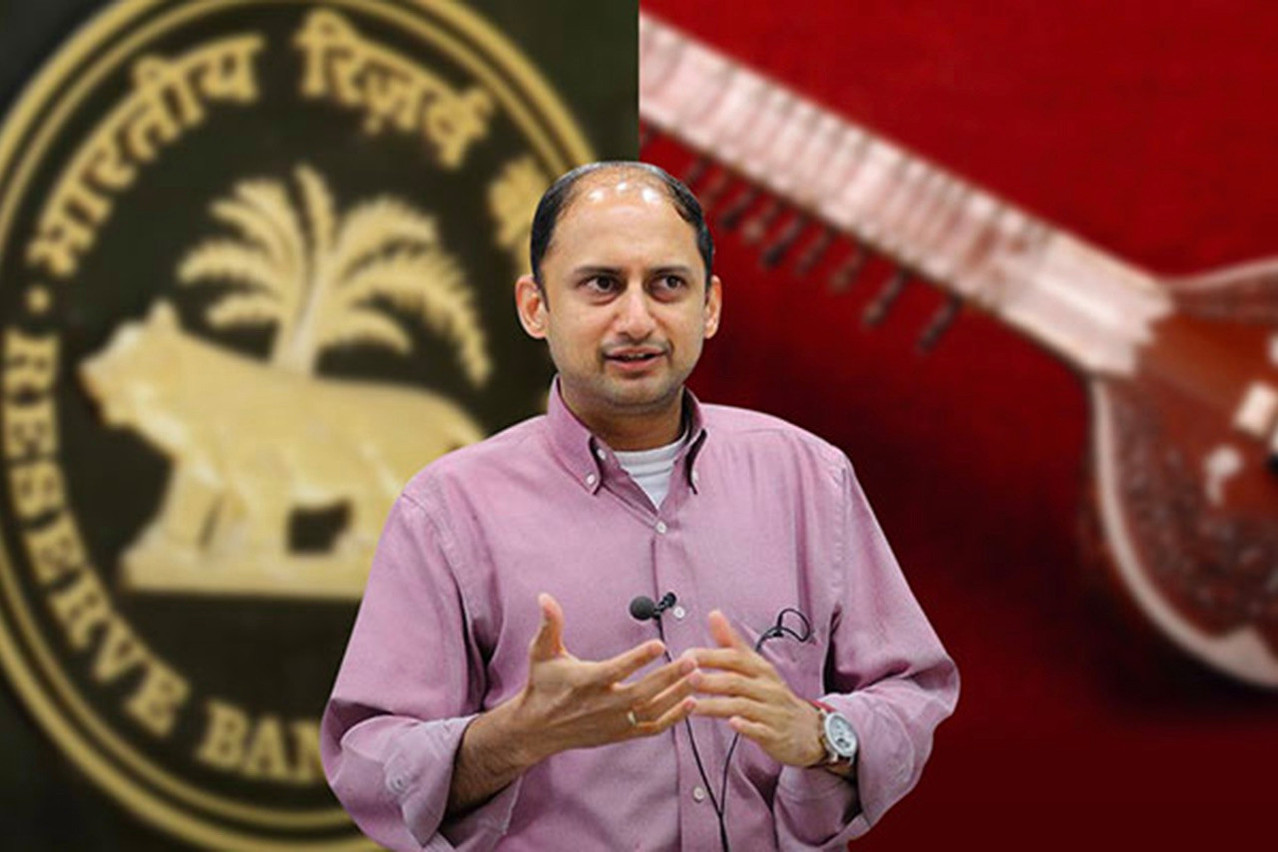
Professor of finance at NYU and former deputy governor of the Indian central bank (RBI), Viral Acharya is the guest of honour at a seminar organised jointly on 28 February by the European Stability Mechanism (ESM) and the University of Luxembourg. Ahead of his visit, he shares his concerns about the global macro-financial situation with Delano’s sister publication Paperjam.
Paperjam: What exactly will be the subject of your talk?
Viral Acharya: I’ll be presenting my work on the evolving status of US treasuries as the safe haven for investments in the world. As we know, the US dollar is currently the reserve currency, and has been for probably close to 100 years. But, on and off, we go through cycles when investors are not sure about the safety and the liquidity of US treasuries--because most investors don’t just keep their dollar savings in bank accounts, at least not the large institutional investors, because then they would earn very little. Instead, they park them in US Treasuries, or agency securities of US-sponsored enterprises like Fannie Mae and Freddie Mac, that guarantee mortgage debt. So the focus of my presentation is to understand when and why the world pays an extra premium for holding these US treasuries.
In the United States, inflation is a major issue in the presidential campaign. Is it under control?
Inflation is certainly coming down, but the last mile is non-trivial. I think the core inflation [the increase in the price of goods and services without taking into account more volatile items like energy or food; editor’s note] is still 4% or so.
Is maintaining a balance between inflation and growth within the Fed’s grasp?
The financial conditions in the US are still relatively easy in the aggregate. There are pockets (small businesses borrowing from small banks) which are probably a bit tight. But otherwise, financial conditions are quite easy. The stock market seems to be very frothy, if anything. Consumption spending, corporate activity--all seem very buoyant.
So I’m not so worried about inflation or growth, per se, but I am worried about the fact that the market has run ahead of the Federal Reserve in terms of anticipating rate cuts. And it doesn’t look like the job on inflation is done. So that’s one problem: there could be some adverse surprises for the market in terms of rate cuts getting pushed further back in the next year. Second, it means that interest rates may remain high for longer, which is a problem for US government’s interest rate burden, given its large quantities of debt that is coming due (and the rollover costs will also be high). And third, while there is not much uncertainty about growth in the US, there’s a lot of uncertainty about inflation and interest rates--and that’s not good news for the bond markets and the US treasuries.
What do you expect from Washington?
It’s pretty important, in my view, for the Federal Reserve to bring inflation down--for the US government to try and bring down its supply of US debt and avoid further debt ceiling kinds of situations. These create political uncertainty in the minds of investors. If they manage that, it would help keep the special status of US treasuries as the safe haven of the world. They’ll [thus] be able to borrow at a lower cost.
In the eurozone, inflationary momentum is slowing. What are the implications for monetary policy?
I think the European Central Bank is in a similar situation as the Fed--maybe a slightly more difficult one. It’s becoming harder to keep trying to bring inflation down to the target level. In some sense, it’s easier in the US for the Fed to make these calls because growth is strong, so they can afford to actually keep their monetary policy a little tighter. Whereas in Europe, on the one hand, they need to support growth--but on the other, inflation also has to be brought down. So I think it’s a difficult situation--that's how it is in a stagflation kind of economy.
Do you see any reassuring signs on the horizon?
The biggest concern is probably that the German economy is not, I think, doing very well. I’m not an expert on the specifics of the German economy, but it looks like that maybe the combination of the oil price shock and the Chinese slowdown are both playing out simultaneously in a manner that seems difficult. Now, Germany has the fiscal space in order to stimulate and invest in the economy--but I think it remains to be seen how much they are willing to push that going forward.
In some ways, the inflation shock was much higher in parts of Europe during the energy crisis; some of them were already dealing with high inflation. And then there are issues relating to corporate pricing power, which has made that shock a little more entrenched. But being in a slightly higher inflation environment--such that the central bank cannot use monetary tools to ease the economy--and simultaneously experiencing low growth is a particularly bad situation. It’s a stagflationary sort of force.
How do we get out of this rut?
In my view: gains in productivity, structural reforms, maybe labor market reforms (where possible). Perhaps the right kind of immigration could also be a possibility, because many parts of Europe aren’t growing in a demographic sense anymore. And I think Europe has to maybe prepare itself for a slow China, not just this year, but I think for many, many years to come. If the German auto industry isn’t going to be exporting heavily for luxury consumption in China, then what’s the new market--where does it need to go? It’s a very challenging time.
And what worries me is that Europe’s last decade was already a bit slow. After the global financial crisis, you had the European sovereign debt crisis. And in some sense, things had just started to normalise on the banking crisis, the sovereign debt, etc, and then covid-19 hit. That’s two pretty large shocks in less than 10 years, so Europe has got to find a way to shift growth structurally to a higher level. I wouldn’t look for patchwork and quick fixes--to me, it calls for something more substantial in the underlying productivity of the European economy.
Given the current challenges, is the 2% inflation target pursued by central banks in the US and Europe still relevant?
There have been some productivity gains over the last few years: maybe it’s about working from home, maybe the fact that covid-19 actually led to more efficient investments by weeding out some of the weaker firms. If these assessments are true, it could be that the inflation target can be higher--but you can’t decide that on the fly. I think this has to be studied by a proper committee of academics and central bankers. (And it’s not something they can do probably in a month or something.)
Is such a step desirable?
I think central banks should ask the question: what’s the right level of inflation to target, given all the changes over the past several decades? But I think this can’t be done on the fly. It can’t be done in the middle of normalising inflation to a lower level. And the timing of switching the target might be very crucial from a credibility standpoint. The least harmful point at which to do it is once you have reached your present target--then you’ll say, okay, I’m changing my target rather than making a mid-course correction (as in: I couldn’t reach my target and therefore I’m changing the target).
This article also appears in Paperjam in French.