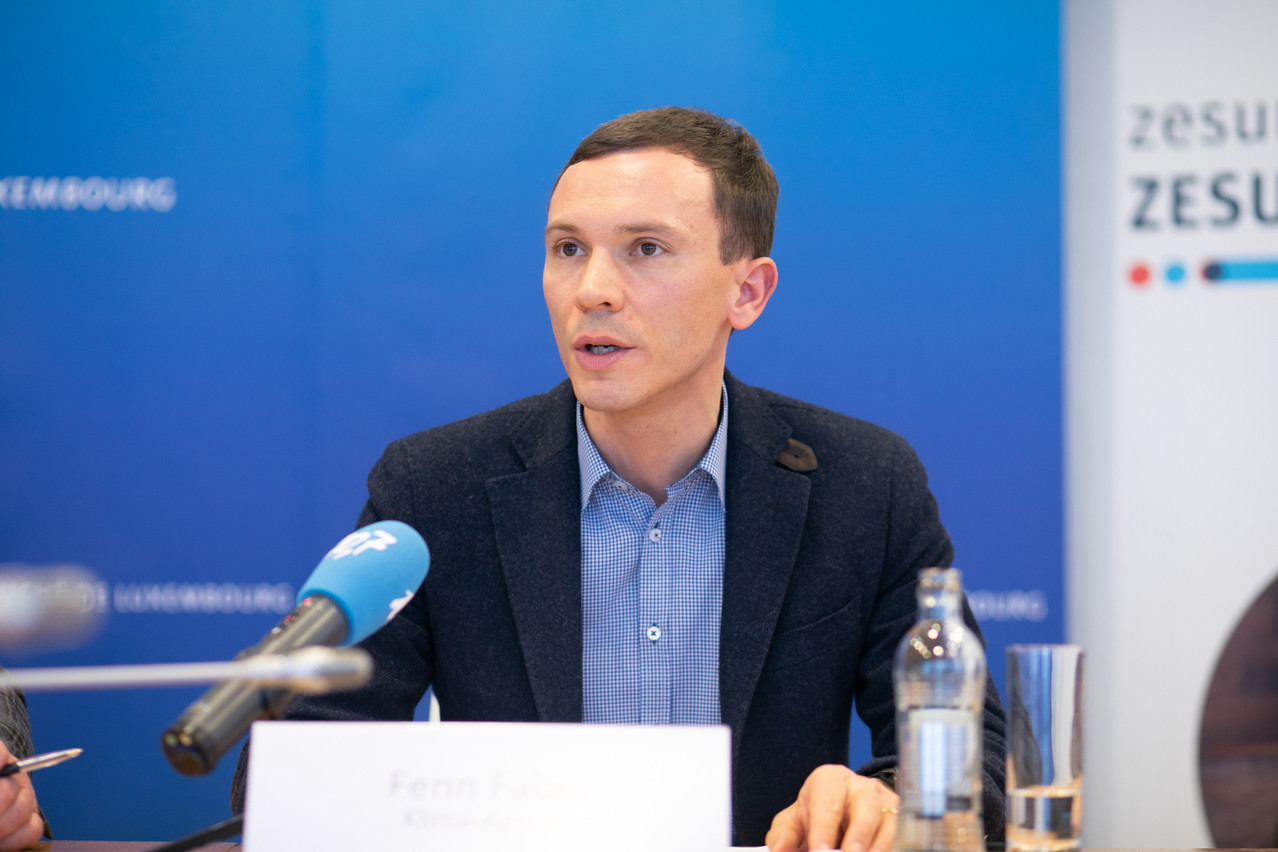
The first and most important challenge to be met if we are to achieve the targets set following the Paris Agreement and ensure that economic development takes a sustainable approach lies in the energy transition that we need to make. “It is now essential to decarbonise our societies. At present, we are still extremely dependent on fossil fuels, whether gas or oil,” comments Fenn Faber, director of the Klima-Agence economic interest group, whose mission is to support all players in society--individuals, local authorities and businesses--in their commitment to climate protection and the energy transition. He adds: “Everyone must play their part in Luxembourg’s commitment to achieving ambitious national targets for reducing greenhouse gas emissions, renewable energies and energy efficiency by 2030.”
These targets are now included in Luxembourg’s Integrated National Energy and Climate Plan for the period 2021-2030 (PNEC). Aligned with European Union requirements, they aim to reduce greenhouse gas emissions by 55% by 2030 compared with 2005, and to achieve a 35% to 37% share of renewable energy in final consumption. The aim is also to improve energy efficiency by 44%. “If we want to achieve these targets, the first challenge is to reduce our energy needs. This mainly involves improving the energy efficiency of buildings. At the level of businesses, particularly those with significant needs, we also need to explore all the levers that can be used to optimise their consumption,” explains Faber. The targets set by the PNEC for 2030 are an initial milestone. The ultimate aim is to achieve carbon neutrality by 2050 at the latest.
In view of these deadlines, anything that helps to increase the volume of projects and speed up the transition must be viewed positively.

Renovating building stock
For private individuals, the first step is to improve the energy efficiency of their homes by investing in insulation. With this in mind, the government has set up a scheme called Klimabonus to encourage homeowners and tenants to carry out energy renovation projects. “We’re there to advise them, to explain the opportunities for carrying out renovation work, whether it involves improving insulation or changing the heating system. Based on an assessment of each individual’s situation, we can identify the existing possibilities for improving the energy efficiency of a building or home, prioritise the projects and support the beneficiaries through the various stages of implementation,” continues Faber. It’s important to note that access to the grants is subject to a number of requirements, including quality criteria, to ensure that the investments made are appropriate and efficient.
Consuming differently
The support offered by the state also extends to the installation of renewable energy production or storage units (such as photovoltaic panels or batteries) on a residential scale. “Generally speaking, to cover residual energy needs, once optimised, the challenge is to support the share of renewable energy in final consumption. Individuals and businesses alike can reduce their dependence on external energy supplies by adopting a self-consumption approach,” explains the Klima-Agence director.
In Luxembourg, the other major challenge of the energy transition concerns travel. In this area, the government wants to encourage individuals to favour soft mobility or to adopt an electric car. In this area too, the government is offering attractive grants to individuals for the purchase of a bicycle, an electric bicycle or an electric car. Businesses can also apply for co-financing for charging infrastructure and vans.
Accelerating change
While these measures are primarily aimed at helping to tackle the climate challenge, the energy crisis that followed Russia’s invasion of Ukraine has acted as a catalyst. “We have in fact seen a greater increase in requests for advice from our teams since the start of 2022. The profiles that have come to us are now more diverse. It’s no longer just people who are already convinced of the importance of looking for ways to improve energy efficiency. We’re seeing more and more people asking questions about whether they should invest in a photovoltaic system or a heat pump, for example,” explains the director of Klima-Agence.
Between 2019 and 2022, the number of advice sessions provided by Klima-Agence at home or remotely doubled, from 6,000 to over 12,000. “The energy crisis, ultimately, supports the country’s commitment to the energy transition. In view of the deadlines, anything that helps to increase the volume of projects and speed up the transition must be seen in a positive light,” adds Faber.
To support the change, Klima-Agence is also working to facilitate access to support, both from the state and from local authorities. The latter are also very committed to supporting this transition. For example, on the aides.klima-agence.lu website, residents can run a simulation of their project and get an idea of all the grants they can claim, whether from the state, local authorities or energy suppliers. The amount of government assistance depends on the nature of the project and the household's income. This aid is not negligible, and in many cases represents 50% of the actual costs of the project, and sometimes more. These various initiatives have proved popular.
In the summer of 2023, the government announced that, since the launch of financial assistance for the purchase of an electric bicycle in May 2020, almost 51,000 applications had been processed, representing a total of €22m. For all these schemes combined (renovation, housing and mobility), €405,058,658 in subsidies have been paid out since 2013 (July 2023 figures).
Facilitating the financing of remaining costs
Although the financial incentives are relatively generous, these investment projects can be seen as costly by a large proportion of the population. In fact, the remaining costs may require recourse to traditional bank financing solutions. At this level, another mechanism, implemented at European level, should play its full role. “As companies, financial players are required to report on their environmental and social commitments and to draw up a transition plan,” explains 
In this context, energy transition projects that meet the criteria defined in the European taxonomy benefit from more favourable financing conditions. This applies to both private individuals and businesses, insofar as the latter can account for the energy savings achieved. In the case of private individuals, if we take into account the public intervention, the energy savings made by the planned project and the possibility of benefiting from an interest subsidy on the bank loan, the investment is often quickly recouped.
Mobilising economic players
And what about companies? In Luxembourg, industry accounts for around 30% of total energy consumption (according to the 2015 energy balance drawn up by Statec). As major consumers, these players are sensitive to the management of their energy parameters. Understanding them properly is part of a company’s responsibility in relation to energy issues. The transition should also make companies less dependent on price fluctuations on the energy markets, and is a lever for improving competitiveness.
Since 1996, industry federation Fedil has been offering companies with high energy consumption the opportunity to participate voluntarily in the “Voluntary Agreement between the Luxembourg Government, Klima-Agence GIE and Fedil on improving energy efficiency and decarbonisation in Luxembourg industry.” The agreement currently involves around 50 energy-intensive companies from Luxembourg’s industrial and service sectors. For the period 2021-2023, the companies taking part in the voluntary agreement have undertaken to achieve the common objective of improving the overall energy efficiency of all participants by 4.5%.
The initiatives to support the energy transition of businesses do not stop there. “Klimapakt fir Betriber, which Klima-Agence is implementing with Luxinnovation, aims to support companies in their efforts to reduce their carbon footprint and make the transition to renewable energies,” says Faber. “The government’s aim with this programme is to facilitate access to a range of resources that will enable every structure, whether an SME or a larger account, to embark on a transition process.”
In response to the constraints faced by many structures that do not have the resources to dedicate staff to these issues, the SME Packages--Sustainability, supported by the economy ministry (DG Classes moyennes) and implemented by the professional chambers, offer companies individual support in identifying concrete solutions to reduce their environmental impact and waste, and generate savings by reducing their energy and water consumption. Luxinnovation, for its part, supports interested companies via the “Fit 4 Sustainability” programme in carrying out an assessment of the environmental impact of their activities. Firstly, in the diagnostic phase, by pre-analysing needs and putting them in touch with an appropriate consultant. Then, in the implementation phase, by proposing suitable financial support programmes.
What fuels Luxembourg?
In Luxembourg, says Statec in a note published at the end of 2023, electricity covers 48% of the energy needs of industry (figures for 2022).
This share has increased by 9% in 20 years. By contrast, electricity accounts for just 17% of household energy needs, a figure that has risen by 4% over the past 20 years. In the tertiary sector, electricity covers 35% of their needs, down 1% on 2002.
Petroleum products are mainly used for transport and residential heating. Natural gas is mainly consumed by industry and households. As Luxembourg is 88% dependent on foreign countries for its energy supplies, price rises on international markets have led businesses and households to limit their consumption of natural gas and heating oil. In 2022, against this backdrop of an energy crisis, industry and the tertiary sector cut their natural gas consumption by 29% and 26% respectively. Households also reduced their natural gas consumption by 11%. Households that were able to do so also switched energy sources. Consumption of firewood and pellets rose by 53%.
This article was written for the ESG supplement of the July 2024 edition of Paperjam, published on 19 June. The content is produced exclusively for the magazine. It is published on the website as a contribution to the complete Paperjam archive. Click here to subscribe to the magazine.
Is your company a member of the Paperjam+Delano Business Club? You can request a subscription in your name. Let us know via club@paperjam.lu
This article was originally published in French.