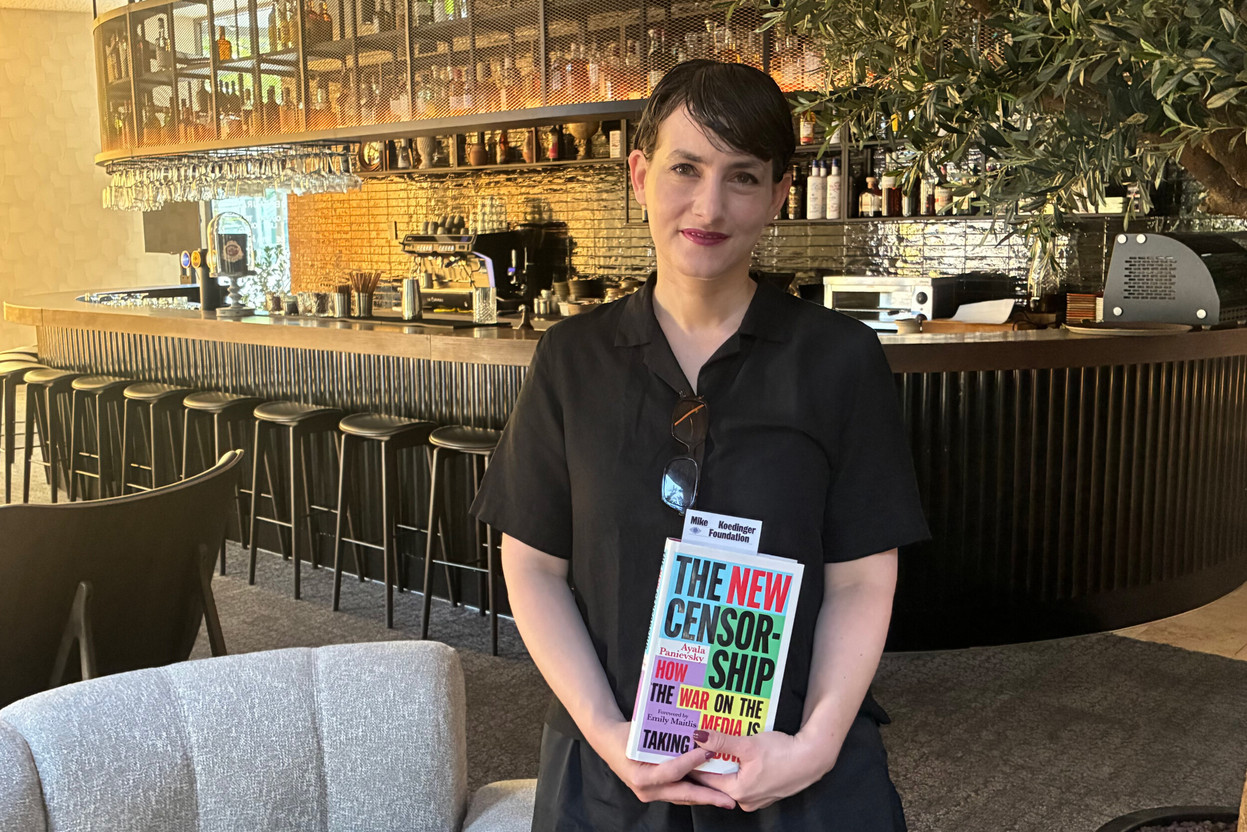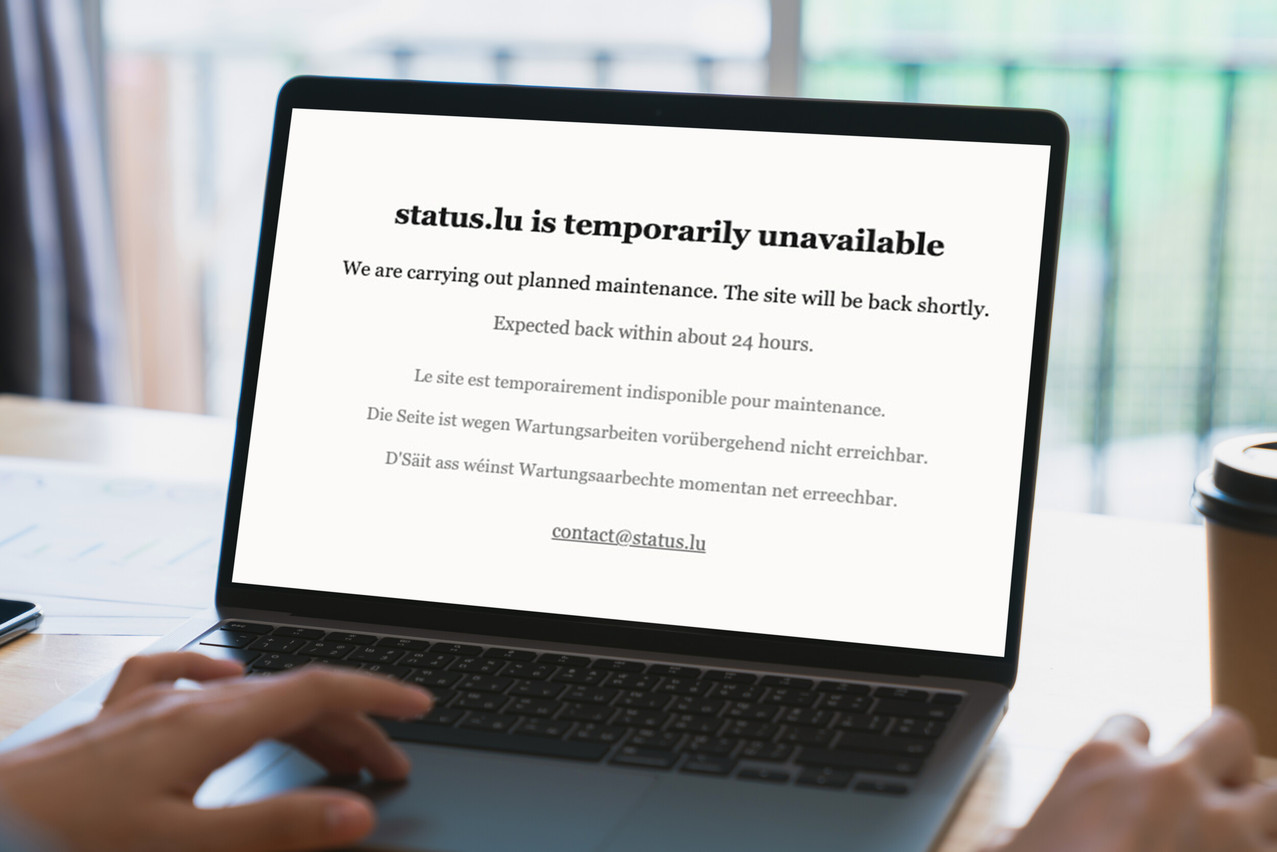
He is a geek as gifted with technology as he is with keeping quiet. For the past few days, ‘Tom’ has not been answering any questions – neither by text message nor by email, let alone via WhatsApp. He is worried that his almost entirely automated news website, available in four languages, may have sparked more debate than controversy. This Thursday morning, it was finally his father who took the initiative to ask him to take the site down. On the phone, he insists that his son had no malicious intent.
“It started out as a personal project. I wanted a daily, automated overview of events, and I wanted to see if I could create the entire process: research, writing, editing and publishing. It worked, and for a long time, for me it was primarily an engineering challenge,” the young man wrote on his website on Thursday. “Over time, my interest shifted to the underlying system rather than the articles themselves. I’d designed a tool capable of researching, writing and publishing a complete daily website for a hosting cost of just a few euros a month. It struck me as really useful, and I was considering developing it into a product that I could offer to established Luxembourgish publishers such as Wort, Tageblatt and others, in the form of an infrastructure they could manage with complete editorial autonomy, with their journalists deciding on the content to be published.”
He also apologises both for not having registered a company and for not having stated, as required by the AI Act since the start of the summer, that the website was written by AI. He denies any intention to interfere.
An editorial team of six journalists… who don’t actually exist
Since December, Status.lu has been drawing on content from ‘mainstream’ media outlets – both large and small – and from various websites, such as Wikipedia, gouvernement.lu, Statec and a whole host of other organisations, to offer articles credited to six journalists, all structured in the same way: headline, lead, summary of key points, body text and, in some cases, the sources used to write the article. No fake news. No defamation. No content that, in a legitimate media outlet, would be objectionable. As clean as it gets. Except that.
Whilst the virtual ‘newsroom’ works well with data, just as journalists do, it does not speak to anyone, does not interview anyone, and does not send any verification or follow-up emails. The content depends on the settings of the tools used and does not really indicate any particular ‘political leanings’, unlike a political opinion piece hosted on his personal website, which, according to our own analysis, leans towards the centre-right to right.
Camille Reuter, listed as the editor-in-chief, has 378 articles to her name, but only 50 are accessible via her profile page and 102 via a search for her name. 50 – not 374 – is also the figure for the managing editor, Jonas Thill. The first accessible article on the site is a short piece dated 3 June, containing no new information, about the football stadium, which appears to indicate an official phase of setting up the tools.
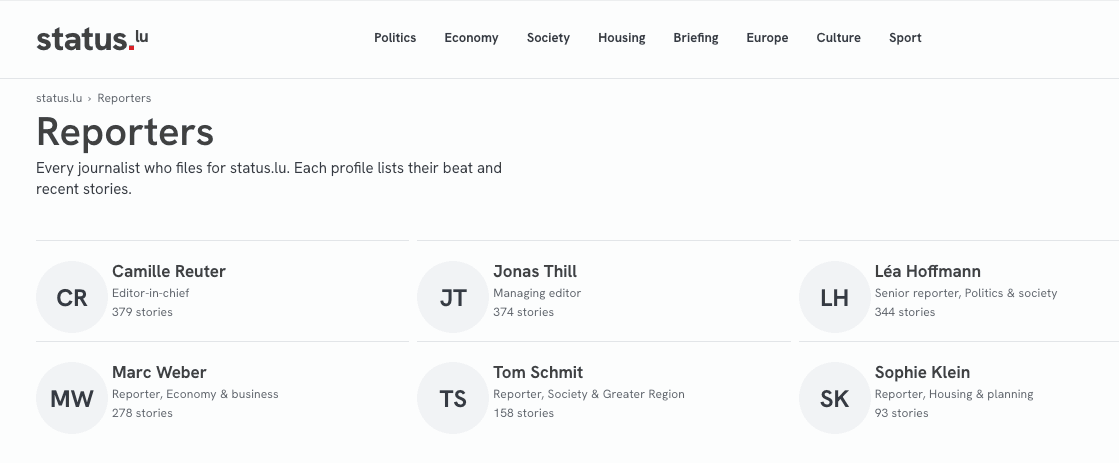
The six journalists on the Status.lu editorial team, according to the website’s legal information. None of them are members of the Press Council. (Capture d’écran: status.lu)
What’s the problem? Behind the ‘legal’ information… there’s nothing to it. The website is reportedly published by Status.lu Media, a company that is not registered with the Luxembourg Trade and Companies Register. It does not provide any details of a publisher, a person responsible for the content, or even an address. And the six journalists – or at least the names of the six journalists with a Luxembourgish ring to them – are not registered with the Press Council, which, in reality, isn’t a problem, as journalists can work under a pen name provided their publisher knows who they really are, should any issues arise.
This 20-year-old cybersecurity graduate has also done everything in his power to prevent anyone from tracking him down. This has led some observers to suggest that he has ‘significant resources behind him’ and ‘highly specialised skills’. However, it is possible to find his first name and surname, as well as his website, CV, LinkedIn profile, GitHub account and other projects he is working on, in a similar vein: how to apply automation using artificial intelligence to processes or topics that are currently as cumbersome as a family Christmas dinner.
What the Media Act says
Is Status.lu in breach of the Media Act, given that it claims to be a media outlet? The current law requires the publisher and those responsible for editorial content to be identified, a requirement that Bill 8625 does not remove. The new law, which has been under discussion at the parliament since it was tabled on 7 October, no longer requires a company to be registered, but allows for a natural person to suffice. The text, amended on 18 June, sets out five criteria: appropriate physical facilities; administrative and technical infrastructure; management effectively and continuously carried out in Luxembourg; the regular presence of the director; and the accessibility in Luxembourg of documents relating to the business’s activities, accounts and staff. The new text, however, introduces greater institutional and financial transparency regarding the media outlet’s owner, its beneficial owners and any public funds received, with supervisory powers entrusted to the Luxembourg Independent Media Authority (Alim). One ambiguity remains, however: Article 21 requires a ‘company name’, whereas the publisher may simply be a natural person.
The unauthorised use of the title ‘professional journalist’ is punishable by a fine of between 500 and 25,000 euros, which is doubled in the event of a repeat offence. As this status is recognised by the Press Council, a fictional character cannot legally claim it. The Luxembourg Independent Audiovisual Authority (Alia) merely highlighted a difficulty in monitoring compliance and proposed requiring publishers to inform Alim of the exact status of the author in question, a procedural detail which members of parliament did not adopt.
At the time of publication, neither the Public Prosecutor’s Office nor the Press Council had responded to our requests for clarification regarding the risks faced by this young man and what they intended to do with this new media outlet. We will update this article once we receive their responses.
What about the influence of public debate?
With two years to go until the next general election, the bill leaves one particularly sensitive question unanswered: what would happen if a foreign actor were to set up a fake news outlet to influence public debate in Luxembourg? The bill does not establish a general offence of disinformation or foreign interference. Information that is false, biased or hostile to democratic institutions does not, by that fact alone, constitute illegal content.
The first line of defence is based on transparency. The provider will be required to disclose its identity, its direct and indirect owners, its beneficial owners, any state ownership, and any advertising revenue received from public authorities in third countries. The Alim will have access to the Register of Beneficial Owners to verify these declarations. This mechanism is intended to reveal who is behind a media outlet, but it does not prevent a foreign interest from owning or financing one.
A second restriction applies to political advertising. During the three months leading up to an election or a referendum, European Regulation 2024/900 prohibits the provision of political advertising services to a company established outside the Union or controlled by third-country interests. However, this ban applies only to content disseminated in return for payment or other consideration. Articles presented as editorials, organic posts or messages shared by fake accounts may fall outside the scope of this ban.
The Alim will also be able to take action where the service disseminates content that is already prohibited: incitement to violence or hatred; terrorist offences; discrimination; child pornography; or the glorification or denial of genocide, crimes of aggression, crimes against humanity or war crimes. However, MPs have removed the broader category of content that jeopardises ‘national security or public order’. The Council of State deemed this wording too vague to justify a penalty. A campaign seeking to undermine confidence in institutions or to polarise society would therefore not automatically be unlawful if it did not cross any of the thresholds retained in the law.
A grey area in Luxembourg law
European law already prohibits the broadcasting of certain Russian media outlets subject to sanctions and now extends this ban to ‘mirror’ entities designed to circumvent it. However, Alia believes that the Luxembourg bill does not yet provide a sufficiently clear legal basis to ensure the swift enforcement of these measures. It proposes being able to withdraw a broadcaster’s licence, suspend an audiovisual service or platform, and prevent Luxembourg’s satellite capacity from being used to broadcast content from sanctioned entities. This proposal, put forward following the amendments in June, has not yet been incorporated.
The proposed legislation therefore makes foreign influence more visible and closes off certain channels, notably election advertising and the dissemination of sanctioned media. However, it does not allow for a blanket ban on operations comparable to ‘Doppelgänger’, which combine fake media outlets, fictitious identities, AI-generated content and misleading social media accounts. As long as its perpetrators do not disseminate content that is prohibited under criminal law, do not purchase political advertising during the protected period, and do not act on behalf of an officially sanctioned entity, such an operation could still exploit a grey area in Luxembourg law.
Welcome to the world of solo entrepreneurs, where, with a little basic knowledge and a few euros, you can revolutionise a sector that has been in turmoil for nearly 30 years. Russia, often cited as an example, has taken a new direction: feeding AI systems to change the way we talk about our actions or choices. Status.lu, meanwhile, was taken offline on Thursday. Nothing had been published there since 16 August.