Note to readers: this interview was conducted on 2 March, prior to the signing of the “Lux2029” tripartite agreement on Friday 20 March, which notably provides for up to 300 departures to deal with the sector’s difficulties.
How would you sum up your first few months as country head? Have your goals changed?

My second objective is obviously to work on our competitiveness in the face of very strong international and European competition. In particular, this involves the quality of our products and our price positioning.
My third objective is linked to the European environment and [its] regulations, particularly with regard to the border carbon adjustment mechanism or the Industrial Clean Deal.
ArcelorMittal has been in the news a lot in recent weeks, particularly over the relocation of support function jobs to Poland and India. What are we really talking about?
“Figures have been circulated, but they are incorrect and the result of a misunderstanding. The figure of 1,150 corresponds to the scope of a study we are currently conducting, i.e. the number of people working in our support functions. It is not the number of jobs that would be affected. This is the source of the confusion [300 departures have finally been agreed following tripartite negotiations. They will take the form of early retirement and pensions, short-time working, voluntary redundancies and internal transfers, editor’s note].
Several solutions are being considered, including the consolidation of certain activities in Poland or India.

What [was] the purpose of this study?
“The aim is to analyse the possibilities for optimising our administrative activities. We are assessing what could be done in terms of automation, digitalisation and robotisation. Several solutions are being considered, including the consolidation of certain activities in Poland or India. We need to ensure that our cutting-edge products and services give us a competitive edge. And that our production costs enable us to remain competitive, even with non-European competitors.
How are you coping with these tense times?
“What is important to me is the accuracy of the information that is relayed. All the decisions we take are aimed at ensuring that the European and Luxembourg steel industry, which has existed for over 100 years, remains sustainable.
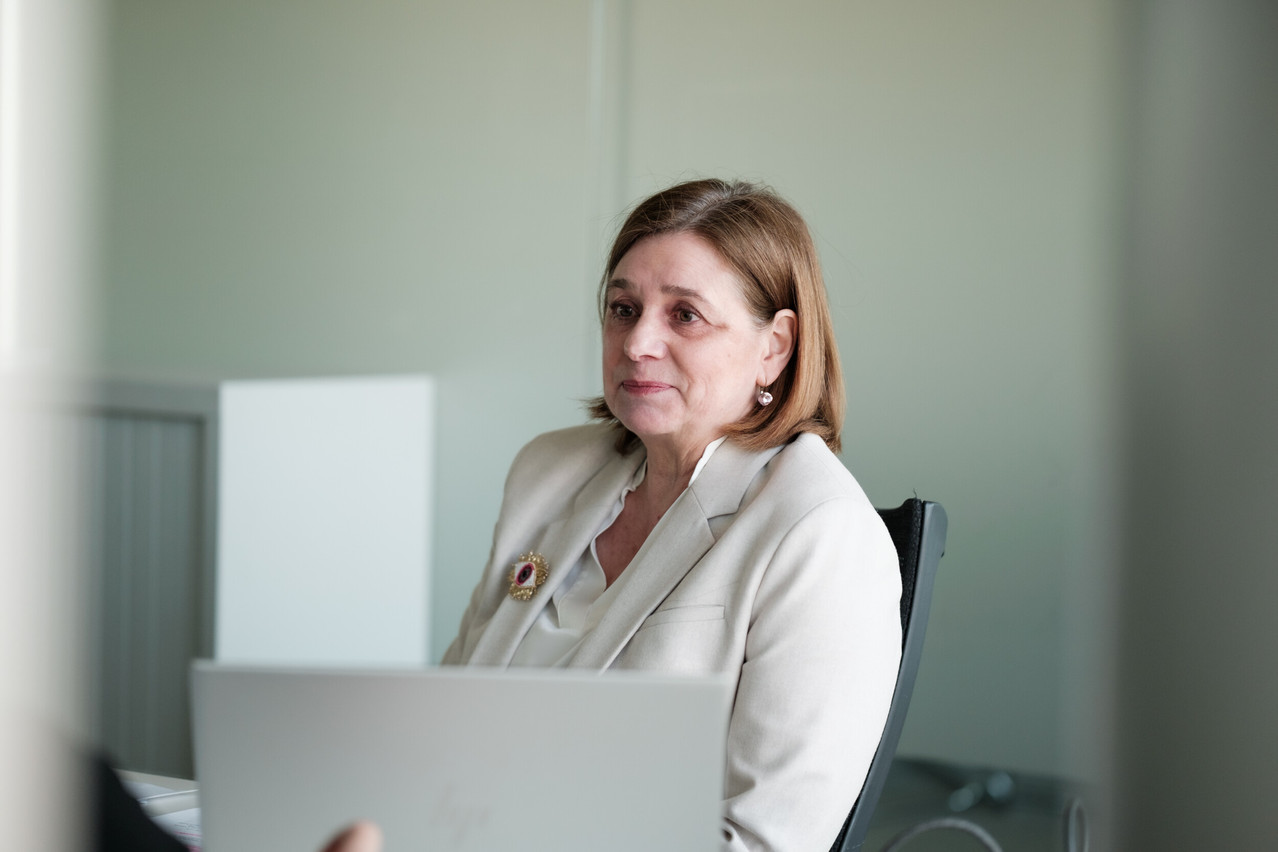
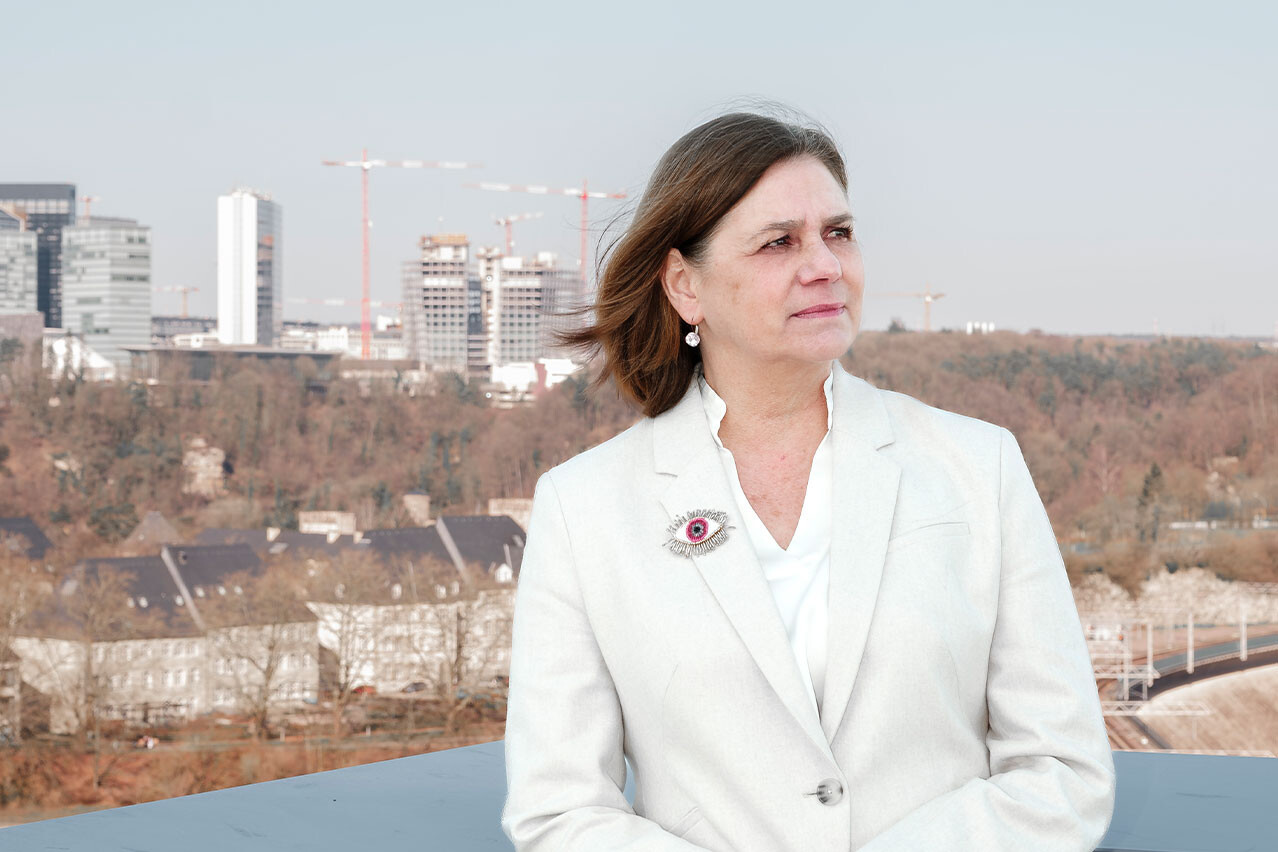
Valérie Massin is defending a better level playing field in the steel sector. (Photo: Patricia Pitsch/Paperjam)
What weighs most heavily on your business and the steel industry in general?
“We are facing global competition. The world is in a situation of steel overcapacity, which is expected to reach around 700 million tonnes by 2026–2027.
At the same time, demand in Europe has fallen by around 25% since 2008. At the same time, imports of non-European products have risen sharply in recent years, making Europe a net importer of steel. Finally, high energy costs represent an additional challenge. For us, this mainly concerns the price of electricity. We are therefore fighting for a level playing field, i.e. fair conditions of competition.
In the face of global competition, what does ArcelorMittal Luxembourg have that the others do not?
“Luxembourg steel is sold in Europe and throughout the world. Our products have high added value, like the ‘Jumbo Beams’, the giant beams manufactured in Differdange. We supplied one for the Henry Ford Hospital in Detroit: it weighs 1.5 tonnes per linear metre, making it the heaviest in the world. Sheet piling is also a product with very high added value: we produce some of the widest sections in the world and we accompany their installation with technical support.
These products are essential elements of our competitiveness. We want to continue to develop innovative products and technical solutions to maintain this lead. All this necessarily involves discussions, particularly on support functions, as is currently the case, as well as continuous optimisation of our production in order to preserve these assets.
Products made from steel must also be protected and subject to the same regime for imports.
The CBAM (Carbon Border Adjustment Mechanism) came into force on 1 January. Is this enough to combat the competition?
“This is an important step forward, but we feel that certain elements still need to be improved, particularly on what is known as downstream. In other words, products made from steel must also be protected and subject to the same import regime. Otherwise, the entire European value chain will be weakened.
The European Parliament approved a reduction in import quotas earlier this year. Again, is this enough?
“This is also a good decision, but certain issues remain under discussion, notably carry-over. Quotas are defined on a quarterly basis, and some importers are asking for unused volumes from one quarter to be carried over to another. We are not in favour of this. We also need to ensure that the place where the steel was cast can be traced, to avoid the pitfall of ‘melted and cast’. The rule imposed by Europe means that the origin of goods must be determined by the place where the metal was initially melted, and not where it was transformed. This avoids transformations—sometimes very slight—that circumvent customs duties.
On the question of energy, what are you doing to reduce costs here in Luxembourg?
“We led the SteelUp project, which involved building a new electric furnace at Belval. It was a technical and organisational challenge, but it will enable us to reduce our energy consumption. At the same time, we installed photovoltaic panels on the roofs of our European logistics centre [AMCLE], as well as on our Belval site, after the one installed at Differdange in 2021. This also contributes to the decarbonisation of our production.
In terms of sustainability, you are pursuing a dual objective: producing greener and offering steels that are themselves more sustainable. How do you achieve this?
“In Luxembourg, we are fortunate to produce with electric furnaces, whose CO₂ emissions are significantly lower than those of a blast furnace: around 800 kilos compared with 2.2 tonnes of CO₂ per tonne of steel produced.
Our industry is clearly part of the solutions for a decarbonised economy.
We are also able to produce XCarb®, i.e. recycled steel produced from green energy. In this case, emissions fall to around 300 kilos of CO₂ per tonne of steel. In 2024, we produced 400,000 tonnes.
I am convinced that the steel industry will be a decarbonised industry and that it will at the same time contribute to the decarbonisation of society as a whole. Steel, for example, is an essential material for the transition to e-mobility and for the construction of wind turbines. Our industry is clearly part of the solutions for a decarbonised economy.
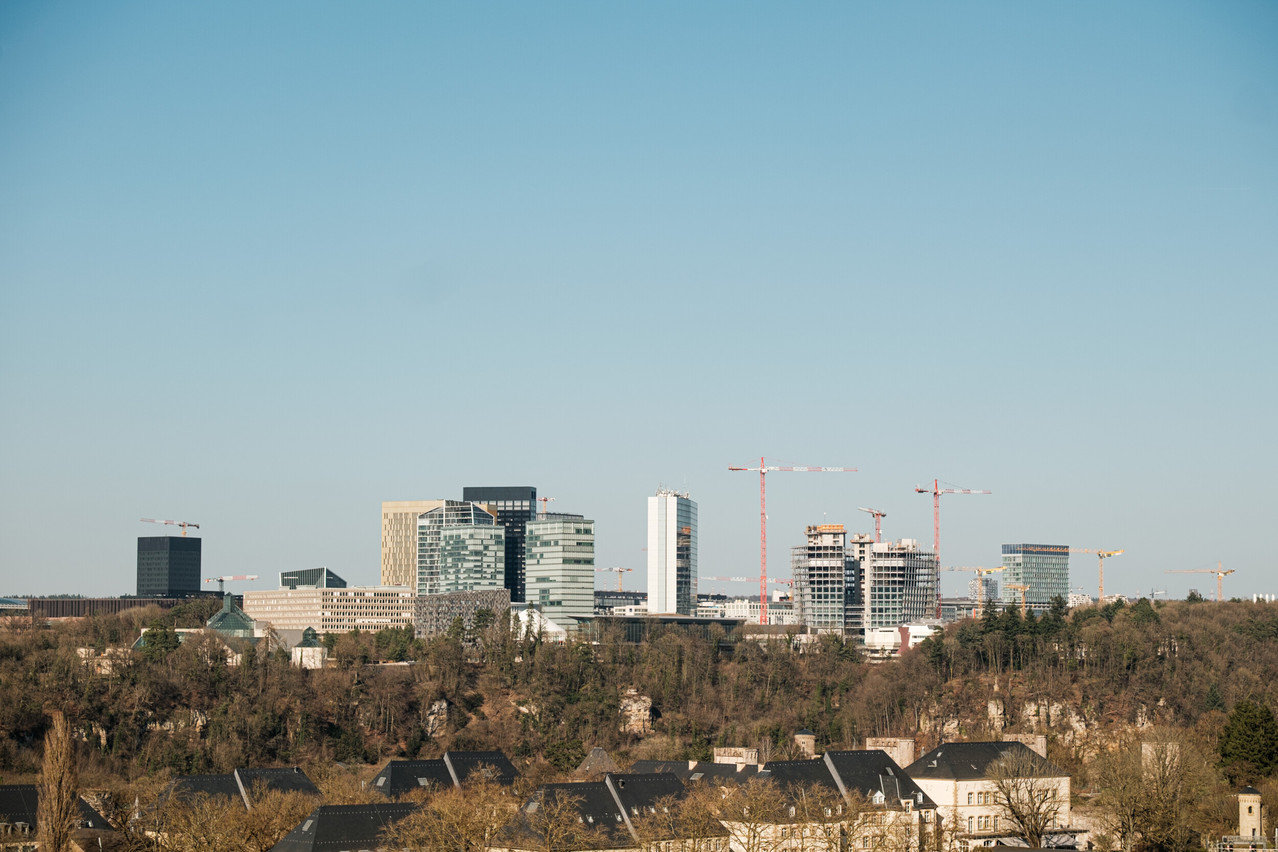
The future ArcelorMittal building in Kirchberg, seen from the current building. (Photo: Patricia Pitsch/Paperjam)
How far along is the project for the future headquarters at Kirchberg?
“We will have our new building in 2027. This project has a dual significance. The first is to confirm ArcelorMittal’s roots in Luxembourg, bearing in mind that this building will also house the group’s global headquarters.
The second is that this building will be constructed mainly with steel produced here in Luxembourg. This is a source of pride for the Luxembourg plants and the teams involved in their production.
The building is also part of a sustainability approach: it will use XCarb® steels and incorporate technical solutions that illustrate the unique know-how of the Luxembourg steel industry.”
This article was written for the April 2026 Paperjam magazine, published on 25 March. The content is produced exclusively for the magazine. It is published on the site to contribute to Paperjam’s comprehensive archive. Click this link to subscribe to the magazine.
Is your company a member of Club Paperjam? You can request a subscription in your name. Let us know via club@paperjam.lu.