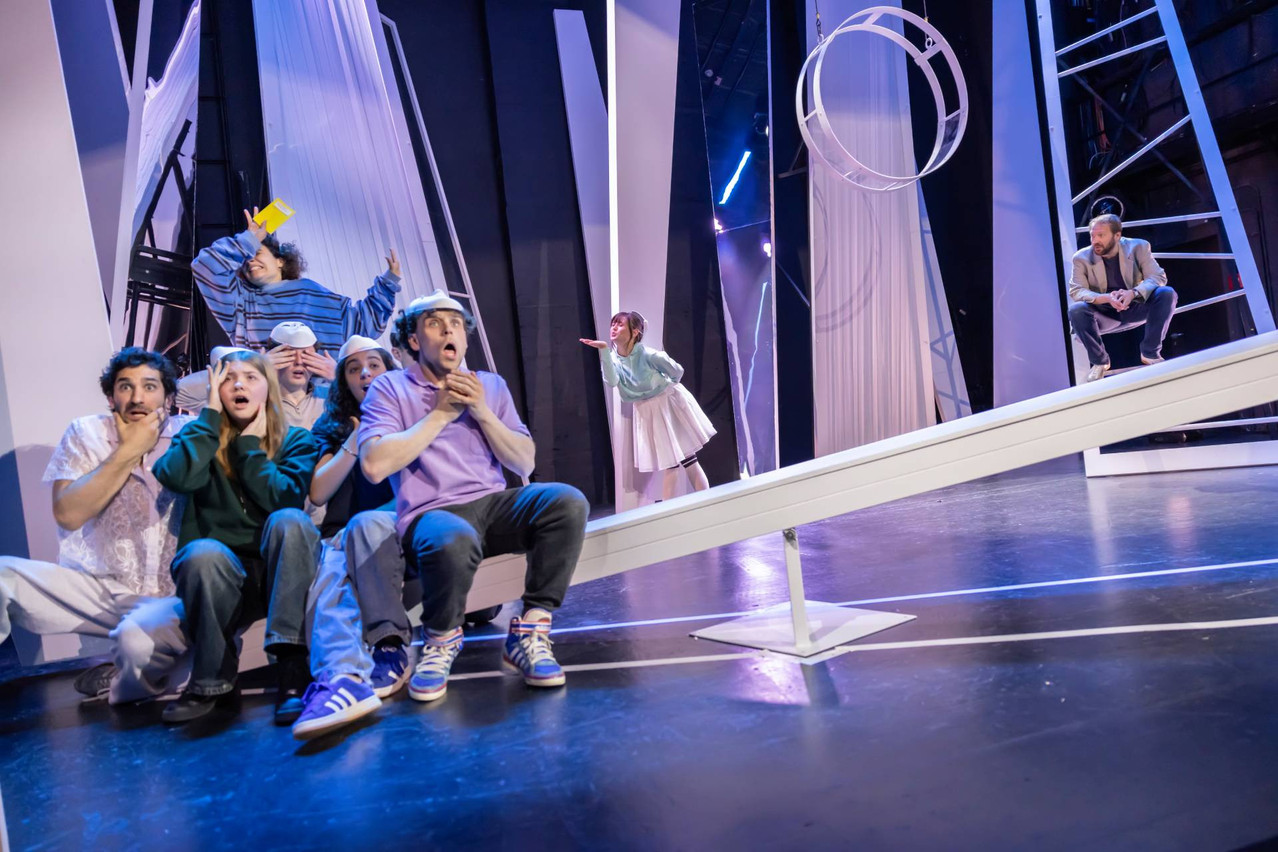
“Spring Awakenings” chronicles the story of a group of teenagers as they discover the tumult of sexuality and struggle to navigate a world torn between information overload and a growing desire for structure. For this multilingual production, director Anne Simon and playwright Antoine Pohu have based their work on Frank Wedekind’s “Frühlingserwachen,” reinventing it with new elements drawn from interviews and workshops with teenagers. The basic material of the daring play--written in 1891 but which resonates disturbingly with current burning issues--is thus supplemented and questioned, reflected and challenged by the realities and voices of today's young people.
Anne Simon and Antoine Pohu explain more.
Céline Coubray: What is the point of origin of this new creation?
Anne Simon (AS): This is a commission for the adolescent focus of the Théâtres de la Ville de Luxembourg, for which I am a guest artist. Director 
And this is how you chose to mix the existing text with a new one?
Antoine Pohu (AP): What remains very present between the text of the past and today is that, even if we know how sexuality works--or rather reproduction--because that’s what we learn, that doesn’t mean that at this age of adolescence we’ve learnt how to manage our emotions, how to treat people we like or don’t like, how to understand who we are and all the violence we produce towards ourselves or others if we don’t understand. It’s very present, often from angles other than what’s in the text, and the text ultimately serves as a filter that both distorts and illuminates the subject. It provides a framework and allows us to take sideways steps, to work with metaphors or echoes.
You conducted workshops with young people for this creation. What did you work on with them?
AP: We had a group of nine teenage volunteers and prepared questions by theme. We hadn’t planned to read the text or give acting lessons, but rather to create a space for them to talk. From a theatrical point of view, we were able to observe how the teenagers behaved, their body language, their group interactions, and for the writing we were able to discover the texture and colour of their language, the words they used, their ways of speaking. I love these participatory playwriting workshops, because the most delicate layer of a play is that last dotted line of colour, the way someone speaks. And in a project like this, that’s what's given right from the start. We write with words, with people’s ways of being.
Did the contemporary additions come easily?
AP: It was more like a long metabolism. A very light narrative thread emerged at the start, which we worked on with Anne. Then we started working with the group of actors on a text that was deliberately not finished. With their input, I reworked the text, which continued to evolve.
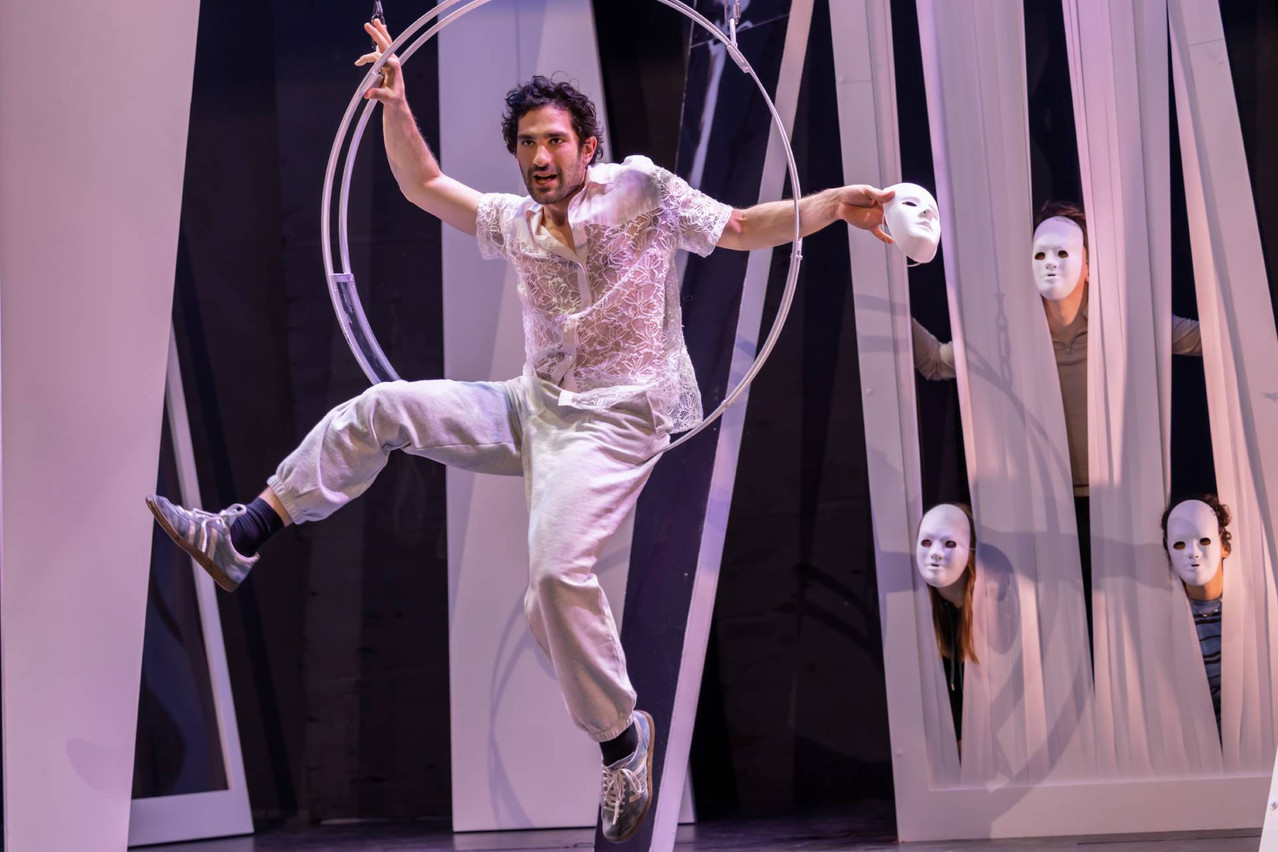
This play tackles the issue of teenage sexuality, but also the construction of one’s identity. Photo: Bohumil Kostohryz
The music plays an important role too. You worked with Edsun. Why?
AS: Music is a means of expression that is very present in the lives of young people. Edsun was included right from the start, came with us to the workshops, so that he could also draw inspiration from what the young people had to say to make the songs.
AP: Amongst the teenagers we met, music is often used to say things, but without words. It’s a place to escape to when you can’t verbalise something. As a result, it was really valuable to have Edsun in the team and on stage where he performs his songs.
Is adolescence a subject of particular interest to you?
AS: I’m more interested in the question of identity than sexuality, which is a subject that is taught a lot more these days. The issue has shifted to the need for performance and the pressure that goes with it. And it also stems from the question of the body, which is very dominant among young people and is a subject that interests me a lot, because it’s also reflected in the imagery of adults.
The presence of social networks is also very important in the play. Tell us about it.
AS: Inevitably, since they are so present in our lives. They increase and accelerate what was already there before, but in a less visible way. The ideals that are promulgated, with this acceleration, are difficult to manage, for teenagers and adults alike. At the same time, we see a more exposed sexuality and the return of a traditionalism, but one that is very hypocritical, because it remains very sexualised.
As a result of this work, have you been able to draw any broad guidelines for behaviour or does it remain multifaceted?
AS: There are still a lot of issues. But when it comes to social networks, young people have the strength to take a step back. They know very well that what they see is not an exact reflection of reality, but they still let themselves be impressed. And the same applies to adults. The strength of teenagers is that they know how to take what they see with a form of humour that puts a distance between the content of the networks and their lives. They have fun with it.
AP: What has changed between the social networks I know and the networks that teenagers watch is that the content they watch is less focused on people. It’s more anonymous. It’s less about showcasing your life and more about sharing actions that are nothing special. Dance videos, for example. A trend is no longer a person, but a gesture.
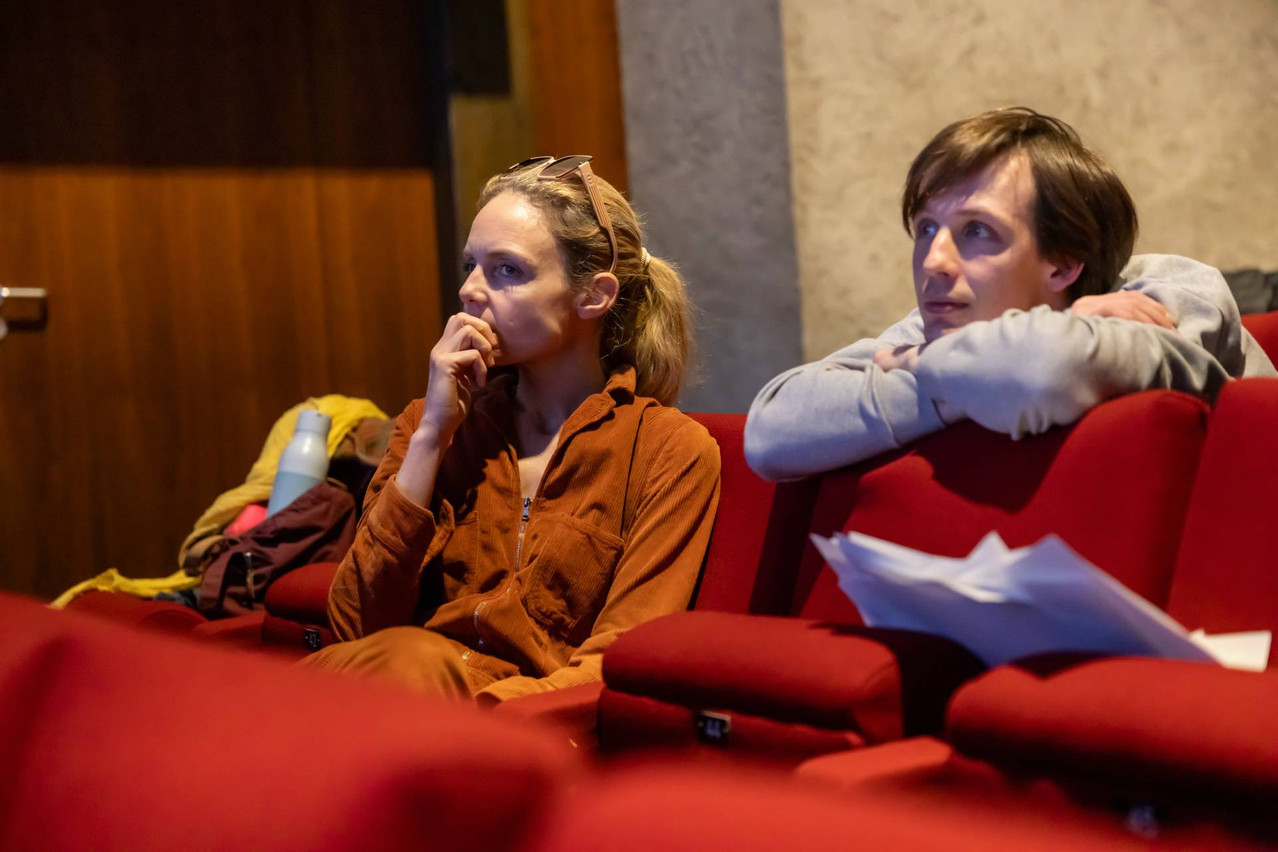
Anne Simon and Antoine Pohu, pictured during rehearsals. Photo: Bohumil Kostohryz
Have social media consumption habits also influenced your writing and staging?
AS: Yes, we find this multitude, this diversity of sources of information in the staging and the narrative, which is constructed in several layers that come together, as in our kaleidoscopic worlds. As in the flow of networks, it’s sometimes hard to find your way around, but you hold on to what you can and work with it. We’re not in a linear narrative, because young people don’t find themselves in that type of narrative at all any more. With this “remix culture,” their understanding of the world is much more radiant. It’s also a more associative, multiform approach.
AP: The play takes place in a classroom where the group reads Wedekind’s text and the story echoes their personal stories. From there, there are parts that are the original text, and then my parts of the text that are multilingual. In general, we kept to one language per scene, apart from certain more performative parts, close to slam or testimony where languages can mix, texts interweave... We also worked in vignettes, by association, or with songs that put a different light on a scene we’ve just seen.
At the Théâtre des Capucins. Opening night Friday 25 April. Additional performances on 27, 29 April and 4, 7, 8, 10 and 11 May. Performances in German, English, Luxembourgish and French; subtitles in German and French.
This article was originally published in French.