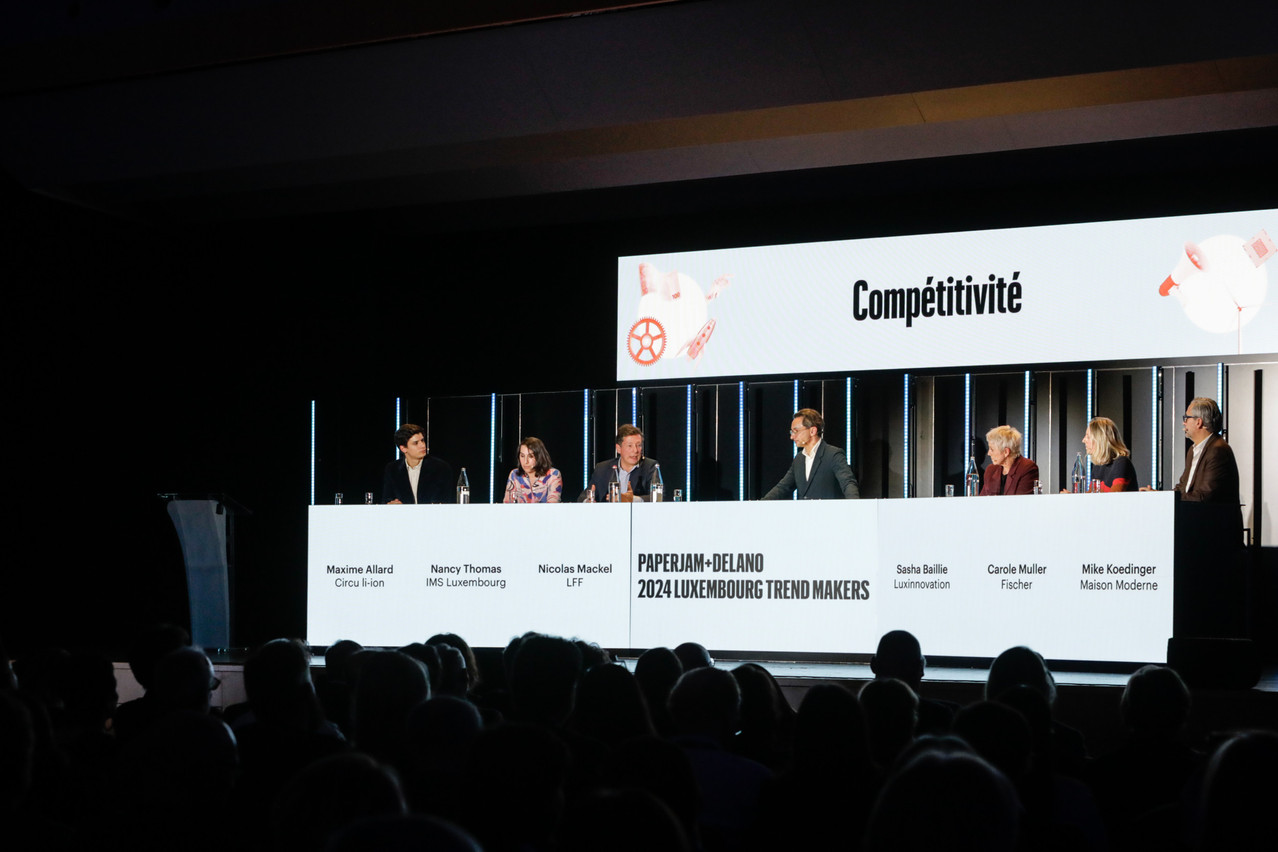
Six experts in their fields, in addition to prime minister 
The heads of Circu Li-ion 


Each in their own speciality, these fine connoisseurs of the country’s issues highlighted the major trends that will mark the year 2024, before an audience of around 300 people, most of them business leaders.
After an initial overview of the key trends for 2024 in the marketing and communications sector, detailed at the Maison Moderne MMMediashow in October, this time the focus was on trends in a broader, nationwide context.
Sustainability, more than ever
We have deliberately chosen to place sustainability at the top of this panorama of trends, because it is the prism through which all action should be viewed in the future. As the CEO of Inspiring More Sustainability (IMS), Nancy Thomas, pointed out, “we have to look at each and every activity at national level from this angle of sustainability.”
After a report that was as alarming as it was realistic, along with a few figures on the state of biodiversity and a telling phrase--“in 100 years, there won't be any insects left”--Thomas spoke of the challenges and trends that will mark 2024 and beyond. “Luxembourg has a role to play,” she said. A transformation of organisations and society is imperative to avoid shortages of water, food and other resources.
Among these challenges, mobility will remain a key issue for the country, which has the highest number of cars per capita (700/1,000): “Solutions are beginning to be developed, such as car-sharing and teleworking, which we’re going to have to look at. There are a lot of issues that are going to start to be addressed, but we’re going to have to come up with concrete solutions for businesses.”
Read also
Sustainability applied to the business world will also be a more topical subject than ever. “ESG, CSRD... I believe that there is a real opportunity to initiate a transformation and lay more sustainable foundations. I invite you to mobilise your own resources. In the Gallup report on the world of work, Luxembourg ranks last in Europe for employee engagement, with only 10% of employees engaged. Something needs to be done to re-engage employees, through pay, transparency, training, etc.,” said Thomas.
In companies
Will 2024 be the year that marks a major change in companies? For Carole Muller, the president of the Luxembourg Confederation and CEO of Fischer, flexible working hours will certainly have to be looked at closely. “We have 460,000 employees today. We’re going to need 300,000 more over the next ten years. We need to see how we can make our businesses more interesting and more flexible to meet the aspirations of Generation Z. Our customers have increasingly personalised demands, and so do our employees. Today, unfortunately, we have too much of a ‘one size fits all’ response.”
Luxinnovation CEO Sasha Baillie cited the example of hackathons as a way of both innovating and bringing employees together around shared goals and values. “I think there really are a few examples of this type, which other companies can certainly draw inspiration from.”
Luxembourg has fallen six places in the international competitiveness ranking.

Another trend in companies in 2024 will be the step-by-step but growing integration of AI. Maxime Allard, head of data & AI at Circu Li-ion, predicts “exponential progress, because users are beginning to understand how to use these tools, like ChatGPT and others. All these tools, based on text, or in biotechnology or even coding, are going to be used more and more in companies and also in other applications,” he declared, implying that in time, people will use ChatGPT as naturally as they currently use a calculator.
But overall, the major issue for businesses will remain competitiveness. “Luxembourg has fallen six places in the international competitiveness rankings. And it’s important today, in a globalised world where companies and people are increasingly mobile, that we really become a magnet for companies, that we create a framework that is conducive to promoting our national companies, but also to attracting foreign companies. The factors that create this problem are the cost of labour, the shortage of talent and property inflation. So these will also be challenges to resolve in the coming years,” noted Muller.
Competitiveness and finance
Competitiveness was mentioned many times during the roundtable, and it appears to be a major issue for the country in 2024. More than just a trend, the quest for greater competitiveness will be the leitmotif of the leaders, whether political or active in business. “Competitiveness, whether in Luxembourg or at European level, will be a subject we hear a lot more about in 2024,” said Nicolas Mackel, CEO of Luxembourg for Finance.
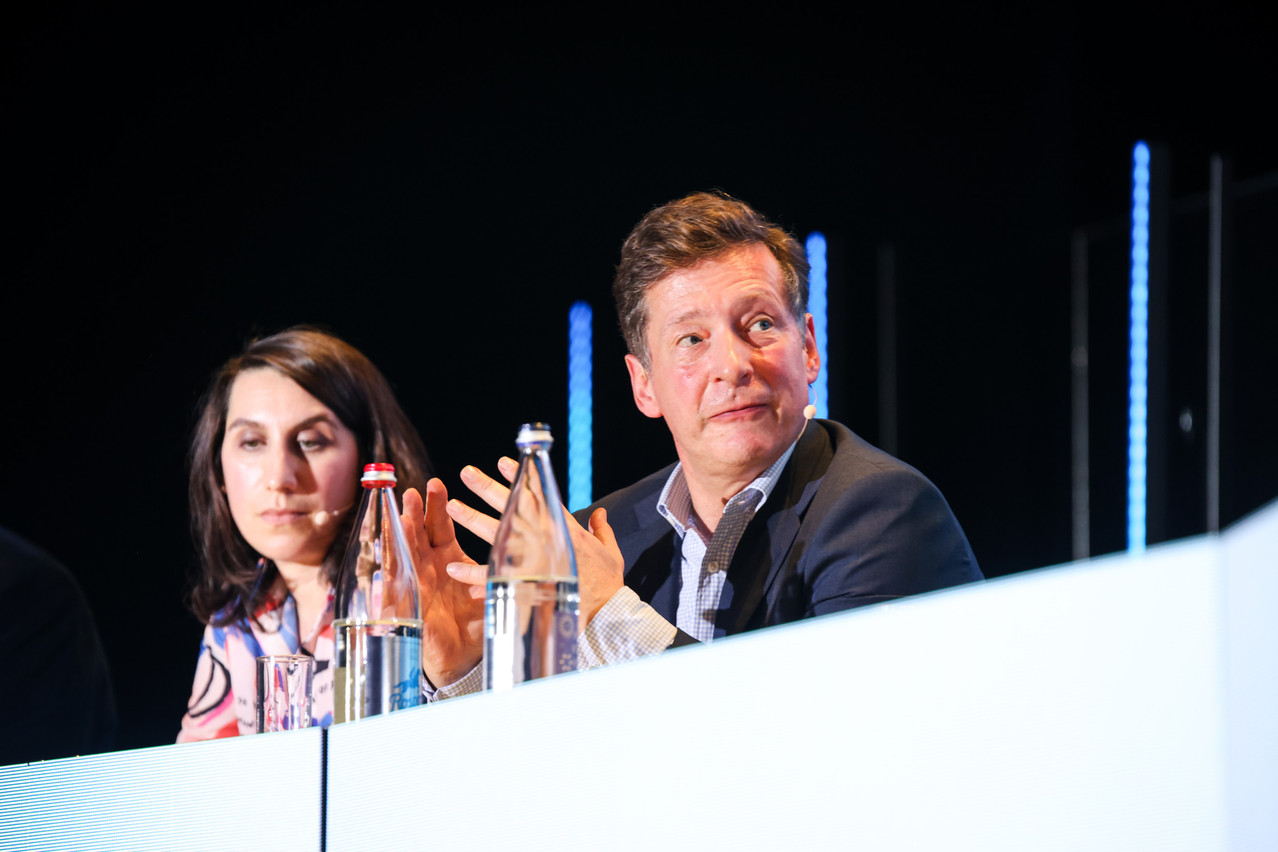
Nicolas Mackel, the CEO of Luxembourg for Finance, outlined some of the challenges facing the financial centre, 12 December 2023. Photo: Maison Moderne
Attracting talent, which is linked to competitiveness, will become an increasingly important requirement, both in companies and in the financial centre. “In all areas, whether it’s innovation, finance or sustainability, what we need is to attract brains. One of the big keys to unlocking the problem is obviously housing. But I think there’s another thing we can do, and that’s to invest massively in training,” said Mackel.
As another example, inspired by the French model, he cited the impatriate scheme which, depending on the conditions, allows a 50% tax exemption for eight years on the salaries of people who come to work in France. Although this measure cannot necessarily be transposed to Luxembourg, it could give us some ideas to work on in 2024.
More generally, the financial centre--sometimes described as a cash cow--is facing a number of challenges: technological developments, artificial intelligence, sustainable finance, “but also other developments such as tokenisation and digital contributions. These are subjects that are of direct interest to us,” added the CEO of Luxembourg for Finance.
Innovation, AI and new technologies
The word “innovation” was used more than thirty times. The increased interest in AI since last year should be a major catalyst in this movement, with a view to boosting productivity. In 2024, the efforts of various players to build a virtuous ecosystem around AI and technologies will therefore continue.
“In Luxembourg, we have the right resources, like computer scientists and good technologies like Meluxina, which are great assets. We just need to use them properly. A good ecosystem rests on three pillars: talent, speed and regulation if it does not hinder innovation,” stressed Allard, who added: “Geopolitical questions will arise: do we want to leave all the power to the Americans, or do we want Europe to have power over all these new technologies too?”
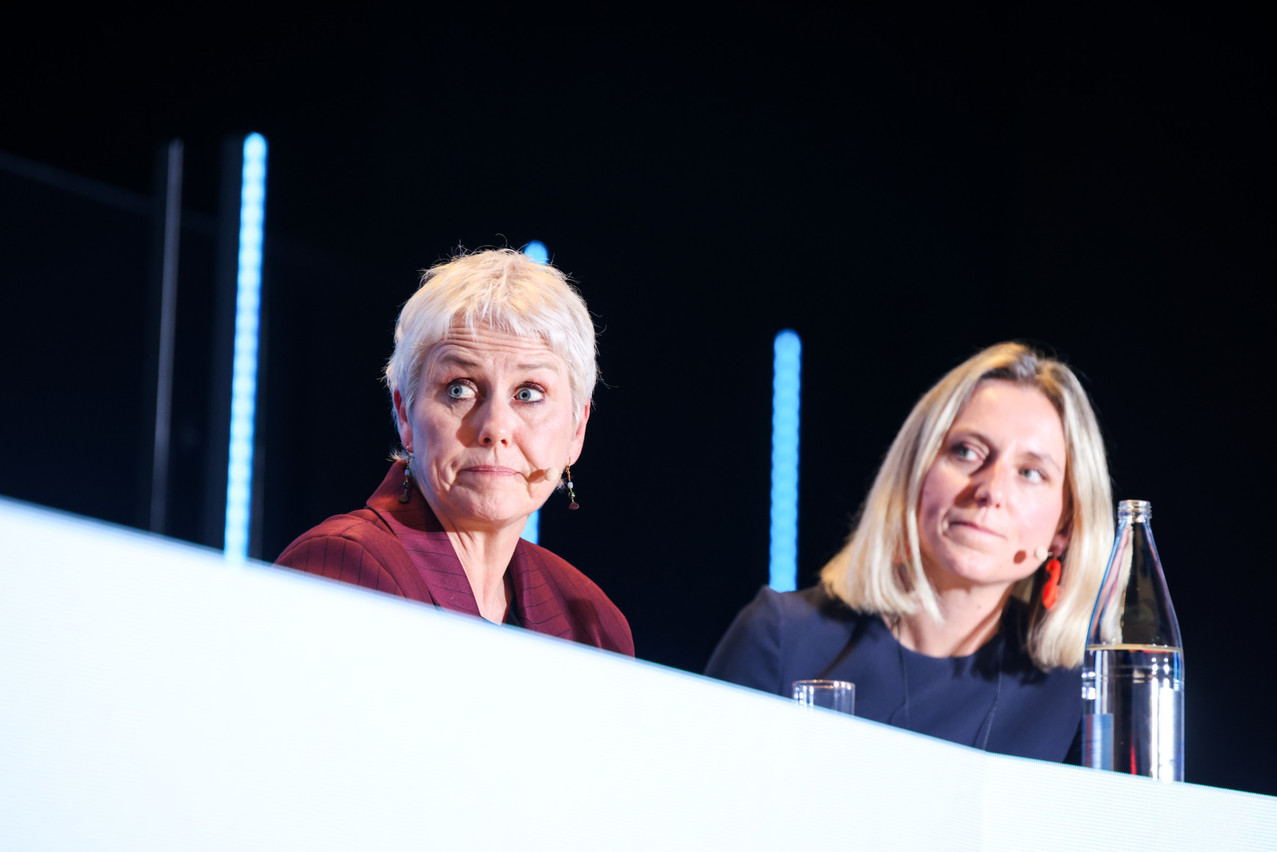
Competitiveness and innovation were two watchwords for Luxinnovation CEO Sasha Baillie (left) and Fischer CEO Carole Muller. Photo: Maison Moderne
In any case, the European Union is taking the subject seriously, as demonstrated by the agreement between the EU and the Member States on 8 December to regulate the development of AI. Baillie, the CEO of Luxinnovation, sees this as good progress: “It’s very important to have a clear framework, which also strikes a balance between the rule of law and innovation. Then, in Luxembourg, we have three factors that are really key to innovation around AI: access to data, and we have the LNDS [Luxembourg National Data Service]; computing power, and we have Meluxina; then research, and we have 500 researchers at SnT,” she explained. All of these capabilities point to a breakthrough in 2024.
In the media
But according to the CEO of Maison Moderne, Mike Koedinger, who has also been president of the European Magazine Media Association since July, the AI Act will still need some fine-tuning. “This paper is not what the industry wants in Europe. It excludes the fact that language models need content produced by people who have been paid, and who get nothing for it. So it’s a disaster for journalists, for content creators.” The problem is directly linked to the content generated. “The content on which the AI learns must be traced. The project will only be finalised in January, so there are still a few weeks to work out this twist in the directive.”
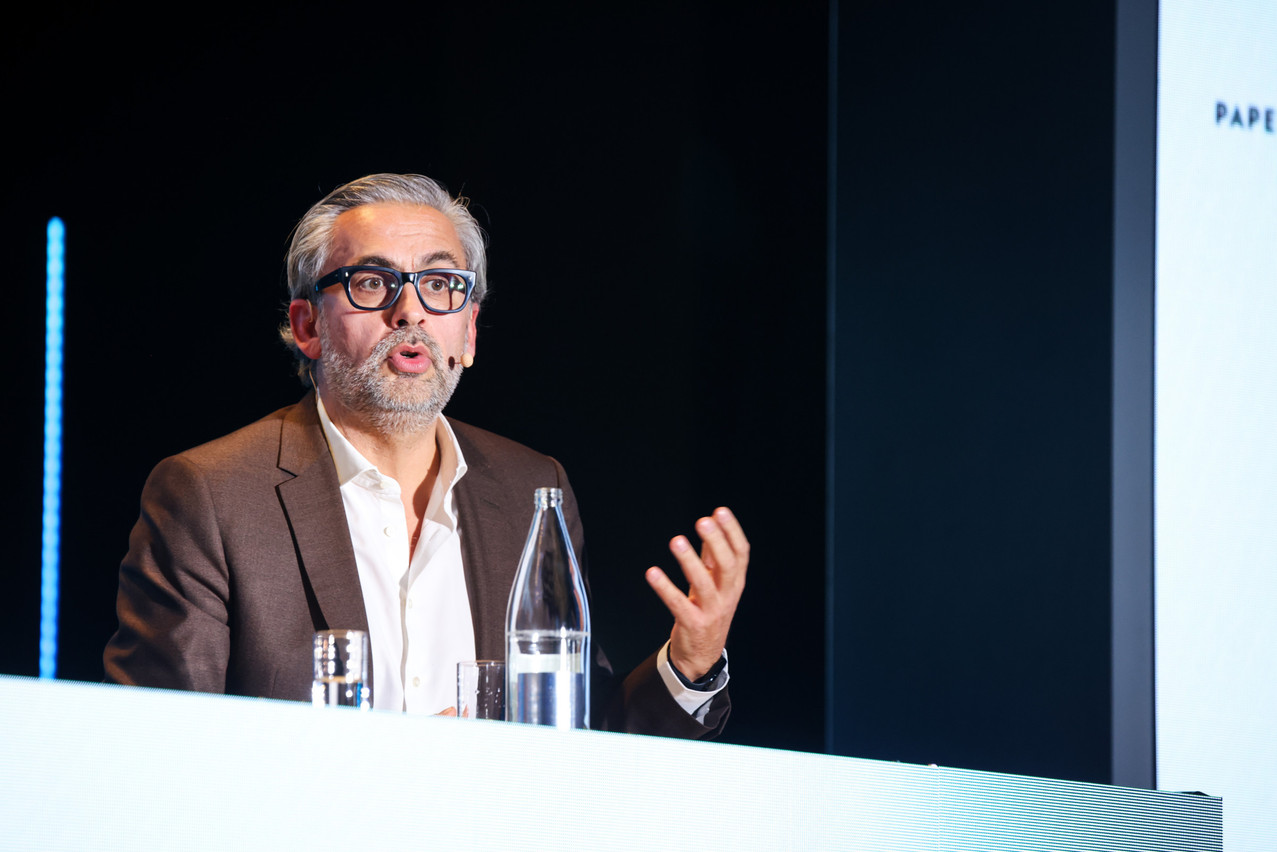
Maison Moderne CEO Mike Koedinger also represents the voice of the European magazine industry through his role as president of the European Magazine Media Association. Photo: Maison Moderne
Another issue that will have an impact on the press throughout Europe is “a conflict with public service radio stations, whose original mission was to produce radio--and we’re glad they’re here--and which, over time, are turning to the internet and starting to create websites with written information.”
Finally, in 2024, the law on state aid to the press and pluralism adopted in 2021 should return to the centre of discussions. The previous government had promised to take stock two years later. After the elections, which have disrupted the timetable, it is likely to be the subject of some discussion. “On the face of it, this law treats the printed daily press and the digital daily press in the same way, but only on the face of it, because a digital daily is capped at a third of that of a printed daily,” said Koedinger.
And around the world...
Because Luxembourg is so open to the world, it is bound to be affected by international events, and the geopolitical context will continue to cast a shadow over the economy. And while it’s difficult to define this as a “trend,” it’s something that needs to be taken into account before looking ahead to 2024. “Whether it’s because of geopolitics and the tensions it sends up, or because of other factors, we’re seeing a real geo-economic fragmentation of the markets. This is something that worries us,” said Mackel.
Baillie agreed. “The balance of economic power is changing fundamentally, making us more vulnerable in supply chains, when it comes to the risk of resources, or when it comes to defence.” But “we also have the capacity to develop defence and security technologies that enable us to better protect ourselves against brutal aggression,” she added.
This article was first published in French on Paperjam. It has been translated and edited for Delano.
