In 2023, Sandra Lieners travelled to Australia for a three-month residency at Bilpin International Ground for Creative Initiatives (Bigci). The results of her stay and her research on the other side of the globe are presented in dialogue with the works she created on her return to Luxembourg. “I applied the same artistic working method to the Luxembourg context. This enabled me to extend the reflections I had made during the residency in Australia and gave me the opportunity to look at the landscapes of my childhood, the south of Luxembourg, in a completely new way,” says Lieners.
Usually, Lieners works in oils. But during her stay in Australia, she was introduced to cyanotype by the Japanese artist Sayoko Suwabe, who was in residence at Bigci at the same time. Lieners began working on paper and exploring this new technique, which involves working with a photosensitive material. “During the second month of the residency, I tried cyanotype on textiles in order to incorporate it into my painted works.” Since 2019, Lieners has been exploring a method of assembling different pieces of canvas and sewing them together. The cyanotype on textile allows her to extend this approach, while introducing another technique.
A dialogue with nature
Lieners works with natural materials found in her immediate environment to preserve a direct trace of them. The residency took place on the edge of the Wollemi National Park, in the Blue Mountains of Bilpin. “I was able to take advantage of a studio where the relationship with nature was very strong, where the transition between painting and nature was very fluid,” explains the artist.
She then set up work sessions in the park, moving her equipment around and capturing the plants around her. “In order not to alter nature, I don’t cut up the plants and flowers I want to use, but simply curve them onto the support. That’s why, on several occasions, you can still see the imprint of my hand or arm,” says Lieners. For her, these handprints and this relationship with nature are also a form of homage to Aboriginal art, which she discovered with great emotion during her Bush walkings.
“I often refer to the history of art in my work. Faced with this Aboriginal art, I asked myself how I could cite it while maintaining the necessary respect. At no point did I want to be this white European artist mimicking this ancestral art. That’s why I preferred to work in a way that was close to what the Aboriginals practised, so that I could pay tribute and reappropriate it in a respectful way.” This hand shape is clearly recognisable in the work “Reconciliation piece, Act II (AU)” and in the “Waratah” and “Rapeseed” series.
“I worked with the Waratah, a plant typical of this region that is endangered, rare and aesthetically pleasing. I put it in dialogue with rapeseed flowers, a plant cultivated in many places, including in the south of Luxembourg, and which has a precise function in the manufacture of products. So there’s a big contrast between these two approaches to nature. In both cases, my hand is present, but even more so for the works in Luxembourg, just as the hand of man is much more present on nature here than in Australia.”
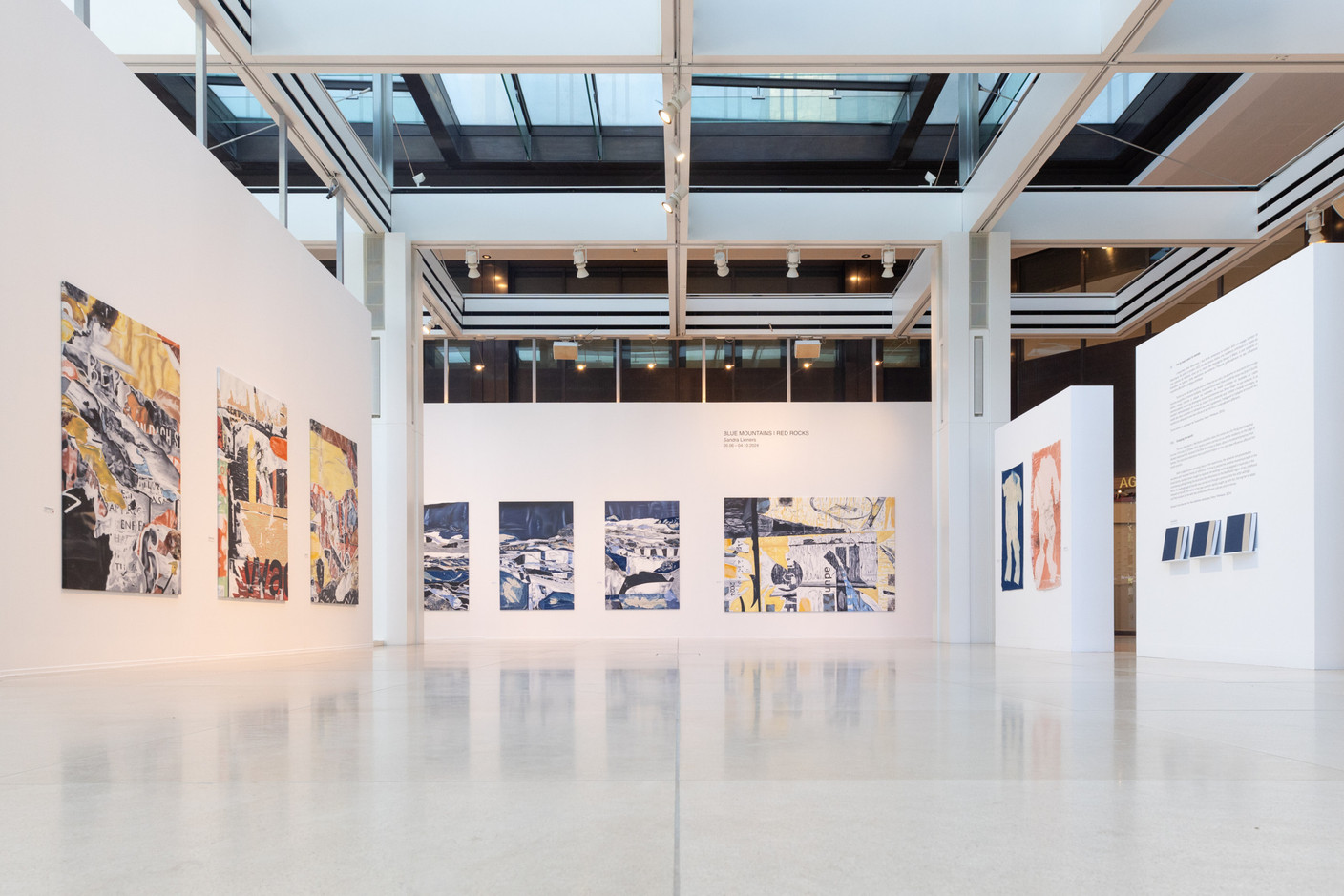
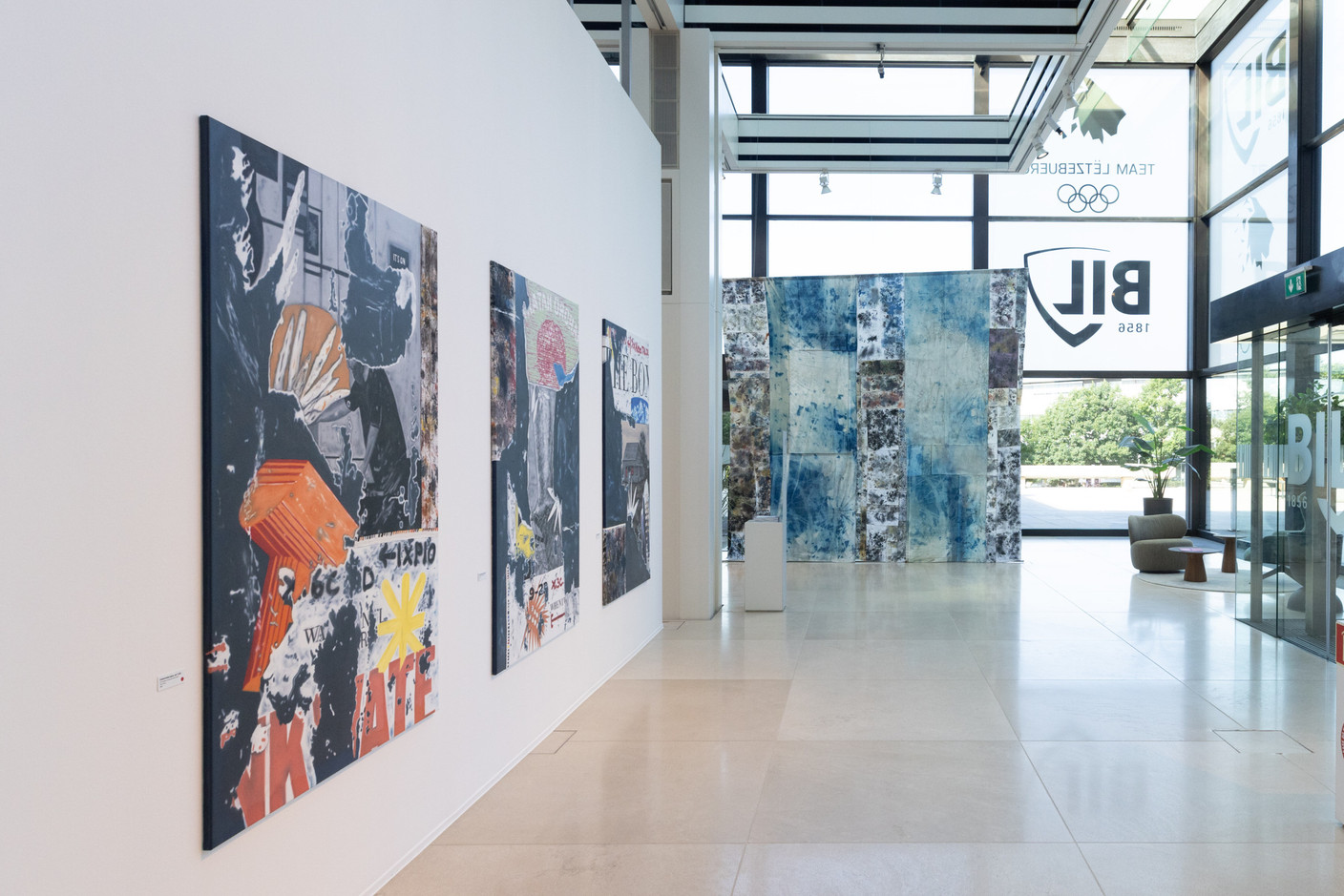
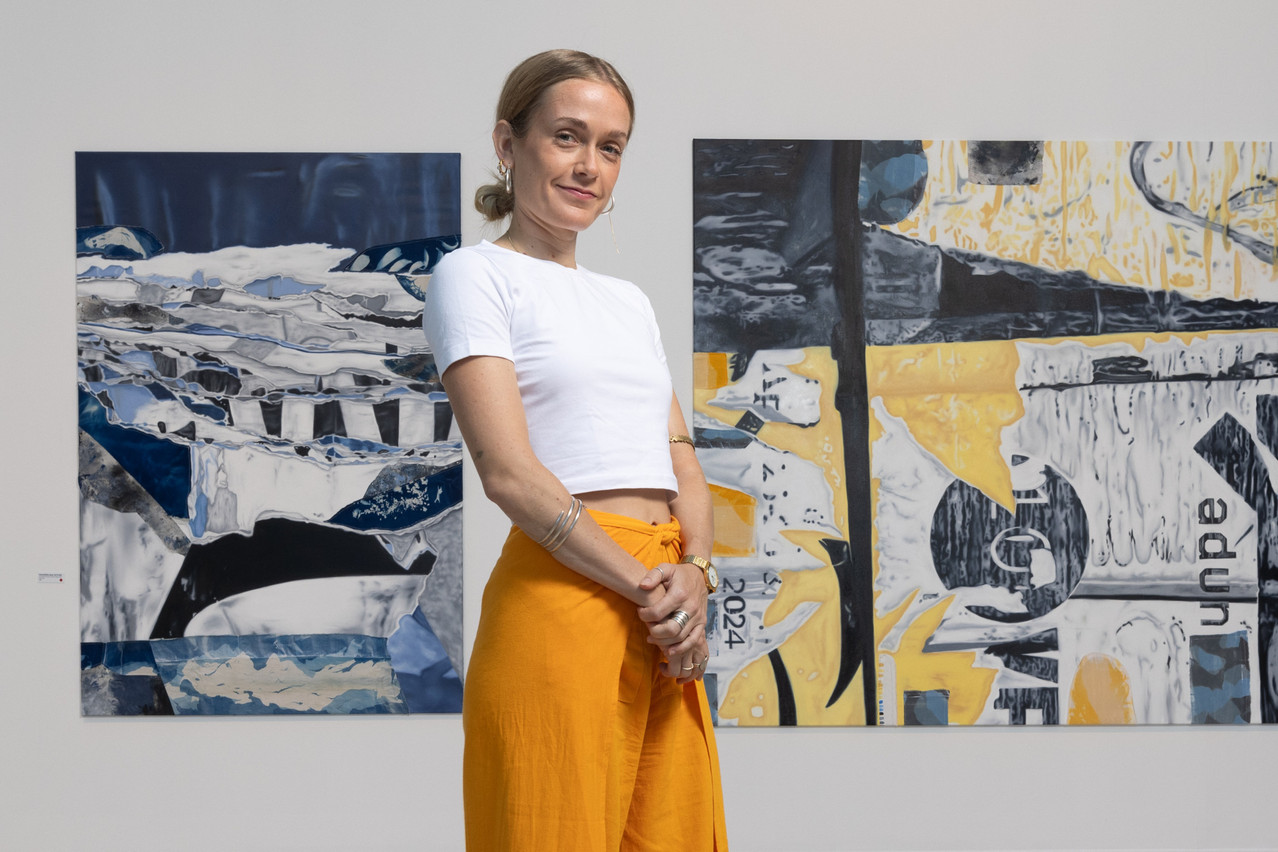
As well as works involving cyanotype, Sandra Lieners has also produced new oil paintings on canvas. Here we find the digital presence that has characterised her work for several years, as well as graphic elements, logos and pieces of signage taken from a more urban context.
“I like to find similar traces in a context that is not at all similar. I’m also interested in bringing contrasts together. I paint in oils, which is a traditional technique that takes time. On the other hand, we live in a society where digital technology plays a dominant role, where everything has to move fast and where images are very much in evidence. As a painter, I look intently at the world around me and that leads me to introduce elements of this digital world into my work. For example, I incorporate elements of pixelation, graphic elements, but I paint it by hand, which induces a certain imperfection.” Australia, Luxembourg... two very different contexts that nevertheless find a certain continuity through the exploration of new methods and a look at the world around the artist.
The "Blue Mountains I Red Rocks” exhibition is on display at the Galerie Indépendance at the Banque Internationale à Luxembourg, 69 route d'Esch, Luxembourg, until 4 October 2024.
This article was originally published in French.